 Uri dhino ripi? Kwizi
 Hondo yemadhino
 Mujaho wemadhino
 Mitambo midiki yemadhino
 Arubhamu yemasitika
 Rondedzero dzeTOP dzemadhino
 Ndishamise!
Cryptoclidus
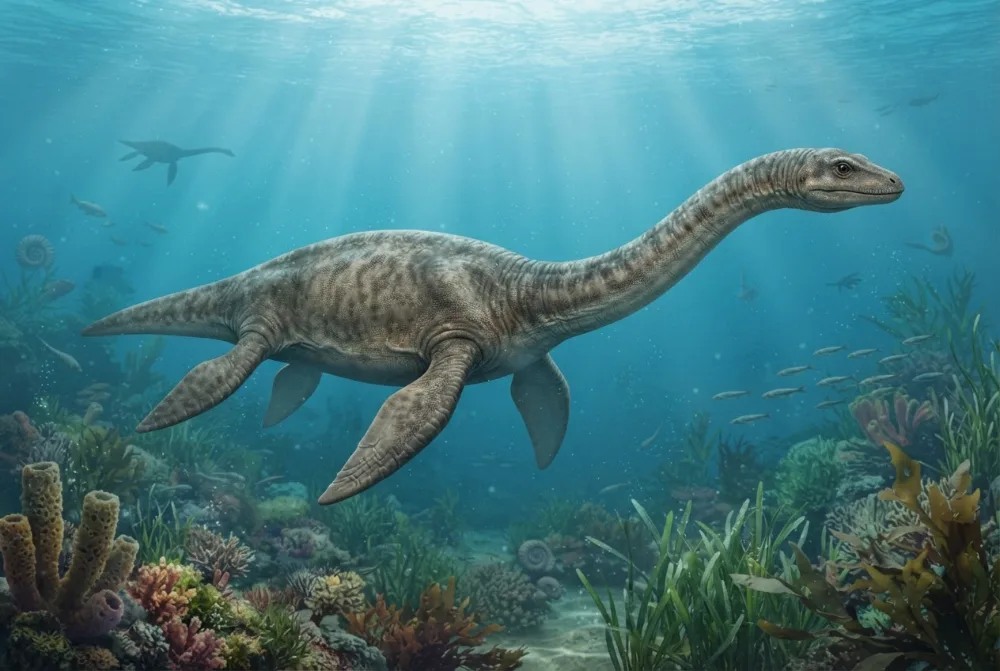
Cryptoclidus was a medium-sized plesiosaur that swam in warm seas during the Middle and Late Jurassic. It had a small head, a long neck, and four flippers. It probably ate soft animals like squid and small fish.1
Rairarama rini?
Raiva hombe sei?
Raiva refu zvakadii?
Rairema zvakadii?
 kureba seimbwa 4 kubva pamhino kusvika kumuswe🍌kureba semabhanana 22 akatevedzana🍉kurema semanwiwa 150🧸kurema sevana vekireshi 40🎒kurema sevana vechikoro 24🏊raigona kushambira kureba kwedziva guru rekushambira (50 m) mumasekonzi 6.4
Cryptoclidus raiva hombe sei kana richienzaniswa NEWE?
Masvomhu chete mubrowser yako. Hapana chinochengetwa kana kutumirwa kupi zvako.
Raimhanya zvakadii?


Zvinonakidza
The name Cryptoclidus means 'hidden collarbone' because its collarbones are tiny and hidden in the shoulder area.1
Fossils of Cryptoclidus have been found in the Oxford Clay of Cambridgeshire, England, and in the Kimmeridge Clay of France.1
The type species was first called Plesiosaurus eurymerus, which means 'wide thigh bone', because scientists mistook a front flipper bone for a back leg bone.1
Cryptoclidus had a small, fragile skull and teeth that could not handle tough prey, so it ate only soft animals.1
Scientists think Cryptoclidus used its long, intermeshing teeth to strain small animals from the water or sift through mud.1
The size and shape of its nostrils suggest Cryptoclidus could smell chemicals in seawater, helping it find food.1
Complete skeletons of Cryptoclidus have been found, including some that are nearly entirely preserved, showing both adults and juveniles.1
Mibvunzo inonyanya kubvunzwa nezve Cryptoclidus
?How big was Cryptoclidus?
About 4 metres long and weighed around 737 to 756 kilograms. That is about as long as a small car.1
?What did Cryptoclidus eat?
It ate small, soft animals like squid and small fish. Its fragile teeth could not handle tough prey.1
?Was Cryptoclidus a dinosaur?
No, it was a plesiosaur, which is a marine reptile that lived in the sea. It is not a dinosaur.1
?When did Cryptoclidus live?
It lived during the Middle and Late Jurassic Period, about 166 to 160 million years ago.1
?Where were Cryptoclidus fossils found?
Fossils have been found in England, France, Cuba, and Russia. Many come from the Oxford Clay in Cambridgeshire, England.12
?Could Cryptoclidus swim?
Yes, it was a good swimmer. It used its four flippers to move through warm Jurassic seas.1
Mubvisi wengano
Ngano: Some people think Cryptoclidus was a dinosaur.
Chokwadi: Cryptoclidus was a plesiosaur, a marine reptile that lived in the sea, not a dinosaur.1
Zvevanyanzvi vemadhino
- Zita resainzi
- Cryptoclidus
- Akaripa zita:
- (Seeley 1892)2
- Boka
- Mapresiosauro
- Mhuri / boka
- Cryptoclididae2
- Kurongwa kwemhuka
- Plesiosauria > Sauropterygia2
- Zera rematombo
- makore mamiriyoni 165 kusvika 143 (Callovian / Tithonian)2
- Mapoka ematombo
- Oxford Clay, Jagua, Kimmeridge Clay2
- Nyika
- United Kingdom, Cuba, Ajentina, France2
- Zvinyorwa zvemafosiri
- 17 mu The Paleobiology Database2
- Rinonziwo
- Apractocleidus (mazita ekare zvino oonekwa semhuka imwe chete)2
- Kuwanikwa
- The first fossils were described in 1871 by John Phillips as Plesiosaurus eurymerus. Harry Govier Seeley renamed it Cryptoclidus in 1892.12
- Zvichiri kupokanwa
- Scientists are not sure whether Cryptoclidus caught prey by swimming fast or by ambushing it, because its skeleton was not built for speed.1
Kunobva chokwadi
- Cryptoclidus (en.wikipedia.org)
- Cryptoclidus in The Paleobiology Database (CC BY 4.0): zera, nzvimbo, mapoka ematombo, kurongwa kwemhuka.
Chokwadi chega chega papeji ino chine nhamba inoratidza kwachakabva. Kana takakanganisa chimwe chinhu, ruregerero, tiri vanoda madhino, kwete magazini yesainzi. Tiudze pa [email protected] tichazvigadzirisa.
 Rex ane nzara! Dino Wiki ipurojekiti yababa yemwanakomana wavo anoda madhino, mahara, pasina kushambadza uye pasina zvinokutevera. Vakuru vanogona kupa Rex chekudyadya kuti vabatsire kuchengeta saiti iri pamhepo.Fudza Rex
 Elasmosaurus
 Pliosaurus
 Plesiosaurus
 Cimoliasaurus
 Colymbosaurus
 Trinacromerum
 Brachiosaurus
 Diplodocus
 Allosaurus
 Brontosaurus
 Compsognathus
 Camarasaurus