 Uri dhino ripi? Kwizi
 Hondo yemadhino
 Mujaho wemadhino
 Mitambo midiki yemadhino
 Arubhamu yemasitika
 Rondedzero dzeTOP dzemadhino
 Ndishamise!
Rairarama rini?

Raiva hombe sei?
Raiva refu zvakadii?
Raiva rakakwirira zvakadii?
fungidziro
Rairema zvakadii?
 kureba semotokari 6 dzakamiswa dzakatevedzana🍌kureba semabhanana 140 akatevedzana
 kurema senzou 1.5🍉kurema semanwiwa 1900🎒kurema semakirasi 12 akazara evana vechikoro🐻❄️kurema semabere echando 21🏢rakakwirira zvekudongorera muhwindo riri pafuroo nhamba 2🏃raigona kumhanya mamita 100 mumasekonzi 24 (munhu anomhanya kupfuura vose anoda 9.6)
Duriatitan raiva hombe sei kana richienzaniswa NEWE?
Masvomhu chete mubrowser yako. Hapana chinochengetwa kana kutumirwa kupi zvako.
Raimhanya zvakadii?


Zvinonakidza
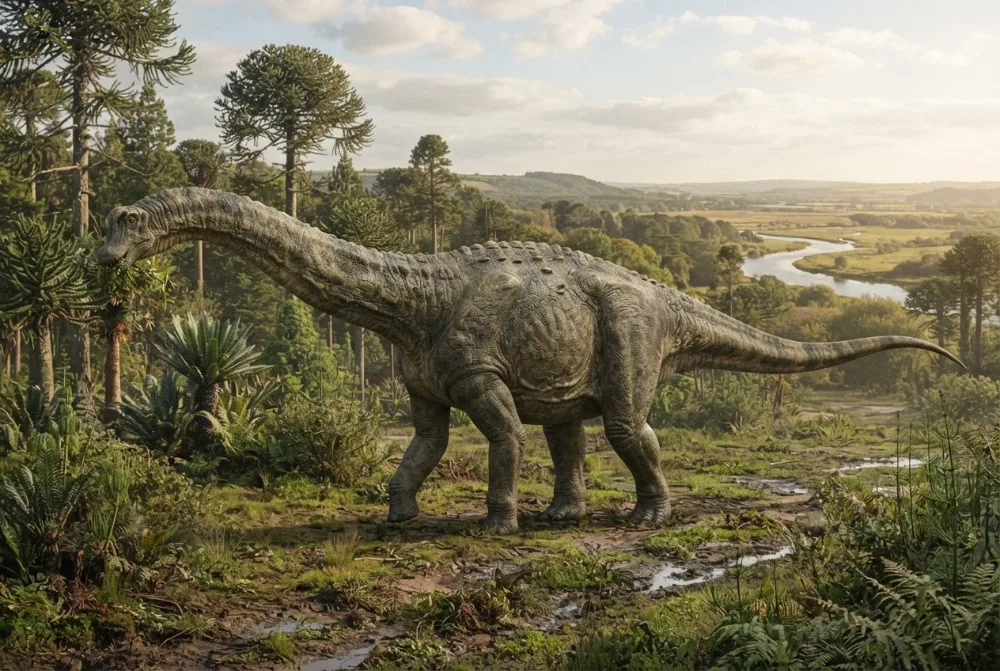
Duriatitan is only known from a single left upper arm bone, called a humerus.1
The bone was found near Sandsfoot, Weymouth in Dorset, England, by a man named R.I. Smith.1
It was first named in 1874 as a species of Cetiosaurus, and later given its own genus in 2010.1
The name Duriatitan comes from the Latin name for Dorset, Duria, and the Greek word Titan, meaning giant.1
Scientists think Duriatitan lived during the Late Jurassic, about 150 million years ago.1
It was a titanosauriform, a group of sauropods that includes some of the largest land animals ever.4
Thomas Holtz estimated Duriatitan could have been up to 25 meters (82 feet) long, as long as a blue whale.1
Mibvunzo inonyanya kubvunzwa nezve Duriatitan
?How big was Duriatitan?
Duriatitan may have been up to 25 meters long, which is shorter than a 30 meter blue whale, though this is an estimate from one bone.13
?What did Duriatitan eat?
Duriatitan was a plant-eater, eating tough leaves from trees. Its huge body and long neck helped it reach food other dinosaurs couldn't.3
?Could Duriatitan swim?
Scientists once thought sauropods like Duriatitan lived in water, but now they think the opposite. Its air-filled bones and small feet would have made it float and be unstable in water.3
Zvevanyanzvi vemadhino
- Zita resainzi
- Duriatitan
- Akaripa zita:
- Barrett et al. 20104
- Boka
- Madhino emitsipa mirefu
- Mhuri / boka
- Titanosauriformes4
- Kurongwa kwemhuka
- Sauropodomorpha > Sauropoda > Macronaria4
- Zera rematombo
- makore mamiriyoni 155 kusvika 137 (Kimmeridgian / Berriasian)4
- Mapoka ematombo
- Kimmeridge Clay, Mont-Lambert, Praia da Amoreira-Porto Novo4
- Nyika
- United Kingdom, France, Portugal, Spain4
- Zvinyorwa zvemafosiri
- 8 mu The Paleobiology Database4
- Kuwanikwa
- The first fossil, a partial left upper arm bone, was found by R.I. Smith near Sandsfoot, Weymouth in Dorset. It was described by John Hulke in 1874 as a species of Cetiosaurus, and later renamed Duriatitan by Paul Barrett, Roger Benson, and Paul Upchurch in 2010.1
- Zvichiri kupokanwa
- Scientists are not sure exactly how big Duriatitan was, because only one arm bone has been found. The length estimate of 25 meters is just a guess.1
Kunobva chokwadi
- Duriatitan (en.wikipedia.org)
- Duriatitan humerocristatus | Dinosaur Database by DinoAnimals.com (dinoanimals.com)
- Britain's biggest Jurassic dinosaurs | Natural History Museum (nhm.ac.uk)
- Duriatitan in The Paleobiology Database (CC BY 4.0): zera, nzvimbo, mapoka ematombo, kurongwa kwemhuka.
Chokwadi chega chega papeji ino chine nhamba inoratidza kwachakabva. Kana takakanganisa chimwe chinhu, ruregerero, tiri vanoda madhino, kwete magazini yesainzi. Tiudze pa [email protected] tichazvigadzirisa.
 Rex ane nzara! Dino Wiki ipurojekiti yababa yemwanakomana wavo anoda madhino, mahara, pasina kushambadza uye pasina zvinokutevera. Vakuru vanogona kupa Rex chekudyadya kuti vabatsire kuchengeta saiti iri pamhepo.Fudza Rex
 Brachiosaurus
 Diplodocus
 Brontosaurus
 Argentinosaurus
 Camarasaurus
 Morosaurus
 Allosaurus
 Compsognathus
 Camptosaurus
 Nanosaurus
 Rhamphorhynchus
 Ceratosaurus