 Uri dhino ripi? Kwizi
 Hondo yemadhino
 Mujaho wemadhino
 Mitambo midiki yemadhino
 Arubhamu yemasitika
 Rondedzero dzeTOP dzemadhino
 Ndishamise!
Rairarama rini?

Raiva hombe sei?
Raiva refu zvakadii?
Raiva rakakwirira zvakadii?
Rairema zvakadii?
 kureba semotokari 4 dzakamiswa dzakatevedzana🍌kureba semabhanana 110 akatevedzana
 kurema senzou 1.5🍉kurema semanwiwa 1800🎒kurema semakirasi 11 akazara evana vechikoro🐻❄️kurema semabere echando 20🏃raigona kumhanya mamita 100 mumasekonzi 22 (munhu anomhanya kupfuura vose anoda 9.6)
Galvesaurus raiva hombe sei kana richienzaniswa NEWE?
Masvomhu chete mubrowser yako. Hapana chinochengetwa kana kutumirwa kupi zvako.
Raimhanya zvakadii?


Zvinonakidza
Galvesaurus lived about 150 to 146 million years ago, during the Tithonian age of the Late Jurassic.1
The first fossils were found in the 1980s by local amateur fossil hunter José María Herrero, who later gave the dinosaur its species name herreroi.1
Scientists have found more than 50 bones from one Galvesaurus skeleton, including parts of the skull, backbone, hips, and limbs.1
Galvesaurus had a slightly curved ischium (hip bone) with a simple end, unlike some other sauropods.2
It belongs to the group Brachiosauridae, making it a relative of the famous Brachiosaurus.4
Mibvunzo inonyanya kubvunzwa nezve Galvesaurus
?How big was Galvesaurus?
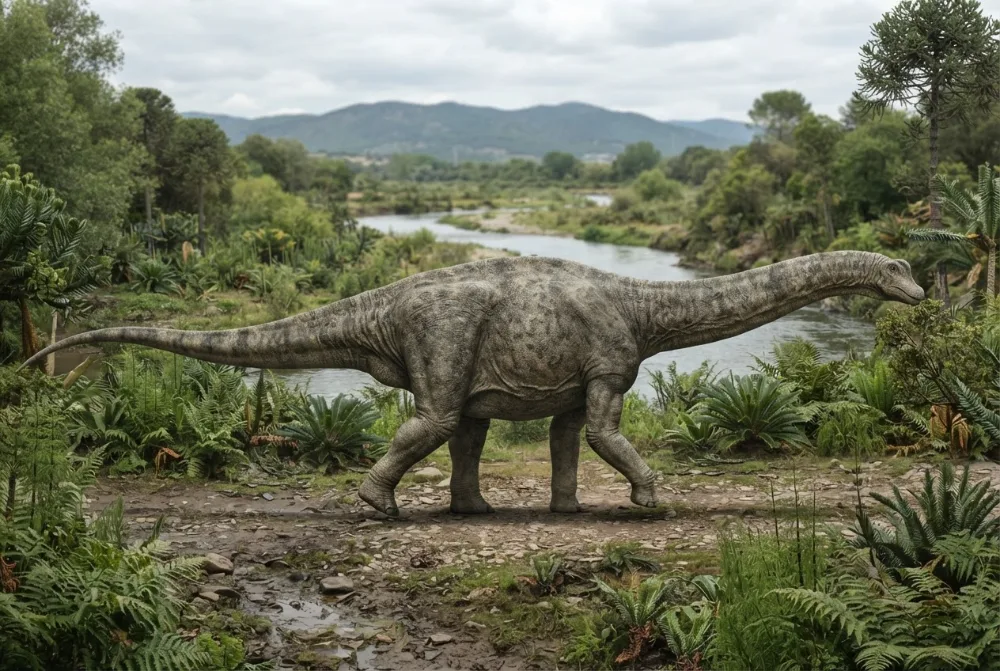
It was about 16 metres long, 4 metres tall, and weighed around 9 tonnes.3
?What did Galvesaurus eat?
It was a plant-eater that used its long neck to reach leaves high up in trees.1
?When did Galvesaurus live?
It lived about 150 to 146 million years ago, during the Tithonian age of the Late Jurassic period.1
?Why does Galvesaurus have two names?
Two groups of scientists published the same dinosaur at almost the same time in 2005, so it is sometimes called Galvesaurus and sometimes Galveosaurus.1
Mubvisi wengano
Ngano: Some people think Galvesaurus and Galveosaurus are different dinosaurs.
Chokwadi: They are the same dinosaur. Two scientists named it separately in 2005, causing a debate over which name is correct.1
Zvevanyanzvi vemadhino
- Zita resainzi
- Galvesaurus
- Akaripa zita:
- Barco et al. 20054
- Boka
- Madhino emitsipa mirefu
- Mhuri / boka
- Brachiosauridae4
- Kurongwa kwemhuka
- Sauropodomorpha > Sauropoda > Macronaria4
- Zera rematombo
- makore mamiriyoni 152 kusvika 145 (Kimmeridgian / Tithonian)4
- Mapoka ematombo
- Villar del Arzobispo4
- Nyika
- Spain4
- Zvinyorwa zvemafosiri
- 1 mu The Paleobiology Database4
- Kuwanikwa
- José María Herrero found the first fossils in the 1980s near Galve, Spain. A team from Zaragoza University excavated the site from 1993 to 2002 and recovered over 50 bones. In 2005, two different research groups published names for the dinosaur: one called it Galvesaurus herreroi, and the other named it Galveosaurus herreroi.1
- Zvichiri kupokanwa
- Some scientists think Galvesaurus might be the same as the Portuguese dinosaur Lusotitan, but others disagree.1
Kunobva chokwadi
- Galvesaurus (en.wikipedia.org)
- Galveosaurus herreroi, a new sauropod dinosaur from Villar del Arzobispo Formation (Tithonian-Berriasian) of Spain (biotaxa.org)
- Galvesaurus herreroi (es.wikipedia.org)
- Galvesaurus in The Paleobiology Database (CC BY 4.0): zera, nzvimbo, mapoka ematombo, kurongwa kwemhuka.
Chokwadi chega chega papeji ino chine nhamba inoratidza kwachakabva. Kana takakanganisa chimwe chinhu, ruregerero, tiri vanoda madhino, kwete magazini yesainzi. Tiudze pa [email protected] tichazvigadzirisa.
 Rex ane nzara! Dino Wiki ipurojekiti yababa yemwanakomana wavo anoda madhino, mahara, pasina kushambadza uye pasina zvinokutevera. Vakuru vanogona kupa Rex chekudyadya kuti vabatsire kuchengeta saiti iri pamhepo.Fudza Rex
 Brachiosaurus
 Diplodocus
 Brontosaurus
 Argentinosaurus
 Camarasaurus
 Morosaurus
 Allosaurus
 Compsognathus
 Camptosaurus
 Nanosaurus
 Rhamphorhynchus
 Ceratosaurus