 Uri dhino ripi? Kwizi
 Hondo yemadhino
 Mujaho wemadhino
 Mitambo midiki yemadhino
 Arubhamu yemasitika
 Rondedzero dzeTOP dzemadhino
 Ndishamise!
Rairarama rini?

Raiva hombe sei?
Raiva refu zvakadii?
Juravenator raiva hombe sei kana richienzaniswa NEWE?
Masvomhu chete mubrowser yako. Hapana chinochengetwa kana kutumirwa kupi zvako.
Raimhanya zvakadii?


Zvinonakidza
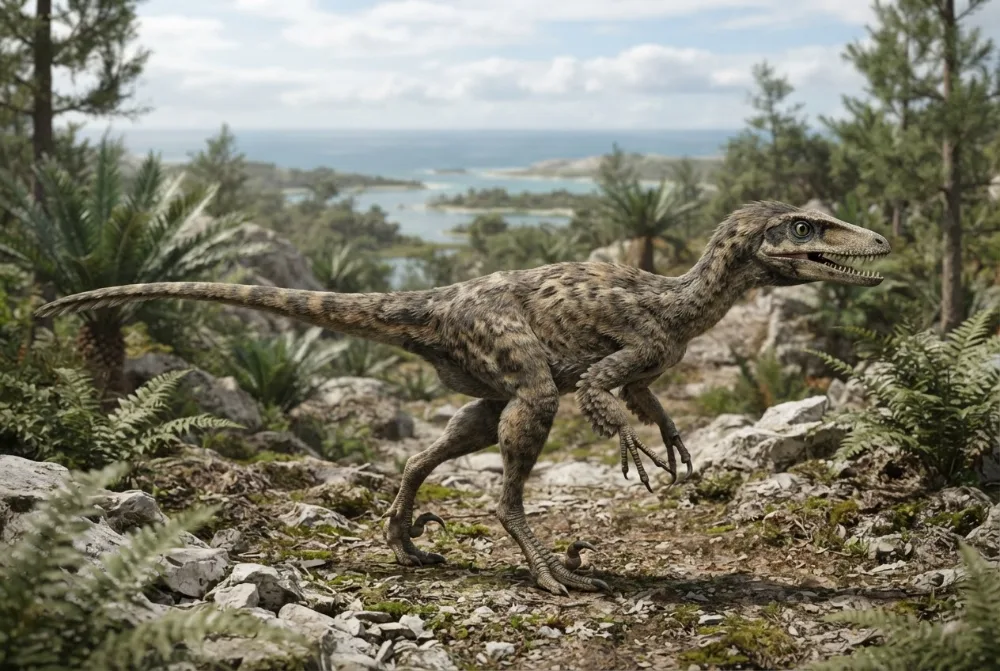
Juravenator is known from a single, nearly complete skeleton of a juvenile, making it one of the best-preserved predatory dinosaurs from Europe.21
Unlike many other small theropods from the same time, Juravenator did not have feathers or feather-like structures on its tail.21
Scientists think Juravenator may have been nocturnal, based on the shape of its eye bones.1
In 2020, researchers found tiny round structures on the sides of Juravenator's tail that might have been sensory organs, like those on crocodile scales.1
The only known Juravenator fossil was found in a lagoon deposit, suggesting it may have drowned after being washed into the water.1
Mibvunzo inonyanya kubvunzwa nezve Juravenator
?How big was Juravenator?
About 75 centimetres (2.46 feet) long, which is roughly the size of a small dog.1
?Did Juravenator have feathers?
It had mostly scales on its tail and legs, but some faint impressions of possible simple feathers have been found on the top of the tail and hips.1
?What did Juravenator eat?
It was a small meat-eater that may have hunted fish and other small prey in shallow water.4
?Could Juravenator swim?
It may have waded in water to hunt, but it probably did not swim well. The only known fossil was found in a lagoon, possibly after drowning.1
?Was Juravenator nocturnal?
Yes, scientists think it may have been nocturnal based on the shape of its eye bones.1
?Where was Juravenator found?
In Germany, in the Franconian Jura region, from rocks that are about 151 to 152 million years old.1
Zvevanyanzvi vemadhino
- Zita resainzi
- Juravenator
- Akaripa zita:
- Göhlich and Chiappe 20065
- Boka
- Madhino anodya nyama
- Mhuri / boka
- Coelurosauria5
- Kurongwa kwemhuka
- Theropoda5
- Zera rematombo
- makore mamiriyoni 152 kusvika 149 (Kimmeridgian)5
- Mapoka ematombo
- Painten5
- Nyika
- Germany5
- Zvinyorwa zvemafosiri
- 1 mu The Paleobiology Database5
- Kuwanikwa
- Juravenator was discovered in 1998 by volunteers Klaus-Dieter Weiß and Hans-Joachim Weiß in a quarry near Schamhaupten, Germany. It was named and described by Ursula Göhlich and Luis Chiappe in 2006.12
- Zvichiri kupokanwa
- Scientists are not sure if Juravenator was fully grown when it died, because the only known skeleton is from a juvenile.1
Kunobva chokwadi
- Juravenator (en.wikipedia.org)
- A new carnivorous dinosaur from the Late Jurassic Solnhofen archipelago | Nature (nature.com)
- PBDB Taxon (paleobiodb.org)
- This small dinosaur had a marvelous sense of touch, detailed fossils reveal | National Geographic (nationalgeographic.com)
- Juravenator in The Paleobiology Database (CC BY 4.0): zera, nzvimbo, mapoka ematombo, kurongwa kwemhuka.
Chokwadi chega chega papeji ino chine nhamba inoratidza kwachakabva. Kana takakanganisa chimwe chinhu, ruregerero, tiri vanoda madhino, kwete magazini yesainzi. Tiudze pa [email protected] tichazvigadzirisa.
 Rex ane nzara! Dino Wiki ipurojekiti yababa yemwanakomana wavo anoda madhino, mahara, pasina kushambadza uye pasina zvinokutevera. Vakuru vanogona kupa Rex chekudyadya kuti vabatsire kuchengeta saiti iri pamhepo.Fudza Rex
 Allosaurus
 Carnotaurus
 Dilophosaurus
 Giganotosaurus
 Compsognathus
 Paronychodon
 Brachiosaurus
 Diplodocus
 Brontosaurus
 Camarasaurus
 Morosaurus
 Apatosaurus