 Uri dhino ripi? Kwizi
 Hondo yemadhino
 Mujaho wemadhino
 Mitambo midiki yemadhino
 Arubhamu yemasitika
 Rondedzero dzeTOP dzemadhino
 Ndishamise!
Kunpengopterus
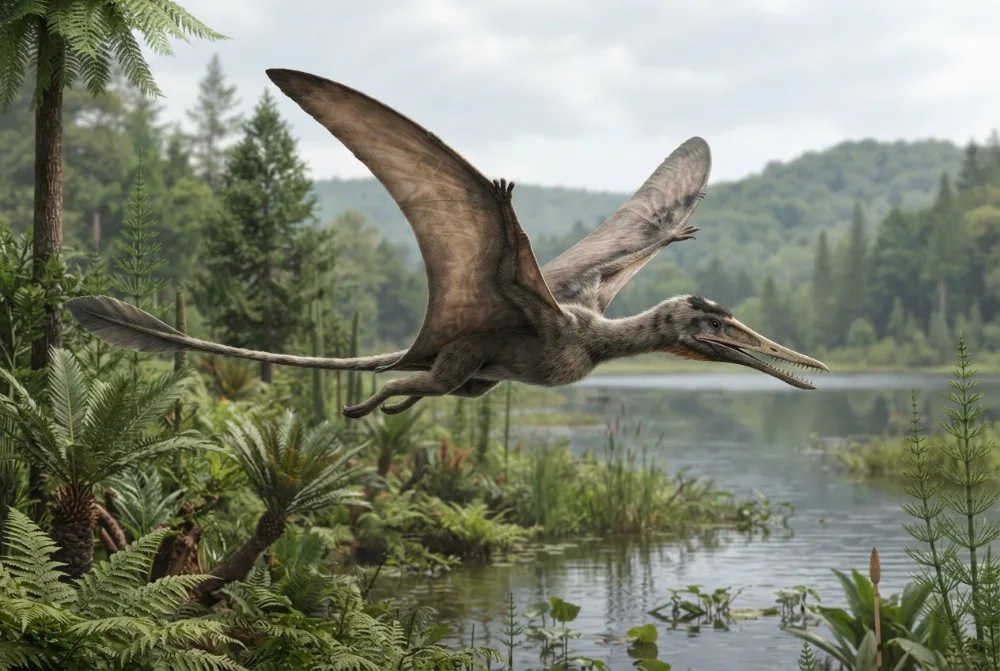
Kunpengopterus was a flying reptile that lived in what is now China during the Jurassic Period. It had a long tail and a head like a bird, and it ate fish.23
Rairarama rini?
Raiva hombe sei?
Rairema zvakadii?
Kunpengopterus raiva hombe sei kana richienzaniswa NEWE?
Masvomhu chete mubrowser yako. Hapana chinochengetwa kana kutumirwa kupi zvako.
Raimhanya zvakadii?


Zvinonakidza
Kunpengopterus sinensis is known from two nearly complete skeletons, one adult and one juvenile, found with fossilized vomit pellets nearby.3
The vomit pellets contain scales of palaeonisciform fish, proving that Kunpengopterus ate fish and could vomit indigestible parts.3
Both the adult and juvenile Kunpengopterus had similar teeth and could fly soon after hatching, like some other pterosaurs.3
The name Kunpengopterus comes from Chinese mythology: the Kun was a giant fish that could turn into the Peng, a huge bird.1
Kunpengopterus lived between about 168 and 152 million years ago, during the Late Jurassic Period.2
The type specimen of Kunpengopterus sinensis is an almost complete skeleton with a full skull and lower jaws.1
Mibvunzo inonyanya kubvunzwa nezve Kunpengopterus
?How big was Kunpengopterus?
Its head was about 10.7 centimetres (4.2 inches) long. The whole body was small, like a modern bird.1
?Did Kunpengopterus have feathers?
No, it did not have feathers. It had pycnofibers, which are thin, hair-like fibers, on its body.4
?What did Kunpengopterus eat?
It ate fish, especially palaeonisciform fish. Scientists know this because fossilized vomit pellets containing fish scales were found with its skeletons.5
?Could Kunpengopterus fly?
Yes, it could fly. Even young Kunpengopterus could fly soon after hatching, just like adults.5
Zvevanyanzvi vemadhino
- Zita resainzi
- Kunpengopterus
- Akaripa zita:
- Wang et al. 20106
- Boka
- Zvinokambaira zvinobhururuka
- Mhuri / boka
- Wukongopteridae6
- Kurongwa kwemhuka
- Pterosauria6
- Zera rematombo
- makore mamiriyoni 168 kusvika 152 (Bathonian / Kimmeridgian)6
- Mapoka ematombo
- Tiaojishan6
- Nyika
- China6
- Zvinyorwa zvemafosiri
- 2 mu The Paleobiology Database6
- Kuwanikwa
- Kunpengopterus sinensis was named by Wang Xiaolin and colleagues in 2010, based on a fossil found in the Tiaojishan Formation of Liaoning, China.12
- Zvichiri kupokanwa
- Scientists are not sure about the exact age of the rocks that contain Kunpengopterus fossils, which may be from the Middle or Late Jurassic.1
Kunobva chokwadi
- Kunpengopterus (en.wikipedia.org)
- PBDB Taxon (paleobiodb.org)
- Two emetolite-pterosaur associations from the Late Jurassic of China: showing the first evidence for antiperistalsis in (royalsocietypublishing.org)
- New long-tailed pterosaurs (Wukongopteridae) from western Liaoning, China (dinodata.de)
- Two emetolite-pterosaur associations from the Late Jurassic of China: showing the first evidence for antiperistalsis in pterosaurs (pmc.ncbi.nlm.nih.gov)
- Kunpengopterus in The Paleobiology Database (CC BY 4.0): zera, nzvimbo, mapoka ematombo, kurongwa kwemhuka.
Chokwadi chega chega papeji ino chine nhamba inoratidza kwachakabva. Kana takakanganisa chimwe chinhu, ruregerero, tiri vanoda madhino, kwete magazini yesainzi. Tiudze pa [email protected] tichazvigadzirisa.
 Rex ane nzara! Dino Wiki ipurojekiti yababa yemwanakomana wavo anoda madhino, mahara, pasina kushambadza uye pasina zvinokutevera. Vakuru vanogona kupa Rex chekudyadya kuti vabatsire kuchengeta saiti iri pamhepo.Fudza Rex
 Pteranodon
 Quetzalcoatlus
 Dorygnathus
 Rhamphorhynchus
 Anhanguera
 Pterodactylus
 Brachiosaurus
 Diplodocus
 Allosaurus
 Brontosaurus
 Compsognathus
 Camarasaurus