 Uri dhino ripi? Kwizi
 Hondo yemadhino
 Mujaho wemadhino
 Mitambo midiki yemadhino
 Arubhamu yemasitika
 Rondedzero dzeTOP dzemadhino
 Ndishamise!
Sciurumimus
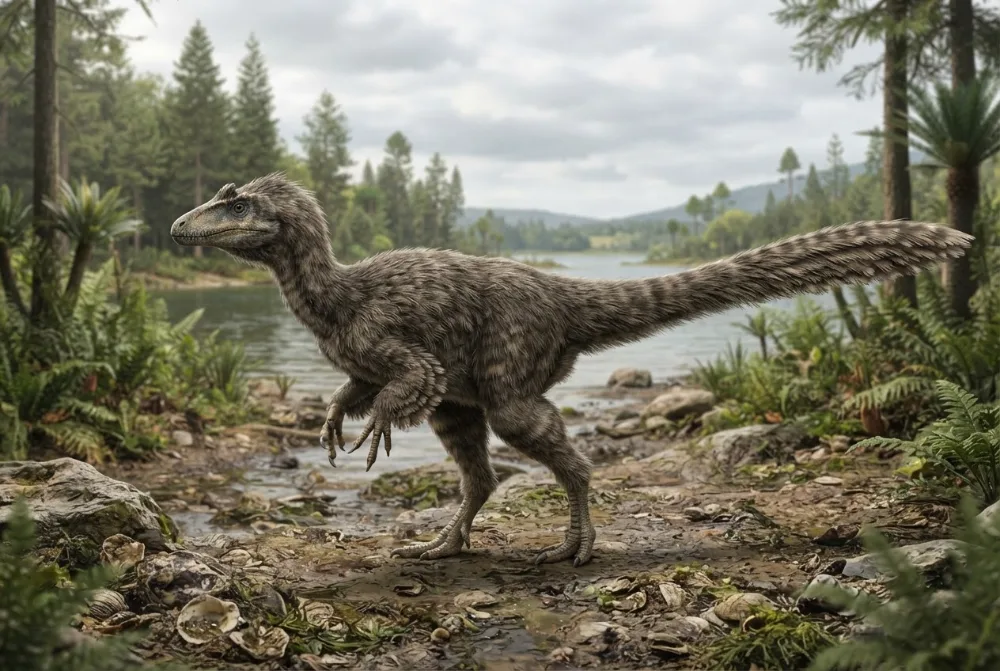
Sciurumimus was a small meat-eating dinosaur that lived in what is now Germany. It looked a bit like a tiny squirrel because it had a long, fluffy tail. Even though it was a young dinosaur, it was already a fast hunter.1
Rairarama rini?
Raiva hombe sei?
Raiva refu zvakadii?
Raiva rakakwirira zvakadii?
fungidziro
Sciurumimus raiva hombe sei kana richienzaniswa NEWE?
Masvomhu chete mubrowser yako. Hapana chinochengetwa kana kutumirwa kupi zvako.
Raimhanya zvakadii?


Zvinonakidza
Sciurumimus is known from just one beautifully preserved baby skeleton.1
Its tail had long, fuzzy filaments that looked like a squirrel's tail, which is how it got its name.1
The fossil even shows some muscle tissue along the back of its leg.1
Sciurumimus had big eyes and a large head compared to its body, like a baby animal.1
Scientists are not sure where Sciurumimus belongs on the dinosaur family tree. Some say it is a megalosauroid, others think it is a coelurosaur.1
Mibvunzo inonyanya kubvunzwa nezve Sciurumimus
?How big was Sciurumimus?
The only known fossil is a baby about 70 cm (2.3 ft) long. Adults probably reached 6 metres (19.7 ft) or more.2
?Did Sciurumimus have feathers?
Yes. The fossil shows long, hair-like filaments on the tail and body that are identical to stage 1 feathers found in other dinosaurs.13
?What did Sciurumimus eat?
The baby probably ate insects and other small prey, based on its slender, pointed teeth. Adults likely hunted larger dinosaurs.2
?Is Sciurumimus a dinosaur?
Yes, it is a theropod dinosaur, a meat-eater that lived about 150 million years ago in what is now Germany.1
?Why is it called Sciurumimus?
Its name means 'squirrel mimic' because its fluffy tail looks like a tree squirrel's tail.1
?How fast could Sciurumimus run?
Scientists do not know its exact speed, but as a small, fast hunter it was probably quick on its feet.1
Mubvisi wengano
Ngano: Because it had feathery filaments, Sciurumimus was a bird-like dinosaur.
Chokwadi: Sciurumimus was a meat-eating theropod dinosaur, not a bird, and its filaments were simple stage 1 feathers similar to those found in some ornithischian dinosaurs and early tyrannosaurs.1
Zvevanyanzvi vemadhino
- Zita resainzi
- Sciurumimus
- Akaripa zita:
- Rauhut et al. 20124
- Boka
- Madhino anodya nyama
- Mhuri / boka
- Megalosauroidea4
- Kurongwa kwemhuka
- Theropoda4
- Zera rematombo
- makore mamiriyoni 152 kusvika 149 (Kimmeridgian)4
- Mapoka ematombo
- Torleite4
- Nyika
- Germany4
- Zvinyorwa zvemafosiri
- 1 mu The Paleobiology Database4
- Kuwanikwa
- The first and only Sciurumimus fossil was found in a limestone quarry near Painten, Germany, and named by scientists Rauhut, Foth, Tischlinger, and Norell in 2012.14
- Zvichiri kupokanwa
- Scientists still debate whether Sciurumimus is a basal megalosauroid or a coelurosaur, because its only known skeleton is from a very young animal, making its adult features hard to guess.1
Kunobva chokwadi
- Sciurumimus (en.wikipedia.org)
- A new, juvenile predatory dinosaur from Bavaria (snsb.de)
- Exceptionally preserved juvenile megalosauroid theropod ... (pubmed.ncbi.nlm.nih.gov)
- Sciurumimus in The Paleobiology Database (CC BY 4.0): zera, nzvimbo, mapoka ematombo, kurongwa kwemhuka.
Chokwadi chega chega papeji ino chine nhamba inoratidza kwachakabva. Kana takakanganisa chimwe chinhu, ruregerero, tiri vanoda madhino, kwete magazini yesainzi. Tiudze pa [email protected] tichazvigadzirisa.
 Rex ane nzara! Dino Wiki ipurojekiti yababa yemwanakomana wavo anoda madhino, mahara, pasina kushambadza uye pasina zvinokutevera. Vakuru vanogona kupa Rex chekudyadya kuti vabatsire kuchengeta saiti iri pamhepo.Fudza Rex
 Allosaurus
 Carnotaurus
 Dilophosaurus
 Giganotosaurus
 Compsognathus
 Paronychodon
 Brachiosaurus
 Diplodocus
 Brontosaurus
 Camarasaurus
 Morosaurus
 Apatosaurus