 Uri dhino ripi? Kwizi
 Hondo yemadhino
 Mujaho wemadhino
 Mitambo midiki yemadhino
 Arubhamu yemasitika
 Rondedzero dzeTOP dzemadhino
 Ndishamise!
Sinomacrops
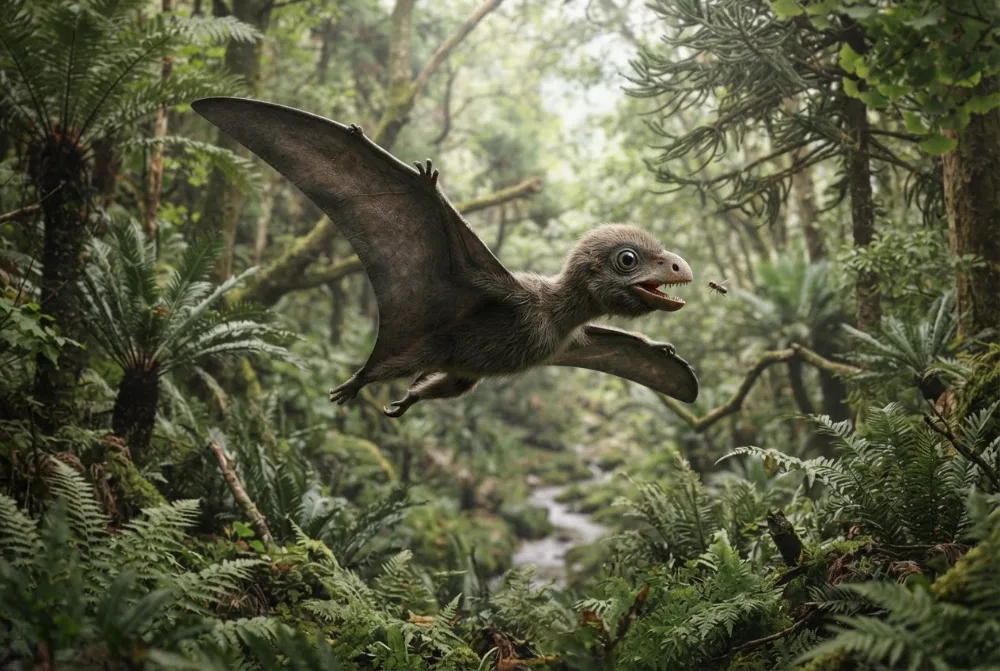
Sinomacrops was a tiny flying reptile that lived about 160 million years ago. It had huge eyes and a short, rounded snout, and it probably fluttered between trees catching insects.1
Rairarama rini?
Raiva hombe sei?
Raiva refu zvakadii?
Sinomacrops raiva hombe sei kana richienzaniswa NEWE?
Masvomhu chete mubrowser yako. Hapana chinochengetwa kana kutumirwa kupi zvako.
Raimhanya zvakadii?


Zvinonakidza
Sinomacrops is known from a single crushed skeleton, but it is the first anurognathid skull seen from the side.1
Its lower leg bone, the tibiotarsus, was twice as long as its thigh bone, which is unusual.1
It had three closely spaced teeth in the front of its upper jaw, a feature unique to this species.1
Sinomacrops is the second anurognathid pterosaur found in the Tiaojishan Formation in China.1
Its closest relative is Batrachognathus, and together they form a group called Batrachognathinae.1
The fossil was found in rocks that are between 165 and 155 million years old, from the Middle to Late Jurassic.3
Mibvunzo inonyanya kubvunzwa nezve Sinomacrops
?Was Sinomacrops a dinosaur?
No, Sinomacrops was a pterosaur, a flying reptile that lived at the same time as dinosaurs, but it was not a dinosaur itself.2
?How big was Sinomacrops?
It was tiny, but the exact size is not known because only one crushed skeleton has been found. It was small enough to flutter between trees.2
?What did Sinomacrops eat?
It probably ate insects. Its short snout and teeth suggest it caught bugs while flying, like other anurognathid pterosaurs.1
?When did Sinomacrops live?
It lived about 164 to 158 million years ago, during the Middle to Late Jurassic period.2
Mubvisi wengano
Ngano: Some people think Sinomacrops was a dinosaur because it lived with dinosaurs.
Chokwadi: Sinomacrops was a pterosaur, a flying reptile, not a dinosaur.1
Zvevanyanzvi vemadhino
- Zita resainzi
- Sinomacrops
- Akaripa zita:
- Wei et al. 20213
- Boka
- Zvinokambaira zvinobhururuka
- Mhuri / boka
- Anurognathidae3
- Kurongwa kwemhuka
- Pterosauria3
- Zera rematombo
- makore mamiriyoni 165 kusvika 155 (Callovian / Oxfordian)3
- Mapoka ematombo
- Tiaojishan3
- Nyika
- China3
- Zvinyorwa zvemafosiri
- 1 mu The Paleobiology Database3
- Kuwanikwa
- Scientists named Sinomacrops in 2021 after studying a fossil found at Mutoudeng in China. The species name bondei honors paleontologist Niels Bonde.1
- Zvichiri kupokanwa
- Scientists still debate exactly where anurognathids like Sinomacrops fit in the pterosaur family tree, and whether they lived mostly in trees.1
Kunobva chokwadi
- Sinomacrops bondei , a new anurognathid pterosaur from the Jurassic of China and comments on the group (pmc.ncbi.nlm.nih.gov)
- Sinomacrops (en.wikipedia.org)
- Sinomacrops in The Paleobiology Database (CC BY 4.0): zera, nzvimbo, mapoka ematombo, kurongwa kwemhuka.
Chokwadi chega chega papeji ino chine nhamba inoratidza kwachakabva. Kana takakanganisa chimwe chinhu, ruregerero, tiri vanoda madhino, kwete magazini yesainzi. Tiudze pa [email protected] tichazvigadzirisa.
 Rex ane nzara! Dino Wiki ipurojekiti yababa yemwanakomana wavo anoda madhino, mahara, pasina kushambadza uye pasina zvinokutevera. Vakuru vanogona kupa Rex chekudyadya kuti vabatsire kuchengeta saiti iri pamhepo.Fudza Rex
 Pteranodon
 Quetzalcoatlus
 Dorygnathus
 Rhamphorhynchus
 Anhanguera
 Pterodactylus
 Brachiosaurus
 Diplodocus
 Allosaurus
 Brontosaurus
 Compsognathus
 Camarasaurus