 Kuizi: Çfarë dinozauri je?
 Beteja e dinozaurëve
 Gara e dinozaurëve
 Minilojëra me dinozaurë
 Albumi i stikerave
 Listat TOP të dinozaurëve
 Më surprizo!
Kur jetoi?

Sa i madh ishte?
Sa i gjatë ishte?
Sa i lartë ishte?
vlerësim
Sa i rëndë ishte?
 i gjatë sa 4 qen nga hunda te bishti🍌i gjatë sa 21 banane njëra pas tjetrës🍉i rëndë sa 54 shalqinj🧸i rëndë sa 14 fëmijë kopshti🎒i rëndë sa 8 nxënës🏃mund të vraponte 100 metra për 8,6 sekonda (njeriu më i shpejtë do 9,6)
Sa i madh ishte Canardia krahasuar me TY?
Vetëm matematikë në shfletuesin tënd. Asgjë nuk ruhet dhe asgjë nuk dërgohet askund.
Sa i shpejtë ishte?


Fakte argëtuese
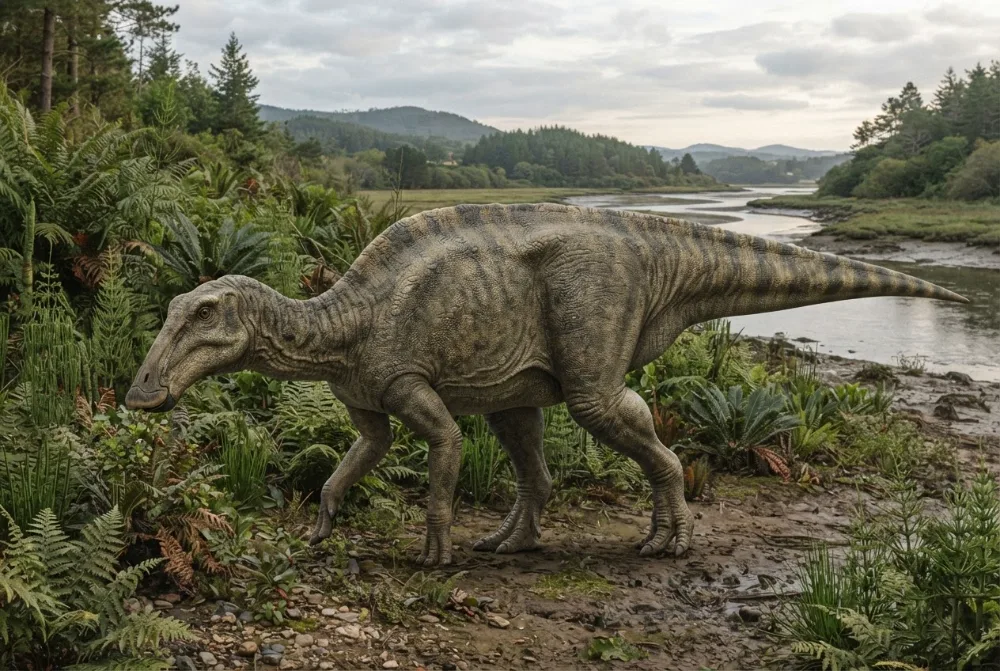
Canardia is known only from juvenile specimens, so scientists think the fossils found so far are from young animals.1
Its name comes from the French word 'canard', which means 'duck', because it belongs to the duck-billed dinosaur group.1
Canardia lived between 67.5 and 66 million years ago, right up to the end of the Cretaceous Period.1
The first fossils of Canardia were discovered in 1999 near the village of Marignac-Laspeyres in France.1
Some scientists think Canardia is closely related to Aralosaurus from Central Asia, while others place it in a group with other European and North African duck-billed dinosaurs.1
One Canardia fossil was found just one metre below the layer that marks the dinosaur extinction event, showing it was one of the very last non-bird dinosaurs in Europe.1
Pyetjet më të shpeshta për Canardia
?How big was Canardia?
Scientists are not sure of its full adult size because all known fossils are from juveniles. The biggest bones found are a maxilla 16.9 cm long, a scapula 21.8 cm long, and a humerus 19.4 cm long.1
?Did Canardia have a crest?
Nobody knows for sure. No complete skull has been found, so scientists cannot tell if it had a hollow bony crest like many other lambeosaurines.1
?What did Canardia eat?
Like other duck-billed dinosaurs, Canardia was a plant-eater. It had teeth with ridges for grinding plants, and its duck-like beak helped it bite off leaves.1
?When did Canardia live?
Canardia lived between 67.5 and 66 million years ago, during the very end of the Cretaceous Period. It was one of the last non-bird dinosaurs before the big extinction.1
?Where was Canardia found?
All Canardia fossils have been found in southwestern France, in the Haute-Garonne department. The first ones were discovered in 1999 near the village of Marignac-Laspeyres.1
?Is Canardia a dinosaur?
Yes, Canardia is a dinosaur. It is a type of duck-billed dinosaur called a lambeosaurine hadrosaurid.1
Për ekspertët e dinozaurëve
- Emri shkencor
- Canardia
- Emërtuar nga
- Prieto-Marquez et al. 20133
- Grupi
- Sqeprosat
- Familja / klada
- Hadrosauridae3
- Klasifikimi
- Ornithischia > Ornithopoda > Iguanodontia > Hadrosauridae3
- Mosha e shkëmbinjve
- 72 deri në 66 milionë vjet (Maastrichtian)3
- Formacionet shkëmbore
- Marno-calcaires jaunes de Gensac, Marnes d'Auzas3
- Vendet
- Franca3
- Gjetjet fosile
- 2 në The Paleobiology Database3
- Zbulimi
- Canardia was named in 2013 by Albert Prieto-Márquez and colleagues. The first fossils were found in 1999 by a team from the Musée des Dinosaures d'Espéraza in southwestern France.1
- Ende i diskutueshëm
- Scientists are not sure exactly where Canardia fits in the duck-billed dinosaur family tree. Some think it belongs to a group called Aralosaurini, while others place it in Arenysaurini.1
Nga vijnë faktet
- Canardia (en.wikipedia.org)
- Canardia garonnensis | Dinosaur Database by DinoAnimals.com (dinoanimals.com)
- Canardia in The Paleobiology Database (CC BY 4.0): mosha, vendet, formacionet shkëmbore, klasifikimi.
Çdo fakt në këtë faqe ka një numër që të çon te burimi i tij. Nëse kemi gabuar diçka, na fal, ne jemi fansa dinozaurësh, jo revistë shkencore. Na shkruaj në [email protected] dhe do ta rregullojmë.
 Rexi ka uri! Dino Wiki është projekti i një babai për djalin e tij që i do dinozaurët, falas, pa reklama dhe pa gjurmues. Të rriturit mund t'i japin Rexit një meze për ta mbajtur online.Ushqe Rexin
 Parasaurolophus
 Edmontosaurus
 Saurolophus
 Hypacrosaurus
 Corythosaurus
 Kritosaurus
 Tyrannosaurus
 Triceratops
 Velociraptor
 Spinosaurus
 Ankylosaurus
 Pteranodon