 Kuizi: Çfarë dinozauri je?
 Beteja e dinozaurëve
 Gara e dinozaurëve
 Minilojëra me dinozaurë
 Albumi i stikerave
 Listat TOP të dinozaurëve
 Më surprizo!
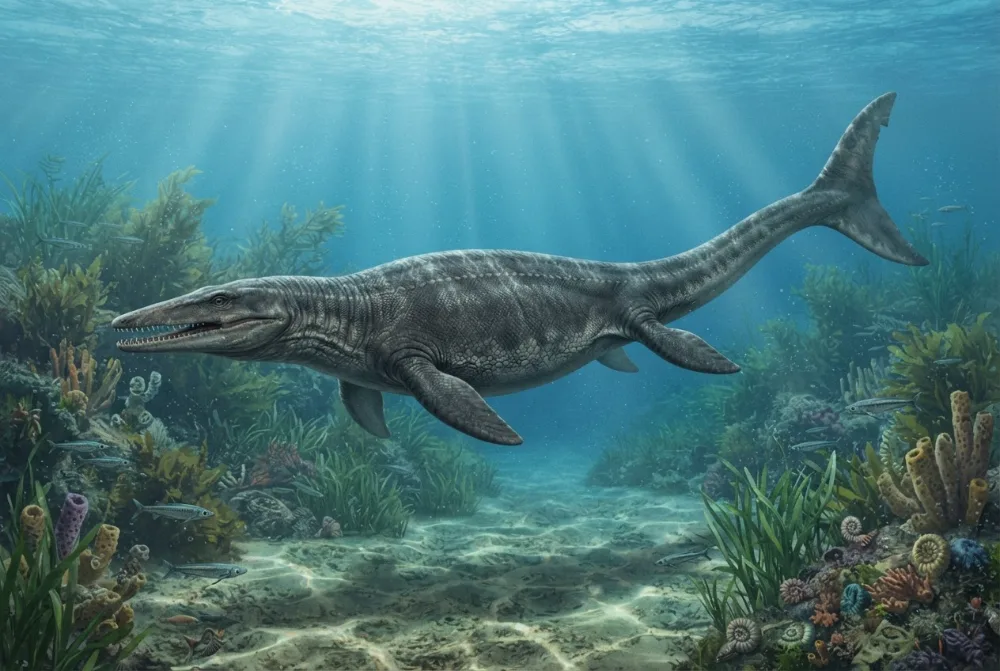
Clidastes
Clidastes was a small, speedy marine lizard that lived in the Late Cretaceous seas. It was one of the smallest mosasaurs, but it was a fast swimmer that chased down fish and squid in shallow waters.1
Kur jetoi?
Sa i madh ishte?
Sa i gjatë ishte?
Sa i rëndë ishte?
 i gjatë sa 6 qen nga hunda te bishti🍌i gjatë sa 34 banane njëra pas tjetrës
 i rëndë sa 14 mace shtëpiake🍉i rëndë sa 11 shalqinj🧸i rëndë sa 3 fëmijë kopshti🎒i rëndë sa 1,5 nxënës🏊mund të notonte gjatësinë e një pishine të madhe (50 m) për 5,5 sekonda
Sa i madh ishte Clidastes krahasuar me TY?
Vetëm matematikë në shfletuesin tënd. Asgjë nuk ruhet dhe asgjë nuk dërgohet askund.
Sa i shpejtë ishte?


Fakte argëtuese
Clidastes had special vertebrae that locked together, making its spine strong and stable for fast swimming.1
It was one of the smallest mosasaurs, only 2 to 4 meters long on average, but some grew up to 6.2 meters.1
Isotope studies on its teeth suggest Clidastes sometimes entered freshwater, like modern sea snakes.1
The first Clidastes fossils were found in Alabama in 1869 by E. D. Cope, and they were beautifully preserved.1
Its tail had extra-strong bones and muscles, which helped it chase down the fastest prey.1
Some scientists think that only one species, Clidastes propython, is valid, but others recognize more.1
Pyetjet më të shpeshta për Clidastes
?Was Clidastes a dinosaur?
No, Clidastes was a marine lizard, not a dinosaur. It belonged to a group called mosasaurs, which are reptiles that lived in the sea.13
?How big was Clidastes?
Clidastes was one of the smallest mosasaurs, averaging 2 to 4 metres (6.6 to 13.1 feet) long. The largest specimens reached about 6.2 metres (20 feet).13
?What did Clidastes eat?
Clidastes likely ate cephalopods (like squid), fish, and other small vertebrates. It hunted in shallow water.13
?Could Clidastes swim in freshwater?
Yes, isotope studies on its teeth suggest Clidastes sometimes entered freshwater, similar to modern sea snakes.1
Për ekspertët e dinozaurëve
- Emri shkencor
- Clidastes
- Emërtuar nga
- Cope 18684
- Grupi
- Mozazaurët
- Familja / klada
- Mosasauridae4
- Klasifikimi
- Mosasauroidea4
- Mosha e shkëmbinjve
- 94 deri në 66 milionë vjet (Turonian / Maastrichtian)4
- Formacionet shkëmbore
- Mooreville Chalk, Niobrara, Pierre Shale4
- Vendet
- SHBA, Suedia, Gjermania, Meksika, Rusia, Jordania4
- Gjetjet fosile
- 34 në The Paleobiology Database4
- Zbulimi
- E. D. Cope named Clidastes in 1868, and in 1869 he found the first good fossils in the Mooreville Chalk of Alabama.14
- Ende i diskutueshëm
- Scientists debate whether fossils from Europe and Jordan really belong to Clidastes or to other mosasaurs.1
Nga vijnë faktet
- Clidastes (en.wikipedia.org)
- Clidastes - Justapedia (justapedia.org)
- Clidastes Facts for Kids (kids.kiddle.co)
- Clidastes in The Paleobiology Database (CC BY 4.0): mosha, vendet, formacionet shkëmbore, klasifikimi.
Çdo fakt në këtë faqe ka një numër që të çon te burimi i tij. Nëse kemi gabuar diçka, na fal, ne jemi fansa dinozaurësh, jo revistë shkencore. Na shkruaj në [email protected] dhe do ta rregullojmë.
 Rexi ka uri! Dino Wiki është projekti i një babai për djalin e tij që i do dinozaurët, falas, pa reklama dhe pa gjurmues. Të rriturit mund t'i japin Rexit një meze për ta mbajtur online.Ushqe Rexin
 Mosasaurus
 Prognathodon
 Tylosaurus
 Platecarpus
 Globidens
 Halisaurus
 Tyrannosaurus
 Triceratops
 Velociraptor
 Spinosaurus
 Ankylosaurus
 Parasaurolophus