 Kuizi: Çfarë dinozauri je?
 Beteja e dinozaurëve
 Gara e dinozaurëve
 Minilojëra me dinozaurë
 Albumi i stikerave
 Listat TOP të dinozaurëve
 Më surprizo!
Kur jetoi?

Sa i madh ishte?
Sa i gjatë ishte?
Sa i lartë ishte?
Sa i rëndë ishte?
 i gjatë sa 3 mace shtëpiake nga hunda te bishti🍌i gjatë sa 8 banane njëra pas tjetrësi rëndë afërsisht sa një mace shtëpiake🍌i rëndë sa 58 banane🏃mund të vraponte 100 metra për 12 sekonda (njeriu më i shpejtë do 9,6)
Sa i madh ishte Segisaurus krahasuar me TY?
Vetëm matematikë në shfletuesin tënd. Asgjë nuk ruhet dhe asgjë nuk dërgohet askund.
Sa i shpejtë ishte?


Fakte argëtuese
Segisaurus had a wishbone, called a furcula, just like birds do. This was one of the first times such a bone was found in a non-bird dinosaur.2
Its bones were first thought to be solid, but a 2005 study showed they were actually hollow, like other theropods.2
The only known fossil was found by a Navajo man named Max Littlesalt in 1933, who was keeping livestock in the canyon.2
Segisaurus lived in an environment like modern sand dunes, and its fossil was buried in sandstone.2
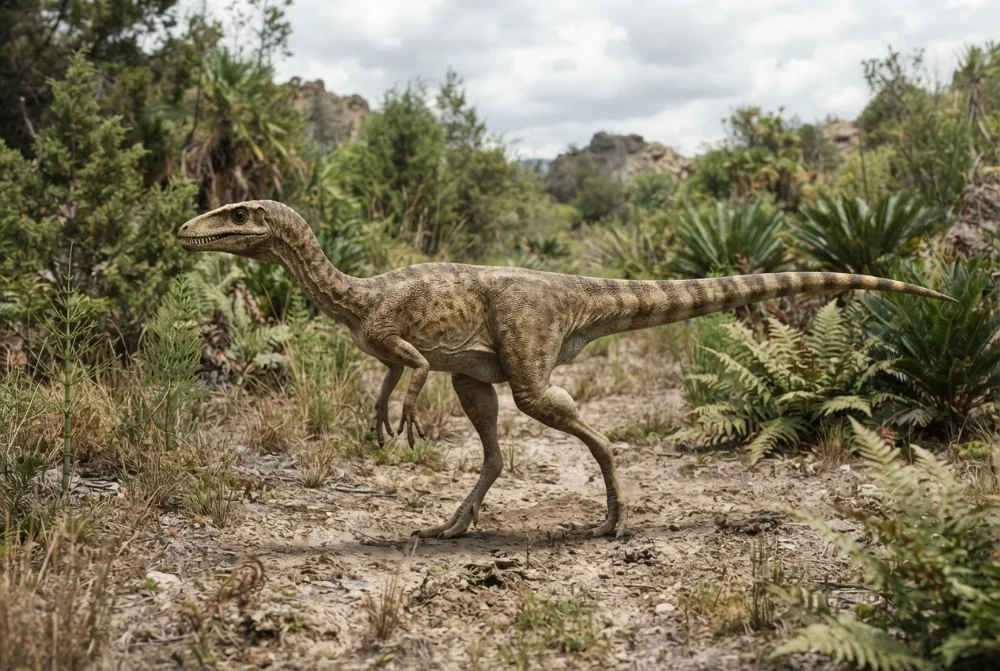
It had a long tail and long forearms, and its legs were powerful and long compared to its body.2
Scientists think Segisaurus was closely related to Coelophysis, but it had some unusual features that made them question that at first.2
Pyetjet më të shpeshta për Segisaurus
?How big was Segisaurus?
Segisaurus was about 1 metre (3.3 feet) long, half a metre (1.65 feet) tall, and weighed about 4 to 7 kilograms. That is roughly the size of a goose.2
?What did Segisaurus eat?
Segisaurus was a meat-eater, probably eating insects and small prey. It may also have scavenged meat.21
?When did Segisaurus live?
Segisaurus lived during the Early Jurassic period, about 200 to 174 million years ago.2
?Did Segisaurus have feathers?
The sources do not mention feathers on Segisaurus. It did have a wishbone, or furcula, like birds, which is a feature linked to birds.2
?Was Segisaurus a dinosaur?
Yes, Segisaurus was a small theropod dinosaur, a meat-eating dinosaur that walked on two legs.21
?Where was Segisaurus found?
The only Segisaurus fossil was found in Tsegi Canyon, Arizona, in the Navajo Sandstone. It was discovered by Max Littlesalt in 1933.2
Shkatërruesi i miteve
Miti: Some people thought Segisaurus had solid bones and might not be a true theropod.
E vërteta: A 2005 re-examination showed its bones were hollow, and it is firmly classified as a coelophysoid theropod.2
Për ekspertët e dinozaurëve
- Emri shkencor
- Segisaurus
- Emërtuar nga
- Camp 19363
- Grupi
- Dinozaurët mishngrënës
- Familja / klada
- Coelophysidae3
- Klasifikimi
- Theropoda > Coelophysoidea3
- Mosha e shkëmbinjve
- 193 deri në 175 milionë vjet (Pliensbachian / Toarcian)3
- Formacionet shkëmbore
- Navajo Sandstone3
- Vendet
- SHBA3
- Gjetjet fosile
- 2 në The Paleobiology Database3
- Zbulimi
- The fossil was discovered in 1933 by Max Littlesalt in Tsegi Canyon, Arizona. Paleontologist Charles Lewis Camp described and named it in 1936.21
- Ende i diskutueshëm
- Because only a sub-adult skeleton has been found, scientists are not sure how big a full-grown Segisaurus could get.2
Nga vijnë faktet
- Segisaurus | Natural History Museum (nhm.ac.uk)
- Segisaurus (en.wikipedia.org)
- Segisaurus in The Paleobiology Database (CC BY 4.0): mosha, vendet, formacionet shkëmbore, klasifikimi.
Çdo fakt në këtë faqe ka një numër që të çon te burimi i tij. Nëse kemi gabuar diçka, na fal, ne jemi fansa dinozaurësh, jo revistë shkencore. Na shkruaj në [email protected] dhe do ta rregullojmë.
 Rexi ka uri! Dino Wiki është projekti i një babai për djalin e tij që i do dinozaurët, falas, pa reklama dhe pa gjurmues. Të rriturit mund t'i japin Rexit një meze për ta mbajtur online.Ushqe Rexin
 Allosaurus
 Carnotaurus
 Dilophosaurus
 Giganotosaurus
 Compsognathus
 Paronychodon
 Stenopterygius
 Dorygnathus
 Lufengosaurus
 Scutellosaurus
 Yunnanosaurus
 Temnodontosaurus