 Kuizi: Çfarë dinozauri je?
 Beteja e dinozaurëve
 Gara e dinozaurëve
 Minilojëra me dinozaurë
 Albumi i stikerave
 Listat TOP të dinozaurëve
 Më surprizo!
Tsintaosaurus
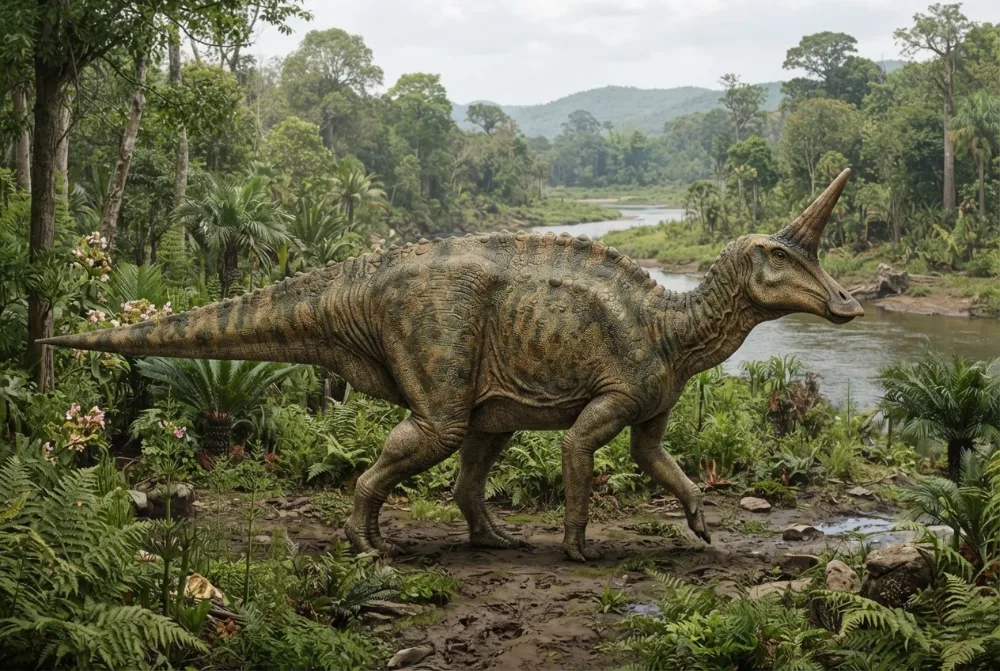
Tsintaosaurus was a duck-billed dinosaur that lived in China during the Late Cretaceous. It had a strange, hollow crest on its head that looked a bit like a unicorn horn. This plant-eater could walk on four legs or run on two to escape predators.21
Kur jetoi?
Sa i madh ishte?
Sa i gjatë ishte?
Sa i lartë ishte?
Sa i rëndë ishte?
 i gjatë sa 2,5 makina të parkuara në rresht🍌i gjatë sa 67 banane njëra pas tjetrës
 i rëndë sa 120 qen🍉i rëndë sa 500 shalqinj🎒i rëndë sa 3 klasa të tëra me nxënës🐻❄️i rëndë sa 6 arinj polarë🏃mund të vraponte 100 metra për 14 sekonda (njeriu më i shpejtë do 9,6)
Sa i madh ishte Tsintaosaurus krahasuar me TY?
Vetëm matematikë në shfletuesin tënd. Asgjë nuk ruhet dhe asgjë nuk dërgohet askund.
Sa i shpejtë ishte?


Fakte argëtuese
Tsintaosaurus was first thought to have a unicorn-like horn, but scientists now think the crest was actually part of a larger, hollow structure on its snout.2
The crest was hollow and may have been used to make loud honking sounds to communicate with other Tsintaosaurus.2
It lived about 84 to 71 million years ago, during the Campanian stage of the Late Cretaceous.1
Tsintaosaurus is known from skulls and a partial skeleton, so scientists are still learning about its body.1
Like other hadrosaurs, Tsintaosaurus probably traveled in herds for protection.2
The name Tsintaosaurus comes from the old spelling of Qingdao, the city near where it was found.2
Pyetjet më të shpeshta për Tsintaosaurus
?How big was Tsintaosaurus?
About 8.3 metres (27 feet) long and weighed 2.5 tonnes (2.8 short tons), according to Wikipedia. The Natural History Museum gives a length of 12.0 metres, so estimates vary.21
?What did Tsintaosaurus eat?
It was a plant-eater. It had a duck-like beak and strong teeth for chewing vegetation.21
?Why did Tsintaosaurus have a crest?
The crest was hollow and may have been used to make loud honking sounds to communicate. It might also have helped attract mates, and the hollow tube made the crest lighter.24
?Could Tsintaosaurus swim?
It had a large tail that may have helped it swim, according to the Australian Museum. It probably lived near lakes and rivers.4
Shkatërruesi i miteve
Miti: Tsintaosaurus had a single, solid horn like a unicorn.
E vërteta: The crest was actually hollow and was the back part of a larger, flat crest that ran from the tip of the snout.2
Për ekspertët e dinozaurëve
- Emri shkencor
- Tsintaosaurus
- Emërtuar nga
- Young 19585
- Grupi
- Sqeprosat
- Familja / klada
- Hadrosauridae5
- Klasifikimi
- Ornithischia > Ornithopoda > Iguanodontia > Hadrosauridae5
- Mosha e shkëmbinjve
- 84 deri në 72 milionë vjet (Campanian)5
- Formacionet shkëmbore
- Jingangkou5
- Vendet
- Kina5
- Gjetjet fosile
- 4 në The Paleobiology Database5
- Zbulimi
- Chinese paleontologist C. C. Young named Tsintaosaurus in 1958 after fossils were found near Laiyang, Shandong, China.21
- Ende i diskutueshëm
- Scientists still debate the exact shape and function of Tsintaosaurus's head crest, because only a few fossils have been found.2
Nga vijnë faktet
- Tsintaosaurus | Natural History Museum (nhm.ac.uk)
- Tsintaosaurus (en.wikipedia.org)
- Tsintaosaurus: Discover more about this Dinosaur | Dinosaurland (dinosaurland.es)
- Dinosaurs - Tsintaosaurus spinorhinus - The Australian Museum (australian.museum)
- Tsintaosaurus in The Paleobiology Database (CC BY 4.0): mosha, vendet, formacionet shkëmbore, klasifikimi.
Çdo fakt në këtë faqe ka një numër që të çon te burimi i tij. Nëse kemi gabuar diçka, na fal, ne jemi fansa dinozaurësh, jo revistë shkencore. Na shkruaj në [email protected] dhe do ta rregullojmë.
 Rexi ka uri! Dino Wiki është projekti i një babai për djalin e tij që i do dinozaurët, falas, pa reklama dhe pa gjurmues. Të rriturit mund t'i japin Rexit një meze për ta mbajtur online.Ushqe Rexin
 Parasaurolophus
 Edmontosaurus
 Saurolophus
 Hypacrosaurus
 Corythosaurus
 Kritosaurus
 Tyrannosaurus
 Triceratops
 Velociraptor
 Spinosaurus
 Ankylosaurus
 Pteranodon