 Kuizi: Çfarë dinozauri je?
 Beteja e dinozaurëve
 Gara e dinozaurëve
 Minilojëra me dinozaurë
 Albumi i stikerave
 Listat TOP të dinozaurëve
 Më surprizo!
Ugrunaaluk
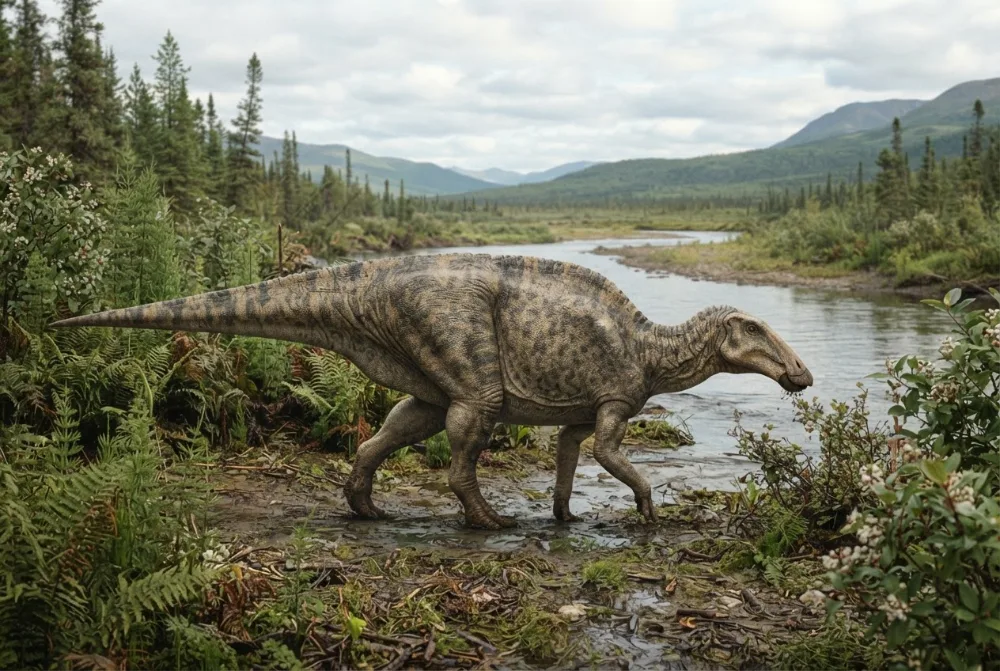
Ugrunaaluk was a duck-billed dinosaur that lived in the ancient Arctic, where it was cold and dark for part of the year. It had a long, flat beak and hundreds of teeth for chewing tough plants. This dinosaur is special because it shows that some dinosaurs could survive in polar regions.51
Kur jetoi?
Sa i madh ishte?
Sa i gjatë ishte?
Sa i lartë ishte?
vlerësim
Sa i rëndë ishte?
 i gjatë sa 2,5 makina të parkuara në rresht🍌i gjatë sa 67 banane njëra pas tjetrës
 i rëndë afërsisht sa një elefant🍉i rëndë sa 1100 shalqinj🎒i rëndë sa 7 klasa të tëra me nxënës🐻❄️i rëndë sa 12 arinj polarë🏃mund të vraponte 100 metra për 17 sekonda (njeriu më i shpejtë do 9,6)
Sa i madh ishte Ugrunaaluk krahasuar me TY?
Vetëm matematikë në shfletuesin tënd. Asgjë nuk ruhet dhe asgjë nuk dërgohet askund.
Sa i shpejtë ishte?


Fakte argëtuese
Ugrunaaluk lived in the Arctic about 69 million years ago, when the climate was much cooler than today, with average temperatures around 5 to 6°C.1
Most of the Ugrunaaluk fossils found are from young animals, not fully grown adults. Scientists think a whole herd of juveniles may have died together in a flood.1
Its name comes from the Iñupiaq language of Alaska. Ugruŋnaq means a grazing animal with grinding teeth, and -aluk means old, so Ugrunaaluk is 'ancient grazer'.1
Ugrunaaluk was a close relative of Edmontosaurus, but scientists found enough differences in its skull bones to give it its own name.1
The Liscomb bonebed where Ugrunaaluk was found has thousands of bones, mostly from this dinosaur, along with a few teeth from tyrannosaurs and other small dinosaurs.1
During the time of Ugrunaaluk, the Arctic had polar woodlands with flowering plants in the understory, and the days were dark for months in winter.1
Pyetjet më të shpeshta për Ugrunaaluk
?How big was Ugrunaaluk?
Ugrunaaluk was about 7.6 to 9.1 meters (25 to 30 feet) long and stood about 1.8 to 2.1 meters (6 to 7 feet) tall at the hip.4
?What did Ugrunaaluk eat?
It was a plant-eater, with a flat beak and hundreds of teeth for chewing tough plants. Its jaw had at least 1,000 teeth with coarse surfaces perfect for pulverizing plants.4
?Did Ugrunaaluk live in the Arctic?
Yes, Ugrunaaluk lived in the ancient Arctic, above the Arctic Circle, about 69 million years ago. It endured cold and dark winters, with average temperatures around 5 to 6°C.41
?Was Ugrunaaluk a duck-billed dinosaur?
Yes, Ugrunaaluk belonged to the hadrosaur group of duck-billed dinosaurs. It had a long, flat beak and hundreds of teeth for chewing plants.4
?Why is Ugrunaaluk special?
Ugrunaaluk is special because it shows that some dinosaurs could survive in polar regions. It lived above the Arctic Circle, enduring months of darkness and cold.4
?How many teeth did Ugrunaaluk have?
Ugrunaaluk had at least 1,000 teeth in its jaw, with coarse surfaces perfect for pulverizing plants.4
?When did Ugrunaaluk live?
Ugrunaaluk lived about 69 million years ago, during the Late Cretaceous period, in the ancient Arctic.4
?Is Ugrunaaluk related to Edmontosaurus?
Yes, Ugrunaaluk is closely related to Edmontosaurus, but scientists found enough differences in its skull bones to give it its own name.1
?Where was Ugrunaaluk found?
Ugrunaaluk fossils were found in the Liscomb bonebed in the Prince Creek Formation of northern Alaska, along the Colville River.1
Shkatërruesi i miteve
Miti: Ugrunaaluk is just a young Edmontosaurus and not a real separate dinosaur.
E vërteta: Scientists showed that Ugrunaaluk has unique skull features that make it a distinct species, even when accounting for age differences.1
Për ekspertët e dinozaurëve
- Emri shkencor
- Ugrunaaluk
- Emërtuar nga
- Mori et al. 20165
- Grupi
- Sqeprosat
- Familja / klada
- Hadrosauridae5
- Klasifikimi
- Ornithischia > Ornithopoda > Iguanodontia > Hadrosauridae5
- Mosha e shkëmbinjve
- 72 deri në 66 milionë vjet (Maastrichtian)5
- Formacionet shkëmbore
- Prince Creek5
- Vendet
- SHBA5
- Gjetjet fosile
- 1 në The Paleobiology Database5
- Zbulimi
- Ugrunaaluk was named in 2016 by Hirotsugu Mori, Patrick Druckenmiller, and Gregory Erickson. The fossils were found in the Liscomb bonebed along the Colville River in northern Alaska.51
- Ende i diskutueshëm
- Scientists are not sure exactly how big adult Ugrunaaluk grew, because almost all the fossils are from juveniles.1
Nga vijnë faktet
- Formation (lower Maastrichtian) of northern Alaska (app.pan.pl)
- Edmontosaurus (en.wikipedia.org)
- Edmontosaurus regalis (en.wikipedia.org)
- New Dinosaur Species Probably Endured Snow and Darkness for Months on End | NOVA | PBS (pbs.org)
- Ugrunaaluk in The Paleobiology Database (CC BY 4.0): mosha, vendet, formacionet shkëmbore, klasifikimi.
Çdo fakt në këtë faqe ka një numër që të çon te burimi i tij. Nëse kemi gabuar diçka, na fal, ne jemi fansa dinozaurësh, jo revistë shkencore. Na shkruaj në [email protected] dhe do ta rregullojmë.
 Rexi ka uri! Dino Wiki është projekti i një babai për djalin e tij që i do dinozaurët, falas, pa reklama dhe pa gjurmues. Të rriturit mund t'i japin Rexit një meze për ta mbajtur online.Ushqe Rexin
 Parasaurolophus
 Edmontosaurus
 Saurolophus
 Hypacrosaurus
 Corythosaurus
 Kritosaurus
 Tyrannosaurus
 Triceratops
 Velociraptor
 Spinosaurus
 Ankylosaurus
 Pteranodon