 Kwisi: O dinosaure efe?
 Ntwa ya didinosaure
 Peiso ya didinosaure
 Dipapadi tse nyane tsa didinosaure
 Albamo ya ditikara
 Manane a TOP a didinosaure
 Nkgethele!
Acostasaurus
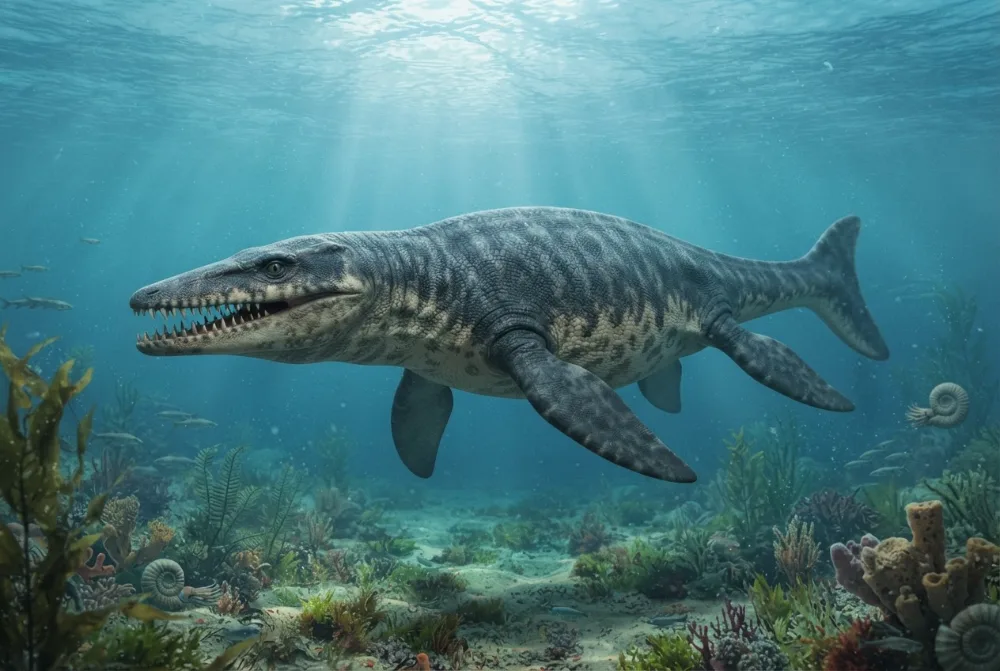
Acostasaurus was a fierce marine reptile that swam in the warm seas of Colombia about 125 million years ago. It had a big head, sharp teeth, and flippers to paddle through the water. Even though it was not a dinosaur, it was a top predator in its ocean home.1
E phetse neng?
E ne e le kgolo hakae?
E ne e le telele hakae?
 telele jwaloka dintja tse 4 ho tloha nkong ho isa mohatleng🍌telele jwaloka dibanana tse 22 di behilwe ka mola🏊e ne e ka sesa bolelele ba letamo le leholo la ho sesa (50 m) ka metsotswana e 6.2
Acostasaurus e ne e le kgolo hakae ha e bapiswa le WENA?
Ke dipalo feela ho browser ya hao. Ha ho letho le bolokwang kapa le romelwang kae kapa kae.
E ne e le lebelo hakae?


Dintlha tse monate
Acostasaurus had very large eye sockets and big scleral rings, which helped it see in deep or murky water.1
Its skull was short and wide in the front, unlike many other pliosaurs that had long snouts.1
The only known fossil is a nearly complete skull and parts of the body, including a whole hind flipper and many vertebrae.1
Acostasaurus lived during the Early Cretaceous, a time when few plesiosaur fossils are known, called the 'Lower Cretaceous Gap'.3
It had a short lower jaw joint area with only five and a half pairs of tooth sockets, which is unusual for a pliosaur.1
The specimen was a subadult, because some bones in its skull were not fully grown together.1
Dipotso tse botswang haholo ka Acostasaurus
?How big was Acostasaurus?
It was over 4 metres (13 feet) long. That is about as long as a small car.1
?Was Acostasaurus a dinosaur?
No, it was a marine reptile called a pliosaur, not a dinosaur. It lived in the ocean.1
?What did Acostasaurus eat?
It was a predator that ate other sea creatures. Its sharp teeth helped it catch prey.1
Bakeng sa ditsebi tsa didinosaure
- Lebitso la saense
- Acostasaurus
- E rehilwe ke
- Gomez-Perez and Noe 20114
- Sehlopha
- Diplesiosaure
- Lelapa / leloko
- Pliosauridae4
- Tlhophiso
- Plesiosauria > Pliosauridae > Sauropterygia4
- Dilemo tsa mafika
- dilemo tse dimilione tse 126 ho isa ho 121 (Barremian)4
- Dibopeho tsa mafika
- Paja4
- Dinaha
- Kolombia4
- Direkoto tsa difosili
- 1 ho The Paleobiology Database4
- Ho sibollwa
- Acostasaurus was named by Marcela Gómez Pérez and Leslie F. Noè in 2011, based on a fossil found in the Paja Formation of Colombia. The species name is Acostasaurus pavachoquensis.12
- E sa ntse e phehwa kgang
- Scientists are not sure whether Acostasaurus belongs to the brachauchenine group of pliosaurs, because its teeth are different from theirs.1
Moo dintlha di tswang teng
- Acostasaurus (en.wikipedia.org)
- PBDB Taxon (paleobiodb.org)
- Cranial anatomy of a new pliosaurid Acostasaurus pavachoquensis from the Lower Cretaceous of Colombia, South America - Palaeontographica Abteilung A Band 310 Lieferung 1-2, Schweizerbart science publishers (schweizerbart.de)
- Acostasaurus in The Paleobiology Database (CC BY 4.0): dilemo, dibaka, dibopeho tsa mafika, tlhophiso.
Ntlha e nngwe le e nngwe leqepheng lena e na le nomoro e supang mohlodi wa yona. Haeba re fositse ho hong, re kopa tshwarelo, re balatedi ba didinosaure, ha re koranta ya saense. Re bolelle ho [email protected] mme re tla e lokisa.
 Rex o lapile! Dino Wiki ke projeke ya ntate bakeng sa mora wa hae ya ratang didinosaure, ke mahala, ha ho dipapatso, ha ho disebedi. Batho ba baholo ba ka fepa Rex seneke ho thusa hore e dule e le inthaneteng.Fepa Rex
 Elasmosaurus
 Pliosaurus
 Plesiosaurus
 Cimoliasaurus
 Colymbosaurus
 Trinacromerum
 Stegosaurus
 Iguanodon
 Archaeopteryx
 Giganotosaurus
 Microraptor
 Deinonychus