 Kwisi: O dinosaure efe?
 Ntwa ya didinosaure
 Peiso ya didinosaure
 Dipapadi tse nyane tsa didinosaure
 Albamo ya ditikara
 Manane a TOP a didinosaure
 Nkgethele!
Angaturama
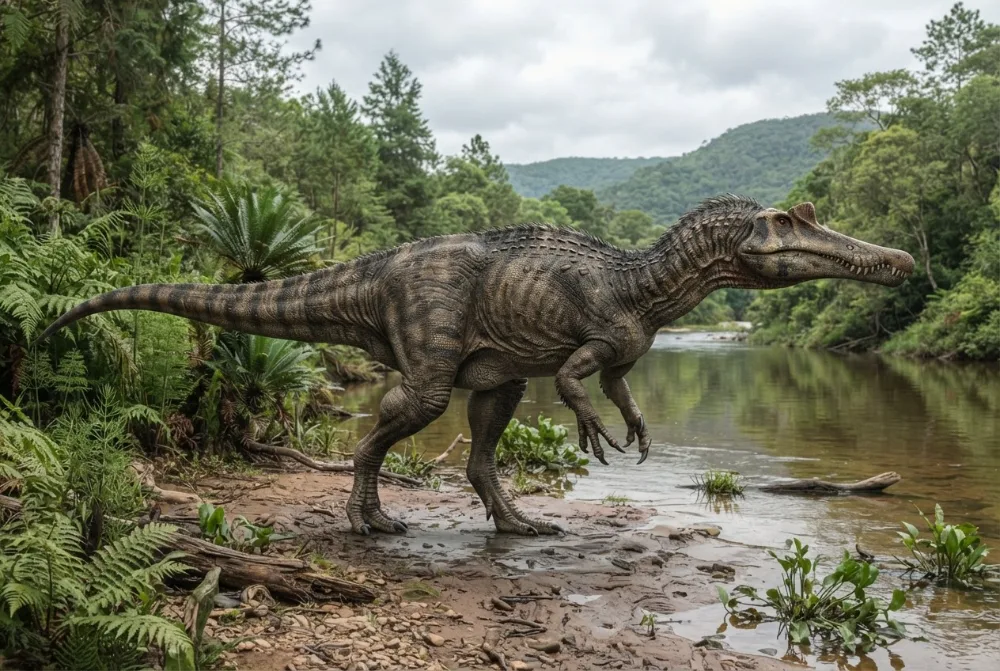
Angaturama was a meat-eating dinosaur that lived about 115 million years ago in what is now Brazil. It had a long, narrow snout with a rosette of teeth at the tip, perfect for catching fish. This dinosaur was one of the smallest spinosaurids, but it was still a fierce hunter.1
E phetse neng?
E ne e le kgolo hakae?
E ne e le telele hakae?
E ne e phahame hakae?
E ne e le boima hakae?
 telele jwaloka dintja tse 8 ho tloha nkong ho isa mohatleng🍌telele jwaloka dibanana tse 44 di behilwe ka mola🍉boima jwaloka mahapu a 200🧸boima jwaloka bana ba kereshe ba 53🎒boima jwaloka bana ba sekolo ba 31🐻❄️boima jwaloka dibere tse tshweu tse 2🏃e ne e ka matha dimitara tse 100 ka metsotswana e 12 (motho ya lebelo ka ho fetisisa o hloka 9,6)
Angaturama e ne e le kgolo hakae ha e bapiswa le WENA?
Ke dipalo feela ho browser ya hao. Ha ho letho le bolokwang kapa le romelwang kae kapa kae.
E ne e le lebelo hakae?


Dintlha tse monate
Angaturama's snout tip was shaped like a rosette, with long teeth that interlocked to trap slippery fish.1
Its nostrils were placed far back on the snout, which helped it breathe while its mouth was underwater.1
Angaturama had a thin crest on top of its head where strong neck muscles attached, helping it snap its jaws quickly.1
This dinosaur lived in a tropical coastal lagoon environment, surrounded by dry land with plants like cycads and conifers.1
Angaturama is known only from a snout tip, but a replica skeleton was built using other bones from the same formation and is displayed in Brazil.1
Dipotso tse botswang haholo ka Angaturama
?How big was Angaturama?
About 6 to 8 meters long and weighed around 1 tonne, making it one of the smallest spinosaurids.5
?What did Angaturama eat?
It mainly ate fish, using its long snout and interlocking teeth to catch them. It also sometimes ate pterosaurs, either by hunting or scavenging.56
?Did Angaturama have a sail on its back?
Yes, like other spinosaurids, it likely had a sail on its back made from long spines on its vertebrae.5
?Is Angaturama the same as Irritator?
Some scientists think Angaturama might be the same species as Irritator, but others disagree. More fossils are needed to know for sure.5
?Where did Angaturama live?
It lived in what is now northeastern Brazil, in a tropical coastal lagoon environment with dry land nearby.56
?Could Angaturama swim?
Yes, it likely spent a lot of time in water hunting for fish. Its nostrils were placed far back on its snout to help it breathe while underwater.57
?Did Angaturama have feathers?
Nobody knows for sure. No feather fossils have been found with Angaturama, and most spinosaurids are not thought to have had feathers.5
Bakeng sa ditsebi tsa didinosaure
- Lebitso la saense
- Angaturama
- E rehilwe ke
- Kellner and Campos 19968
- Sehlopha
- Dispinosaure
- Lelapa / leloko
- Spinosauridae8
- Tlhophiso
- Theropoda > Spinosauridae8
- Dilemo tsa mafika
- dilemo tse dimilione tse 120 ho isa ho 113 (Aptian)8
- Dibopeho tsa mafika
- Romualdo8
- Dinaha
- Brazil8
- Direkoto tsa difosili
- 1 ho The Paleobiology Database8
- Ho sibollwa
- Angaturama was named by Brazilian paleontologists Alexander W. A. Kellner and Diogenes de Almeida Campos in February 1996. The fossil snout tip was found in a limestone nodule from the Romualdo Formation in Brazil.13
- E sa ntse e phehwa kgang
- Scientists are not sure if Angaturama is a separate species from Irritator, or if they are the same dinosaur.21
Moo dintlha di tswang teng
- Irritator (en.wikipedia.org)
- PBDB Taxon (paleobiodb.org)
- First Early Cretaceous theropod dinosaur from Brazil with comments on Spinosauridae - Neues Jahrbuch für Geologie und Paläontologie - Abhandlungen Band 199 Heft 2, Schweizerbart science publishers (schweizerbart.de)
- Angaturama limai (es.wikipedia.org)
- Irritator (Wikipedia) (Wikipedia)
- Dinossauro Carnívoro - Angaturama limai (museunacional.ufrj.br)
- Spinosaur taxonomy and evolution of craniodental features: Evidence from Brazil (pmc.ncbi.nlm.nih.gov)
- Angaturama in The Paleobiology Database (CC BY 4.0): dilemo, dibaka, dibopeho tsa mafika, tlhophiso.
Ntlha e nngwe le e nngwe leqepheng lena e na le nomoro e supang mohlodi wa yona. Haeba re fositse ho hong, re kopa tshwarelo, re balatedi ba didinosaure, ha re koranta ya saense. Re bolelle ho [email protected] mme re tla e lokisa.
 Rex o lapile! Dino Wiki ke projeke ya ntate bakeng sa mora wa hae ya ratang didinosaure, ke mahala, ha ho dipapatso, ha ho disebedi. Batho ba baholo ba ka fepa Rex seneke ho thusa hore e dule e le inthaneteng.Fepa Rex
 Spinosaurus
 Baryonyx
 Suchomimus
 Camarillasaurus
 Ceratosuchops
 Iberospinus
 Stegosaurus
 Iguanodon
 Archaeopteryx
 Giganotosaurus
 Microraptor
 Deinonychus