 Kwisi: O dinosaure efe?
 Ntwa ya didinosaure
 Peiso ya didinosaure
 Dipapadi tse nyane tsa didinosaure
 Albamo ya ditikara
 Manane a TOP a didinosaure
 Nkgethele!
Anhanguera
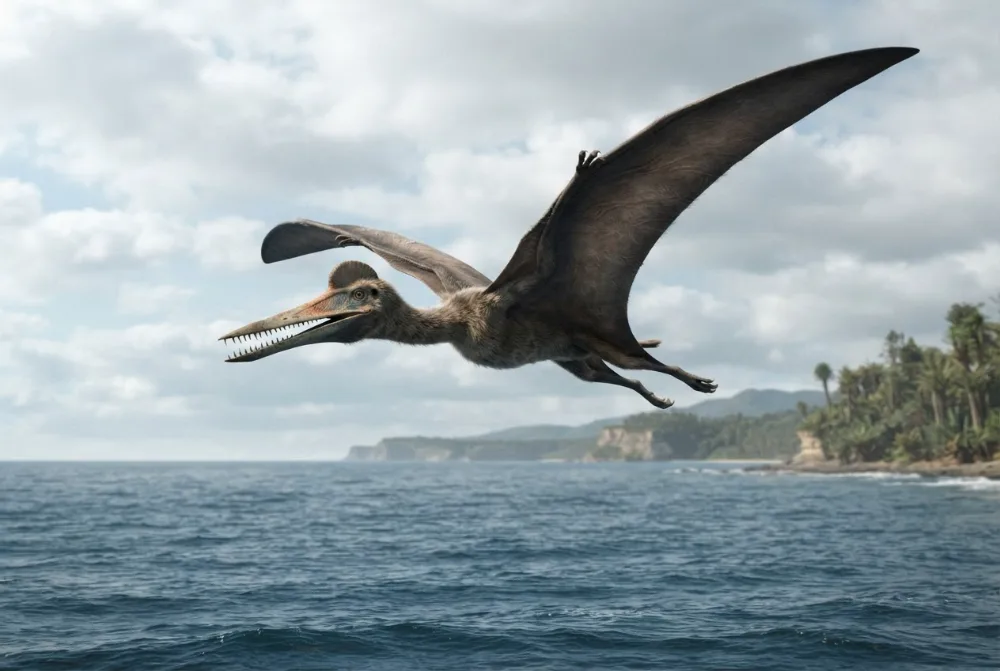
Anhanguera was a flying reptile that soared over ancient seas. It had a long, toothy beak and a wingspan as wide as a car. It was not a dinosaur, but a pterosaur, a close cousin of dinosaurs.1
E phetse neng?
E ne e le kgolo hakae?
E ne e le telele hakae?
E ne e le boima hakae?
 telele jwaloka dikatse tsa lapeng tse 4 ho tloha nkong ho isa mohatleng🍌telele jwaloka dibanana tse 11 di behilwe ka mola🍉boima jwaloka mahapu a 6⚽e ne e ka fofa ho tshela lebala lohle la bolo ya maoto ka metsotswana e 5.7
Anhanguera e ne e le kgolo hakae ha e bapiswa le WENA?
Ke dipalo feela ho browser ya hao. Ha ho letho le bolokwang kapa le romelwang kae kapa kae.
E ne e le lebelo hakae?


Dintlha tse monate
Anhanguera had a crest on the front of its upper jaw, but it was set farther back on the skull than in its close relatives Coloborhynchus and Ornithocheirus.1
Some Anhanguera fossils have a small, blunt crest at the back of the skull, similar to other pteranodontoids.1
A study in 2003 showed that Anhanguera likely held its head at an angle to the ground, based on its inner ear structure, which helped it keep its balance.1
Anhanguera had bony rings in its eye sockets called scleral rings, which may have supported its eyes, similar to modern birds.1
The name Anhanguera comes from the Tupi language and means 'old spirit' or 'spirit protector of the animals'.1
Anhanguera lived during the Early to Late Cretaceous, from about 112 to 93 million years ago.1
Dipotso tse botswang haholo ka Anhanguera
?How big was Anhanguera?
Anhanguera had a wingspan of about 4.6 meters (15 ft).1
?What did Anhanguera eat?
Anhanguera ate fish. It had sharp, curved teeth to pierce and grip slippery fish.13
?Why did Anhanguera have a crest?
Scientists aren't sure. It might have been for display to attract mates or show off, or it might have helped the animal eat.3
?Could Anhanguera fly?
Yes, Anhanguera was a flying reptile. It had thin, light bones to save weight and a large brain area for coordinating flight, similar to birds.3
?When did Anhanguera live?
Anhanguera lived during the Early to Late Cretaceous, from about 112 to 93 million years ago.1
Bakeng sa ditsebi tsa didinosaure
- Lebitso la saense
- Anhanguera
- E rehilwe ke
- Campos and Kellner 19854
- Sehlopha
- Dihahabi tse fofang
- Lelapa / leloko
- Ornithocheiroidea4
- Tlhophiso
- Pterosauria > Pterodactyloidea4
- Dilemo tsa mafika
- dilemo tse dimilione tse 137 ho isa ho 94 (Valanginian / Cenomanian)4
- Dibopeho tsa mafika
- Romualdo, West Melbury Marly Chalk, Toolebuc4
- Dinaha
- Brazil, United Kingdom, Australia, Moroko, Egepeta, Kolombia4
- Direkoto tsa difosili
- 18 ho The Paleobiology Database4
- Ho sibollwa
- Anhanguera was named in 1985 by Brazilian paleontologists Diogenes de Almeida Campos and Alexander Wilhelm Armin Kellner, based on a complete skull found in the Romualdo Formation of Brazil.14
- E sa ntse e phehwa kgang
- Scientists are not sure whether the crests on the jaws were present in all Anhanguera individuals or only in some, possibly depending on age or sex.1
Moo dintlha di tswang teng
- Anhanguera (pterosaur) (en.wikipedia.org)
- _Anhanguera_ (pterosaur) — Grokipedia (grokipedia.com)
- Watch a pterosaur fly | Natural History Museum (nhm.ac.uk)
- Anhanguera in The Paleobiology Database (CC BY 4.0): dilemo, dibaka, dibopeho tsa mafika, tlhophiso.
Ntlha e nngwe le e nngwe leqepheng lena e na le nomoro e supang mohlodi wa yona. Haeba re fositse ho hong, re kopa tshwarelo, re balatedi ba didinosaure, ha re koranta ya saense. Re bolelle ho [email protected] mme re tla e lokisa.
 Rex o lapile! Dino Wiki ke projeke ya ntate bakeng sa mora wa hae ya ratang didinosaure, ke mahala, ha ho dipapatso, ha ho disebedi. Batho ba baholo ba ka fepa Rex seneke ho thusa hore e dule e le inthaneteng.Fepa Rex
 Pteranodon
 Quetzalcoatlus
 Dorygnathus
 Rhamphorhynchus
 Pterodactylus
 Eudimorphodon
 Stegosaurus
 Iguanodon
 Archaeopteryx
 Giganotosaurus
 Microraptor
 Deinonychus