 Kwisi: O dinosaure efe?
 Ntwa ya didinosaure
 Peiso ya didinosaure
 Dipapadi tse nyane tsa didinosaure
 Albamo ya ditikara
 Manane a TOP a didinosaure
 Nkgethele!
Brancasaurus
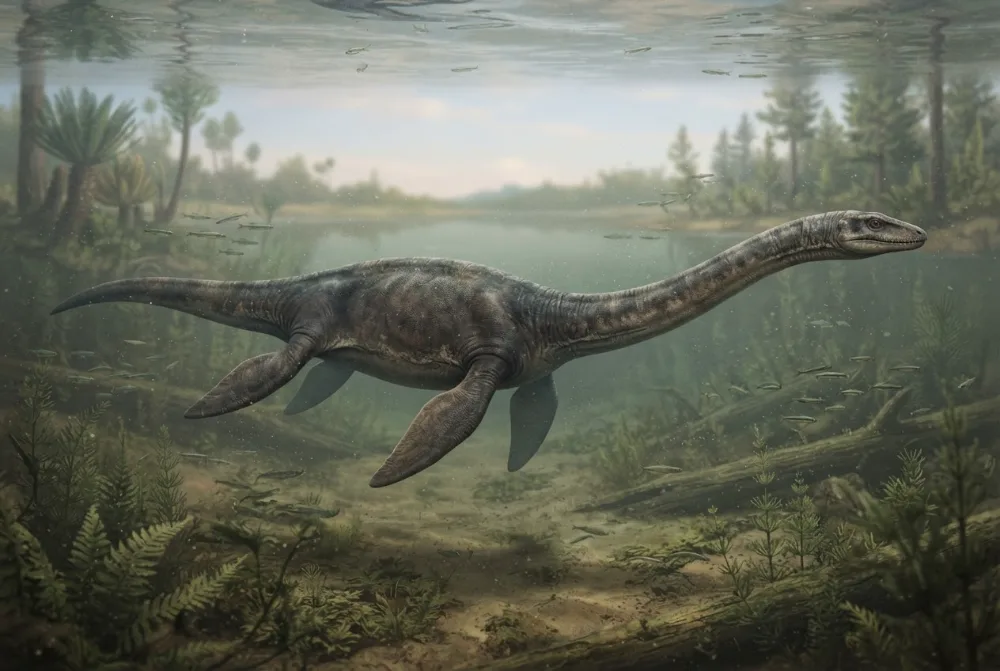
Brancasaurus was a plesiosaur, a long-necked marine reptile that lived in a freshwater lake. It had a small head and a long tail, and swam with four flippers like paddles.1
E phetse neng?
E ne e le kgolo hakae?
E ne e le telele hakae?
 telele jwaloka dintja tse 3 ho tloha nkong ho isa mohatleng🍌telele jwaloka dibanana tse 18 di behilwe ka mola🏊e ne e ka sesa bolelele ba letamo le leholo la ho sesa (50 m) ka metsotswana e 6.4
Brancasaurus e ne e le kgolo hakae ha e bapiswa le WENA?
Ke dipalo feela ho browser ya hao. Ha ho letho le bolokwang kapa le romelwang kae kapa kae.
E ne e le lebelo hakae?


Dintlha tse monate
Brancasaurus lived in a huge freshwater lake, not the ocean. The lake was sometimes connected to the sea.1
Its neck bones had tall, shark-fin-shaped spines on top, which is unusual for plesiosaurs.1
The first fossil was found by workers digging clay with pickaxes in 1910. They accidentally broke the hip bone into 176 pieces.1
Brancasaurus was about 3.26 metres (10.7 feet) long as a subadult. Adults may have been a bit bigger.1
Another plesiosaur named Gronausaurus wegneri is now thought to be the same as Brancasaurus, just a different growth stage.12
Brancasaurus shared its lake with sharks, crocodiles, turtles, and many kinds of fish.1
Dipotso tse botswang haholo ka Brancasaurus
?Was Brancasaurus a dinosaur?
No, Brancasaurus was a plesiosaur, a type of marine reptile that lived in the time of the dinosaurs, but it was not a dinosaur itself.13
?How big was Brancasaurus?
The most complete fossil, a subadult, was about 3.26 metres (10.7 feet) long. Adults may have been a bit bigger.143
Bakeng sa ditsebi tsa didinosaure
- Lebitso la saense
- Brancasaurus
- E rehilwe ke
- Wegner 19145
- Sehlopha
- Diplesiosaure
- Lelapa / leloko
- Leptocleididae5
- Tlhophiso
- Plesiosauria > Sauropterygia5
- Dilemo tsa mafika
- dilemo tse dimilione tse 139 ho isa ho 137 (Berriasian)5
- Dibopeho tsa mafika
- Bückeberg5
- Dinaha
- Jeremane5
- Direkoto tsa difosili
- 1 ho The Paleobiology Database5
- Ho sibollwa
- Brancasaurus was named by Theodor Wegner in 1914. He named it after the paleontologist Wilhelm von Branca. The first skeleton was found in a clay pit near Gronau, Germany in 1910.1
- E sa ntse e phehwa kgang
- Scientists are not sure whether Brancasaurus belongs to the elasmosaurid family or the leptocleidid family. Different studies give different answers.12
Moo dintlha di tswang teng
- Brancasaurus (en.wikipedia.org)
- Reappraisal of Europe's most complete Early Cretaceous plesiosaurian: Brancasaurus brancai Wegner, 1914 from the "Wealden facies" of Germany (pubmed.ncbi.nlm.nih.gov)
- Brancasaurus Facts for Kids (kids.kiddle.co)
- Reappraisal of Europe’s most complete Early Cretaceous plesiosaurian: Brancasaurus brancai Wegner, 1914 from the “Wealden facies” of Germany [PeerJ] (peerj.com)
- Brancasaurus in The Paleobiology Database (CC BY 4.0): dilemo, dibaka, dibopeho tsa mafika, tlhophiso.
Ntlha e nngwe le e nngwe leqepheng lena e na le nomoro e supang mohlodi wa yona. Haeba re fositse ho hong, re kopa tshwarelo, re balatedi ba didinosaure, ha re koranta ya saense. Re bolelle ho [email protected] mme re tla e lokisa.
 Rex o lapile! Dino Wiki ke projeke ya ntate bakeng sa mora wa hae ya ratang didinosaure, ke mahala, ha ho dipapatso, ha ho disebedi. Batho ba baholo ba ka fepa Rex seneke ho thusa hore e dule e le inthaneteng.Fepa Rex
 Elasmosaurus
 Pliosaurus
 Plesiosaurus
 Cimoliasaurus
 Colymbosaurus
 Trinacromerum
 Stegosaurus
 Iguanodon
 Archaeopteryx
 Giganotosaurus
 Microraptor
 Deinonychus