 Kwisi: O dinosaure efe?
 Ntwa ya didinosaure
 Peiso ya didinosaure
 Dipapadi tse nyane tsa didinosaure
 Albamo ya ditikara
 Manane a TOP a didinosaure
 Nkgethele!
Cariocecus
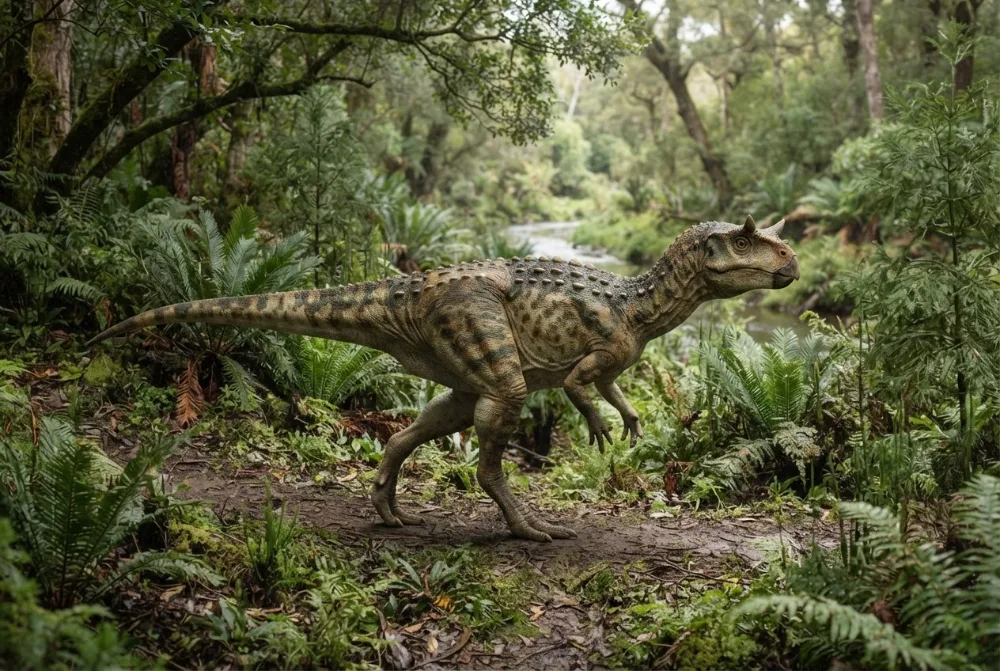
Cariocecus was a medium-sized plant-eating dinosaur that lived in what is now Portugal. It had a bony brow over its eye that made it look like an eagle, and its upper jaw bones were fused together to help it chew tough plants.1
E phetse neng?
E ne e le kgolo hakae?
E ne e le telele hakae?
E ne e phahame hakae?
kakanyo
E ne e le boima hakae?
 telele jwaloka dintja tse 7 ho tloha nkong ho isa mohatleng🍌telele jwaloka dibanana tse 39 di behilwe ka mola🍉boima jwaloka mahapu a 120🧸boima jwaloka bana ba kereshe ba 32🎒boima jwaloka bana ba sekolo ba 19🏃e ne e ka matha dimitara tse 100 ka metsotswana e 9.7 (motho ya lebelo ka ho fetisisa o hloka 9,6)
Cariocecus e ne e le kgolo hakae ha e bapiswa le WENA?
Ke dipalo feela ho browser ya hao. Ha ho letho le bolokwang kapa le romelwang kae kapa kae.
E ne e le lebelo hakae?


Dintlha tse monate
Cariocecus is the first iguanodontian skull ever found in Portugal.1
The skull of Cariocecus was about 45 centimetres (18 inches) long, and the animal was not fully grown when it died.2
Its maxilla and jugal bones were completely fused together, which is unique among all ornithopods.1
Cariocecus had a large bony brow over its eye that may have protected it from sun glare and injury.1
Scientists used micro-CT scanning to study the inside of the skull, including the brain and inner ear.2
Cariocecus lived alongside the spinosaurid Iberospinus and other dinosaurs in a shallow coastal environment.1
The fossil was discovered in 2016 by Pedro Marrecas and was named in 2025.1
Bakeng sa ditsebi tsa didinosaure
- Lebitso la saense
- Cariocecus
- E rehilwe ke
- Bertozzo et al. 20254
- Sehlopha
- Dija-dimela tse nang le melomo
- Lelapa / leloko
- Hadrosauroidea4
- Tlhophiso
- Ornithischia > Ornithopoda > Iguanodontia4
- Dilemo tsa mafika
- dilemo tse dimilione tse 126 ho isa ho 121 (Barremian)4
- Dibopeho tsa mafika
- Papo Seco4
- Dinaha
- Portugal4
- Direkoto tsa difosili
- 1 ho The Paleobiology Database4
- Ho sibollwa
- The only known skull was found in 2016 by Pedro Marrecas in a limestone outcrop in Portugal. It was named Cariocecus bocagei in 2025 by Filippo Bertozzo and colleagues.1
- E sa ntse e phehwa kgang
- Scientists are not sure exactly how large Cariocecus grew, because the only known fossil is from a young individual.1
Moo dintlha di tswang teng
- Cariocecus bocagei (en.wikipedia.org)
- Cariocecus bocagei, a new basal hadrosauroid from the Lower Cretaceous of Portugal: Journal of Systematic Palaeontology: Vol 23, No 1 (tandfonline.com)
- Cariocecus bocagei | Dinosaur Database by DinoAnimals.com (dinoanimals.com)
- Cariocecus in The Paleobiology Database (CC BY 4.0): dilemo, dibaka, dibopeho tsa mafika, tlhophiso.
Ntlha e nngwe le e nngwe leqepheng lena e na le nomoro e supang mohlodi wa yona. Haeba re fositse ho hong, re kopa tshwarelo, re balatedi ba didinosaure, ha re koranta ya saense. Re bolelle ho [email protected] mme re tla e lokisa.
 Rex o lapile! Dino Wiki ke projeke ya ntate bakeng sa mora wa hae ya ratang didinosaure, ke mahala, ha ho dipapatso, ha ho disebedi. Batho ba baholo ba ka fepa Rex seneke ho thusa hore e dule e le inthaneteng.Fepa Rex
 Iguanodon
 Tenontosaurus
 Thescelosaurus
 Zalmoxes
 Camptosaurus
 Rhabdodon
 Stegosaurus
 Archaeopteryx
 Giganotosaurus
 Microraptor
 Deinonychus
 Baryonyx