 Kwisi: O dinosaure efe?
 Ntwa ya didinosaure
 Peiso ya didinosaure
 Dipapadi tse nyane tsa didinosaure
 Albamo ya ditikara
 Manane a TOP a didinosaure
 Nkgethele!
E phetse neng?

E ne e le kgolo hakae?
E ne e le telele hakae?
E ne e phahame hakae?
E ne e le boima hakae?
 telele jwaloka dikoloi tse 4 tse pakilweng ka mola🍌telele jwaloka dibanana tse 110 di behilwe ka mola
 e batla e le boima jwaloka tlou🍉boima jwaloka mahapu a 1200🎒boima jwaloka ditlelase tse feletseng tse 8 tsa bana ba sekolo🐻❄️boima jwaloka dibere tse tshweu tse 13🏃e ne e ka matha dimitara tse 100 ka metsotswana e 20 (motho ya lebelo ka ho fetisisa o hloka 9,6)
Dicraeosaurus e ne e le kgolo hakae ha e bapiswa le WENA?
Ke dipalo feela ho browser ya hao. Ha ho letho le bolokwang kapa le romelwang kae kapa kae.
E ne e le lebelo hakae?


Dintlha tse monate
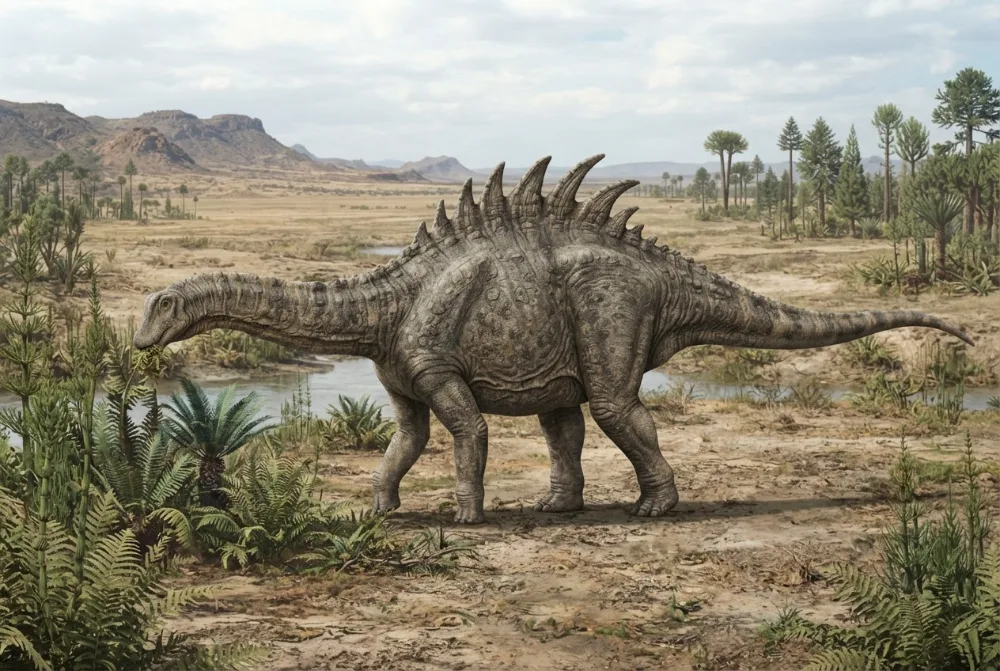
Dicraeosaurus had forked spines on its backbone, which is why its name means 'forked lizard'.1
It lived between 161 and 143 million years ago, during the Late Jurassic period.5
This dinosaur was a sauropod, a group of huge, long-necked plant-eaters.1
Fossils of Dicraeosaurus have been found in the Tendaguru Formation in Tanzania.5
Dicraeosaurus was about 20 metres long, as long as two school buses.1
It was named by German paleontologist Werner Janensch in 1914.5
Dipotso tse botswang haholo ka Dicraeosaurus
?How big was Dicraeosaurus?
Dicraeosaurus was about 14 to 15 metres (46 to 49 feet) long and weighed around 5 to 6 metric tons (5.5 to 6.6 short tons). That is roughly as long as two school buses.34
?What did Dicraeosaurus eat?
Dicraeosaurus was a herbivore, meaning it ate plants. It likely browsed on low-level vegetation no more than 3 metres (about 10 feet) off the ground, using its peg-like teeth.34
?Why did Dicraeosaurus have forked spines?
The forked spines on its backbone likely provided attachment points for muscles, which helped support its neck. They might have also supported a small sail or fatty ridge, but scientists aren't sure.34
?When did Dicraeosaurus live?
Dicraeosaurus lived during the Late Jurassic period, about 155 to 151 million years ago.34
?Where was Dicraeosaurus found?
Fossils of Dicraeosaurus were found in the Tendaguru Formation in Tanzania, Africa. The first fossils were discovered by Werner Janensch and Edwin Hennig between 1909 and 1912.34
?Was Dicraeosaurus bigger than T. rex?
Dicraeosaurus was about 14 to 15 metres long, which is longer than a T. rex, but it was lighter, weighing around 5 to 6 metric tons. T. rex was heavier and more robust.3
Bakeng sa ditsebi tsa didinosaure
- Lebitso la saense
- Dicraeosaurus
- E rehilwe ke
- Janensch 19145
- Sehlopha
- Melala e melelele
- Lelapa / leloko
- Dicraeosauridae5
- Tlhophiso
- Sauropodomorpha > Sauropoda > Diplodocoidea5
- Dilemo tsa mafika
- dilemo tse dimilione tse 162 ho isa ho 143 (Oxfordian / Tithonian)5
- Dibopeho tsa mafika
- Tendaguru, Kadzi5
- Dinaha
- Tanzania, Zimbabwe5
- Direkoto tsa difosili
- 19 ho The Paleobiology Database5
- Ho sibollwa
- Dicraeosaurus was named by Werner Janensch in 1914 based on fossils found in Tanzania.5
Moo dintlha di tswang teng
- Dicraeosaurus | Natural History Museum (nhm.ac.uk)
- Dicraeosaurus hansemanni skeletal reconstruction (deviantart.com)
- Dicraeosaurus (en.wikipedia.org)
- DICRAEOSAURUS - DinoChecker dinosaur archive (dinochecker.com)
- Dicraeosaurus in The Paleobiology Database (CC BY 4.0): dilemo, dibaka, dibopeho tsa mafika, tlhophiso.
Ntlha e nngwe le e nngwe leqepheng lena e na le nomoro e supang mohlodi wa yona. Haeba re fositse ho hong, re kopa tshwarelo, re balatedi ba didinosaure, ha re koranta ya saense. Re bolelle ho [email protected] mme re tla e lokisa.
 Rex o lapile! Dino Wiki ke projeke ya ntate bakeng sa mora wa hae ya ratang didinosaure, ke mahala, ha ho dipapatso, ha ho disebedi. Batho ba baholo ba ka fepa Rex seneke ho thusa hore e dule e le inthaneteng.Fepa Rex
 Brachiosaurus
 Diplodocus
 Brontosaurus
 Argentinosaurus
 Camarasaurus
 Morosaurus
 Allosaurus
 Compsognathus
 Camptosaurus
 Nanosaurus
 Rhamphorhynchus
 Ceratosaurus