 Kwisi: O dinosaure efe?
 Ntwa ya didinosaure
 Peiso ya didinosaure
 Dipapadi tse nyane tsa didinosaure
 Albamo ya ditikara
 Manane a TOP a didinosaure
 Nkgethele!
E phetse neng?

E ne e le kgolo hakae?
E ne e le telele hakae?
E ne e phahame hakae?
kakanyo
E ne e le boima hakae?
 telele jwaloka dikoloi tse 6 tse pakilweng ka mola🍌telele jwaloka dibanana tse 140 di behilwe ka mola
 boima jwaloka ditlou tse 1.5🍉boima jwaloka mahapu a 1900🎒boima jwaloka ditlelase tse feletseng tse 12 tsa bana ba sekolo🐻❄️boima jwaloka dibere tse tshweu tse 21🏢e phahame hoo e ka nyarelang ka fensetere mokatong wa 2🏃e ne e ka matha dimitara tse 100 ka metsotswana e 24 (motho ya lebelo ka ho fetisisa o hloka 9,6)
Duriatitan e ne e le kgolo hakae ha e bapiswa le WENA?
Ke dipalo feela ho browser ya hao. Ha ho letho le bolokwang kapa le romelwang kae kapa kae.
E ne e le lebelo hakae?


Dintlha tse monate
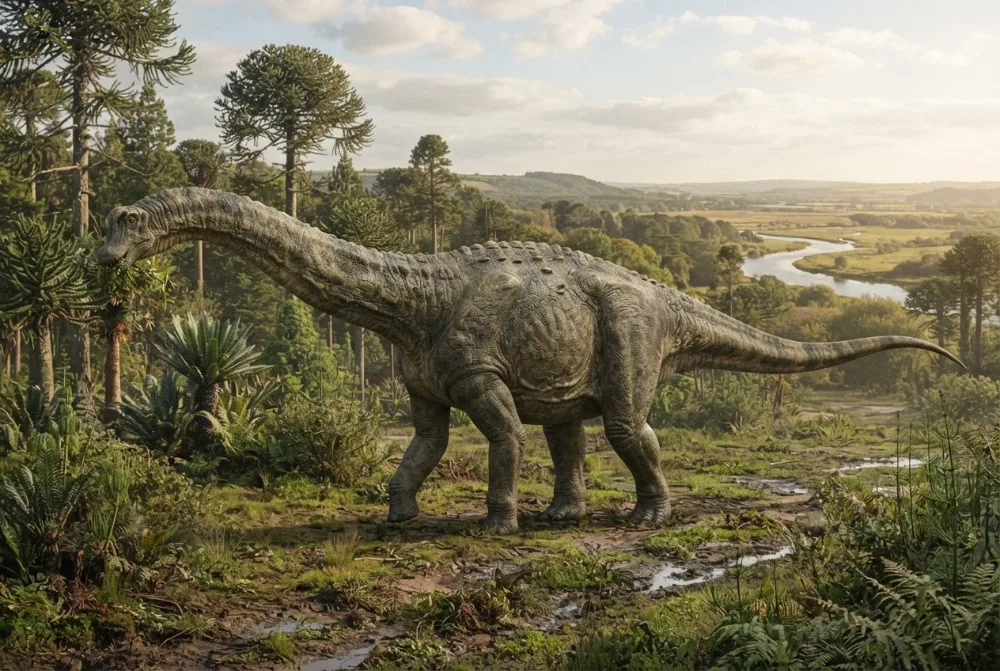
Duriatitan is only known from a single left upper arm bone, called a humerus.1
The bone was found near Sandsfoot, Weymouth in Dorset, England, by a man named R.I. Smith.1
It was first named in 1874 as a species of Cetiosaurus, and later given its own genus in 2010.1
The name Duriatitan comes from the Latin name for Dorset, Duria, and the Greek word Titan, meaning giant.1
Scientists think Duriatitan lived during the Late Jurassic, about 150 million years ago.1
It was a titanosauriform, a group of sauropods that includes some of the largest land animals ever.4
Thomas Holtz estimated Duriatitan could have been up to 25 meters (82 feet) long, as long as a blue whale.1
Dipotso tse botswang haholo ka Duriatitan
?How big was Duriatitan?
Duriatitan may have been up to 25 meters long, which is shorter than a 30 meter blue whale, though this is an estimate from one bone.13
?What did Duriatitan eat?
Duriatitan was a plant-eater, eating tough leaves from trees. Its huge body and long neck helped it reach food other dinosaurs couldn't.3
?Could Duriatitan swim?
Scientists once thought sauropods like Duriatitan lived in water, but now they think the opposite. Its air-filled bones and small feet would have made it float and be unstable in water.3
Bakeng sa ditsebi tsa didinosaure
- Lebitso la saense
- Duriatitan
- E rehilwe ke
- Barrett et al. 20104
- Sehlopha
- Melala e melelele
- Lelapa / leloko
- Titanosauriformes4
- Tlhophiso
- Sauropodomorpha > Sauropoda > Macronaria4
- Dilemo tsa mafika
- dilemo tse dimilione tse 155 ho isa ho 137 (Kimmeridgian / Berriasian)4
- Dibopeho tsa mafika
- Kimmeridge Clay, Mont-Lambert, Praia da Amoreira-Porto Novo4
- Dinaha
- United Kingdom, Fora, Portugal, Sepania4
- Direkoto tsa difosili
- 8 ho The Paleobiology Database4
- Ho sibollwa
- The first fossil, a partial left upper arm bone, was found by R.I. Smith near Sandsfoot, Weymouth in Dorset. It was described by John Hulke in 1874 as a species of Cetiosaurus, and later renamed Duriatitan by Paul Barrett, Roger Benson, and Paul Upchurch in 2010.1
- E sa ntse e phehwa kgang
- Scientists are not sure exactly how big Duriatitan was, because only one arm bone has been found. The length estimate of 25 meters is just a guess.1
Moo dintlha di tswang teng
- Duriatitan (en.wikipedia.org)
- Duriatitan humerocristatus | Dinosaur Database by DinoAnimals.com (dinoanimals.com)
- Britain's biggest Jurassic dinosaurs | Natural History Museum (nhm.ac.uk)
- Duriatitan in The Paleobiology Database (CC BY 4.0): dilemo, dibaka, dibopeho tsa mafika, tlhophiso.
Ntlha e nngwe le e nngwe leqepheng lena e na le nomoro e supang mohlodi wa yona. Haeba re fositse ho hong, re kopa tshwarelo, re balatedi ba didinosaure, ha re koranta ya saense. Re bolelle ho [email protected] mme re tla e lokisa.
 Rex o lapile! Dino Wiki ke projeke ya ntate bakeng sa mora wa hae ya ratang didinosaure, ke mahala, ha ho dipapatso, ha ho disebedi. Batho ba baholo ba ka fepa Rex seneke ho thusa hore e dule e le inthaneteng.Fepa Rex
 Brachiosaurus
 Diplodocus
 Brontosaurus
 Argentinosaurus
 Camarasaurus
 Morosaurus
 Allosaurus
 Compsognathus
 Camptosaurus
 Nanosaurus
 Rhamphorhynchus
 Ceratosaurus