 Kwisi: O dinosaure efe?
 Ntwa ya didinosaure
 Peiso ya didinosaure
 Dipapadi tse nyane tsa didinosaure
 Albamo ya ditikara
 Manane a TOP a didinosaure
 Nkgethele!
E phetse neng?

E ne e le kgolo hakae?
E ne e le telele hakae?
E ne e phahame hakae?
kakanyo
E ne e le boima hakae?
 telele jwaloka dintja tse 5 ho tloha nkong ho isa mohatleng🍌telele jwaloka dibanana tse 28 di behilwe ka mola🍉boima jwaloka mahapu a 260🧸boima jwaloka bana ba kereshe ba 68🎒boima jwaloka bana ba sekolo ba 41🐻❄️boima jwaloka dibere tse tshweu tse 3🏃e ne e ka matha dimitara tse 100 ka metsotswana e 21 (motho ya lebelo ka ho fetisisa o hloka 9,6)
Europelta e ne e le kgolo hakae ha e bapiswa le WENA?
Ke dipalo feela ho browser ya hao. Ha ho letho le bolokwang kapa le romelwang kae kapa kae.
E ne e le lebelo hakae?


Dintlha tse monate
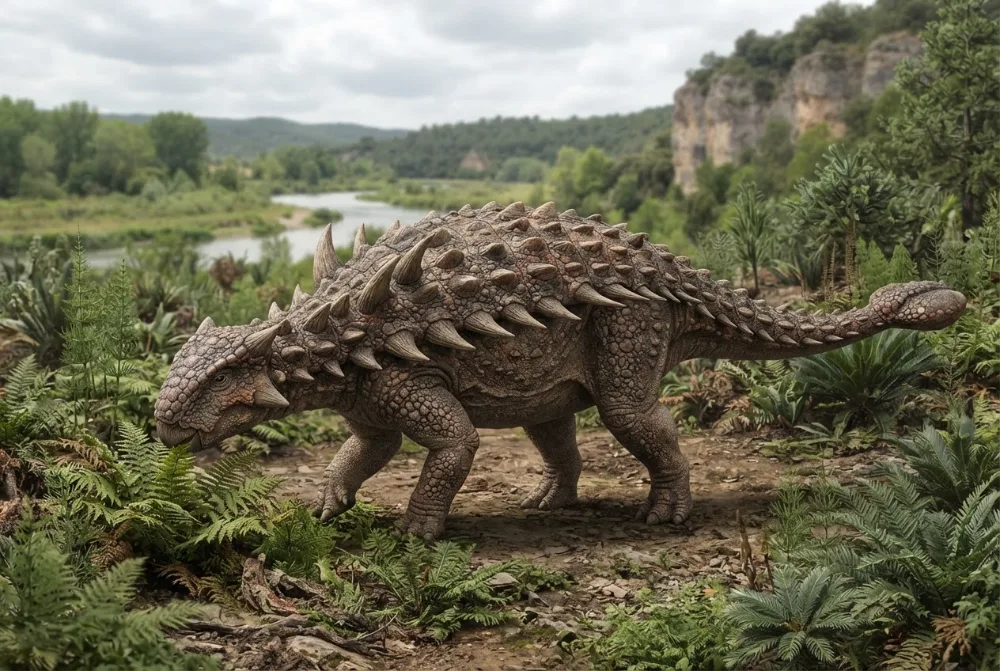
Europelta is the most complete ankylosaur ever found in Europe.1
Two partial skeletons were found together in a coal mine, showing these dinosaurs may have lived in groups.2
It was a nodosaurid, a type of armored dinosaur with spikes on its shoulders and a club-less tail.1
Europelta was the largest member of its group, Struthiosaurini, weighing about as much as a small car.1
Its fossils were found in rocks that were once a freshwater swamp, full of plant debris and coal.2
Dipotso tse botswang haholo ka Europelta
?How big was Europelta?
Europelta was about 5 metres (16 feet) long and weighed around 1.3 tonnes (2,866 lbs), about as much as a small car.1
?Did Europelta have a tail club?
No, Europelta was a nodosaurid, a type of armored dinosaur that did not have a tail club.3
?What did Europelta eat?
Europelta was a plant-eater that ate low-lying plants in its swampy habitat.3
Bakeng sa ditsebi tsa didinosaure
- Lebitso la saense
- Europelta
- E rehilwe ke
- Kirkland et al. 20134
- Sehlopha
- Didinosaure tse nang le sesireletsi
- Lelapa / leloko
- Nodosauridae4
- Tlhophiso
- Ornithischia > Ankylosauria > Nodosauridae > Thyreophora4
- Dilemo tsa mafika
- dilemo tse dimilione tse 113 ho isa ho 110 (Albian)4
- Dibopeho tsa mafika
- Escucha4
- Dinaha
- Sepania4
- Direkoto tsa difosili
- 1 ho The Paleobiology Database4
- Ho sibollwa
- Europelta was named in 2013 by James Kirkland and his team. The two skeletons were dug up from the Santa María coal mine in Spain.14
- E sa ntse e phehwa kgang
- Scientists are not sure exactly how Europelta is related to other armored dinosaurs from Europe and North America.2
Moo dintlha di tswang teng
- Europelta (en.wikipedia.org)
- The Basal Nodosaurid Ankylosaur Europelta carbonensis n. gen., n. sp. from the Lower Cretaceous (Lower Albian) Escucha Formation of Northeastern Spain (pmc.ncbi.nlm.nih.gov)
- Europe’s Shield, From the Coal | National Geographic (nationalgeographic.com)
- Europelta in The Paleobiology Database (CC BY 4.0): dilemo, dibaka, dibopeho tsa mafika, tlhophiso.
Ntlha e nngwe le e nngwe leqepheng lena e na le nomoro e supang mohlodi wa yona. Haeba re fositse ho hong, re kopa tshwarelo, re balatedi ba didinosaure, ha re koranta ya saense. Re bolelle ho [email protected] mme re tla e lokisa.
 Rex o lapile! Dino Wiki ke projeke ya ntate bakeng sa mora wa hae ya ratang didinosaure, ke mahala, ha ho dipapatso, ha ho disebedi. Batho ba baholo ba ka fepa Rex seneke ho thusa hore e dule e le inthaneteng.Fepa Rex
 Ankylosaurus
 Sauropelta
 Pinacosaurus
 Scutellosaurus
 Struthiosaurus
 Euoplocephalus
 Stegosaurus
 Iguanodon
 Archaeopteryx
 Giganotosaurus
 Microraptor
 Deinonychus