 Kwisi: O dinosaure efe?
 Ntwa ya didinosaure
 Peiso ya didinosaure
 Dipapadi tse nyane tsa didinosaure
 Albamo ya ditikara
 Manane a TOP a didinosaure
 Nkgethele!
Garumbatitan
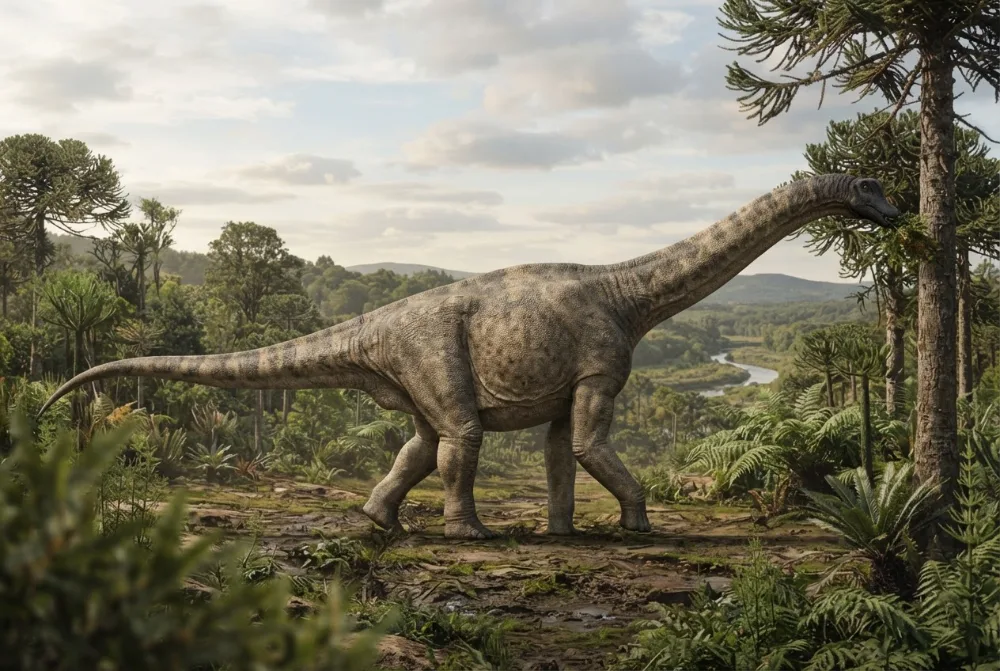
Garumbatitan was a huge, long-necked plant-eating dinosaur that lived in what is now Spain. It belonged to a group of sauropods called somphospondylans, which had strong, sturdy legs and a long tail. This dinosaur helps scientists understand how different sauropods spread across Europe and other continents long ago.1
E phetse neng?
E ne e le kgolo hakae?
E ne e le telele hakae?
E ne e phahame hakae?
 telele jwaloka dikoloi tse 22 tse pakilweng ka mola🍌telele jwaloka dibanana tse 560 di behilwe ka mola🦒phahame jwaloka dithuhlo tse 18 di emeng e nngwe hodima e nngwe🏢e phahame hoo e ka nyarelang ka fensetere mokatong wa 34🏃e ne e ka matha dimitara tse 100 ka metsotswana e 24 (motho ya lebelo ka ho fetisisa o hloka 9,6)
Garumbatitan e ne e le kgolo hakae ha e bapiswa le WENA?
Ke dipalo feela ho browser ya hao. Ha ho letho le bolokwang kapa le romelwang kae kapa kae.
E ne e le lebelo hakae?


Dintlha tse monate
Garumbatitan is known from a partial skeleton, including bones from its leg, ankle, and foot.1
It had a unique foot with no calcaneum (heel bone) and a reduced claw on the third toe.1
Scientists identified 19 unique features in Garumbatitan that are not seen in other sauropods.1
It lived during the Barremian age, about 125 to 121 million years ago, in the Early Cretaceous period.2
Garumbatitan was an early member of the somphospondylan group, more primitive than Tastavinsaurus but more advanced than Dongbeititan.1
Its fossils were found in the Arcillas de Morella Formation, which was once a river or floodplain environment.2
Dipotso tse botswang haholo ka Garumbatitan
?How big was Garumbatitan?
It was a very large sauropod. One individual had vertebrae over 1 meter wide and a femur nearly 2 meters long, suggesting a total length of about 20 to 25 metres.3
?What did Garumbatitan eat?
It was a plant-eater. Like other sauropods, it had a long neck and ate leaves and other plants.3
?When did Garumbatitan live?
It lived about 122 million years ago, during the Early Cretaceous period.3
Bakeng sa ditsebi tsa didinosaure
- Lebitso la saense
- Garumbatitan
- E rehilwe ke
- Mocho et al. 20244
- Sehlopha
- Melala e melelele
- Lelapa / leloko
- Somphospondyli4
- Tlhophiso
- Sauropodomorpha > Sauropoda > Macronaria4
- Dilemo tsa mafika
- dilemo tse dimilione tse 126 ho isa ho 121 (Barremian)4
- Dibopeho tsa mafika
- Arcillas de Morella4
- Dinaha
- Sepania4
- Direkoto tsa difosili
- 1 ho The Paleobiology Database4
- Ho sibollwa
- Garumbatitan was named in 2024 by Pedro Mocho and colleagues. The fossils were found at the Sant Antoni de la Vespa site near Morella, Spain.4
- E sa ntse e phehwa kgang
- Scientists are still debating exactly how Garumbatitan is related to other sauropods, because it has a mix of features from both European and African dinosaur groups.1
Moo dintlha di tswang teng
- New sauropod dinosaur from the Lower Cretaceous of Morella (Spain) provides new insights on the evolutionary history of Iberian somphospondylan titanosauriforms. | Earth and Atmospheric Sciences | Zoological Journal of the Linnean Society | EBSCOhost (ebsco.com)
- PBDB Taxon (paleobiodb.org)
- Garumbatitan, a new giant dinosaur from the Early Cretaceous of Morella (icp.cat)
- Garumbatitan in The Paleobiology Database (CC BY 4.0): dilemo, dibaka, dibopeho tsa mafika, tlhophiso.
Ntlha e nngwe le e nngwe leqepheng lena e na le nomoro e supang mohlodi wa yona. Haeba re fositse ho hong, re kopa tshwarelo, re balatedi ba didinosaure, ha re koranta ya saense. Re bolelle ho [email protected] mme re tla e lokisa.
 Rex o lapile! Dino Wiki ke projeke ya ntate bakeng sa mora wa hae ya ratang didinosaure, ke mahala, ha ho dipapatso, ha ho disebedi. Batho ba baholo ba ka fepa Rex seneke ho thusa hore e dule e le inthaneteng.Fepa Rex
 Brachiosaurus
 Diplodocus
 Brontosaurus
 Argentinosaurus
 Camarasaurus
 Morosaurus
 Stegosaurus
 Iguanodon
 Archaeopteryx
 Giganotosaurus
 Microraptor
 Deinonychus