 Kwisi: O dinosaure efe?
 Ntwa ya didinosaure
 Peiso ya didinosaure
 Dipapadi tse nyane tsa didinosaure
 Albamo ya ditikara
 Manane a TOP a didinosaure
 Nkgethele!
E phetse neng?

E ne e le kgolo hakae?
E ne e le telele hakae?
 telele jwaloka dikatse tsa lapeng tse 5 ho tloha nkong ho isa mohatleng🍌telele jwaloka dibanana tse 14 di behilwe ka mola🏃e ne e ka matha dimitara tse 100 ka metsotswana e 8.8 (motho ya lebelo ka ho fetisisa o hloka 9,6)
Haolong e ne e le kgolo hakae ha e bapiswa le WENA?
Ke dipalo feela ho browser ya hao. Ha ho letho le bolokwang kapa le romelwang kae kapa kae.
E ne e le lebelo hakae?


Dintlha tse monate
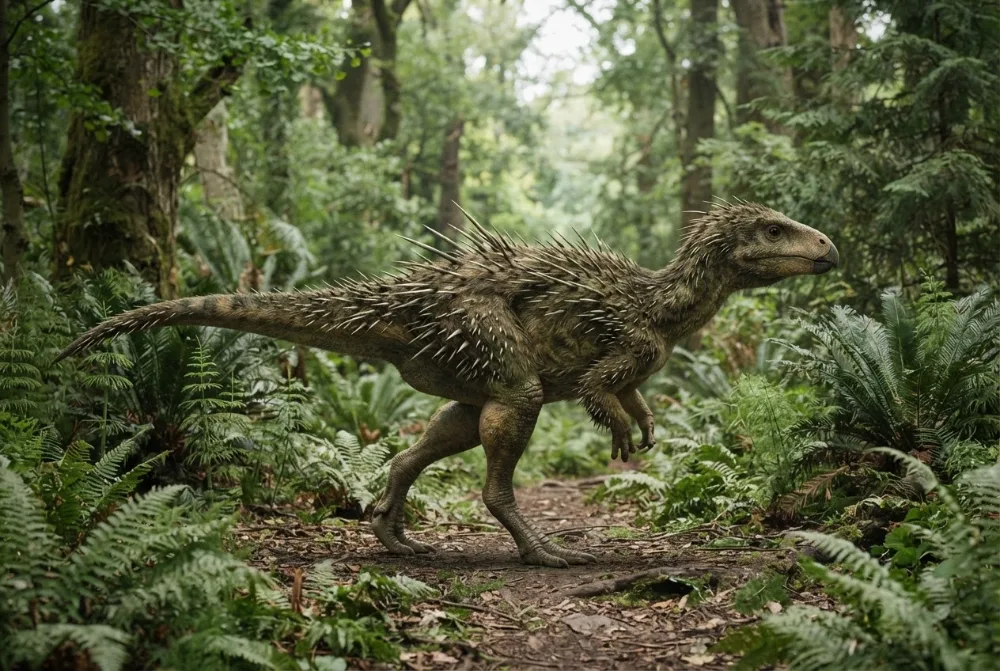
Haolong's skin had large overlapping scales on its tail and smaller bumpy scales around its neck and chest.2
The spikes on Haolong were hollow and made of keratin, the same stuff as your fingernails.2
Scientists could see the preserved nuclei of skin cells in Haolong's spikes under a microscope.2
Haolong's spikes were different from the feathers of meat-eating dinosaurs and the spines of modern lizards.12
Dipotso tse botswang haholo ka Haolong
?How big was Haolong?
About 2.45 metres (8 feet) long. That is about the size of a small motorcycle.1
?Did Haolong have feathers?
No. Its skin had scales and hollow spikes made of keratin, not feathers.12
?What did Haolong eat?
It was a plant-eater, so it ate leaves and other plants.3
?When did Haolong live?
About 125 million years ago, during the Early Cretaceous period.1
?Where was Haolong found?
In Liaoning Province, northeastern China, in the Yixian Formation.1
Bakeng sa ditsebi tsa didinosaure
- Lebitso la saense
- Haolong
- E rehilwe ke
- Huang et al. 20264
- Sehlopha
- Dija-dimela tse nang le melomo
- Lelapa / leloko
- Hadrosauroidea4
- Tlhophiso
- Ornithischia > Ornithopoda > Iguanodontia4
- Dilemo tsa mafika
- dilemo tse dimilione tse 126 ho isa ho 121 (Barremian)4
- Dibopeho tsa mafika
- Yixian4
- Dinaha
- Tjhaena4
- Direkoto tsa difosili
- 1 ho The Paleobiology Database4
- Ho sibollwa
- Haolong was named in 2026 by a team of scientists led by J. Huang. The name honors the famous Chinese paleontologist Dong Zhiming.14
- E sa ntse e phehwa kgang
- Scientists are not sure if adult Haolong also had spikes, because the only known fossil is a juvenile.1
Moo dintlha di tswang teng
- Haolong (en.wikipedia.org)
- Cellular-level preservation of cutaneous spikes in an Early Cretaceous iguanodontian dinosaur | Nature Ecology & Evolution (nature.com)
- A dinosaur with spikes exhibiting unprecedented properties discovered in China | CNRS (cnrs.fr)
- Haolong in The Paleobiology Database (CC BY 4.0): dilemo, dibaka, dibopeho tsa mafika, tlhophiso.
Ntlha e nngwe le e nngwe leqepheng lena e na le nomoro e supang mohlodi wa yona. Haeba re fositse ho hong, re kopa tshwarelo, re balatedi ba didinosaure, ha re koranta ya saense. Re bolelle ho [email protected] mme re tla e lokisa.
 Rex o lapile! Dino Wiki ke projeke ya ntate bakeng sa mora wa hae ya ratang didinosaure, ke mahala, ha ho dipapatso, ha ho disebedi. Batho ba baholo ba ka fepa Rex seneke ho thusa hore e dule e le inthaneteng.Fepa Rex
 Iguanodon
 Tenontosaurus
 Thescelosaurus
 Zalmoxes
 Camptosaurus
 Rhabdodon
 Stegosaurus
 Archaeopteryx
 Giganotosaurus
 Microraptor
 Deinonychus
 Baryonyx