 Kwisi: O dinosaure efe?
 Ntwa ya didinosaure
 Peiso ya didinosaure
 Dipapadi tse nyane tsa didinosaure
 Albamo ya ditikara
 Manane a TOP a didinosaure
 Nkgethele!
Hypsilophodon
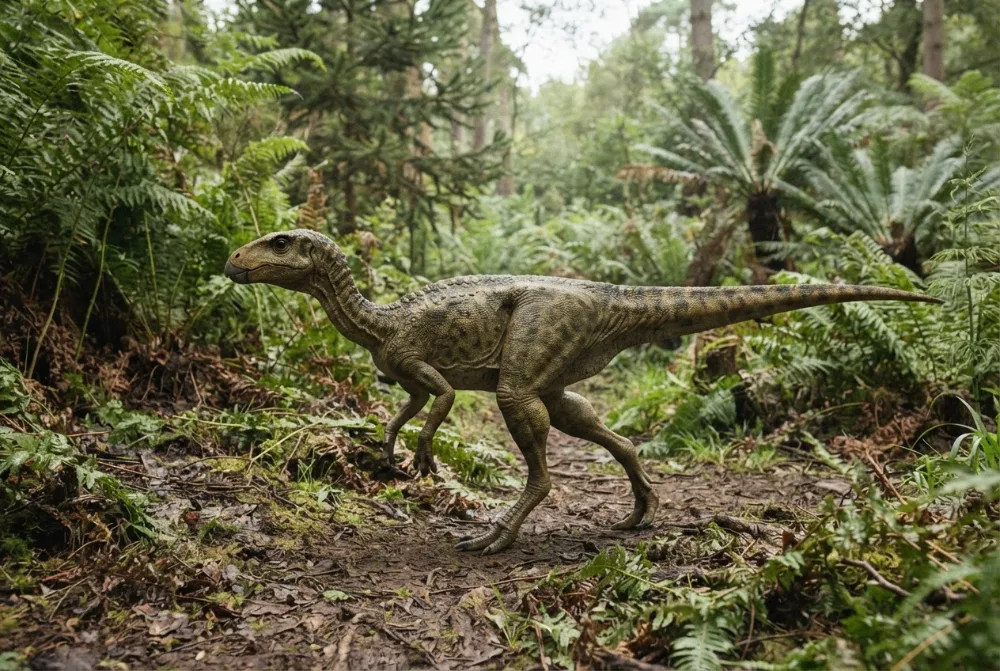
Hypsilophodon was a tiny, speedy plant-eater that sprinted through the forests of Early Cretaceous England. It had a sharp beak like a parrot and a long stiff tail to help it balance while running.12
E phetse neng?
E ne e le kgolo hakae?
E ne e le telele hakae?
E ne e phahame hakae?
E ne e le boima hakae?
 telele jwaloka dikatse tsa lapeng tse 4 ho tloha nkong ho isa mohatleng🍌telele jwaloka dibanana tse 11 di behilwe ka mola🍉boima jwaloka mahapu a 4🏃e ne e ka matha dimitara tse 100 ka metsotswana e 9.2 (motho ya lebelo ka ho fetisisa o hloka 9,6)
Hypsilophodon e ne e le kgolo hakae ha e bapiswa le WENA?
Ke dipalo feela ho browser ya hao. Ha ho letho le bolokwang kapa le romelwang kae kapa kae.
E ne e le lebelo hakae?


Dintlha tse monate
Hypsilophodon had five fingers on each hand, and one of them was opposable, like a thumb, so it could grasp branches and food.1
Its tail was stiffened by bony tendons, which helped it keep balance while running fast on two legs.1
Its teeth were self-sharpening: the upper and lower teeth rubbed together as it chewed, keeping them sharp.1
Hypsilophodon probably had cheeks, which helped it hold and chew food, just like modern plant-eaters.12
All the true Hypsilophodon fossils come from a single layer of rock called the Hypsilophodon Bed, on the Isle of Wight.1
Dipotso tse botswang haholo ka Hypsilophodon
?How big was Hypsilophodon?
It was about 1.5 to 2 metres (5 to 6.5 feet) long and weighed around 20 kilograms (44 pounds).12
?What did Hypsilophodon eat?
It was a herbivore, eating low-growing plants like young shoots and roots. It used its sharp beak to clip vegetation and probably had cheeks to help chew.21
?Could Hypsilophodon climb trees?
No, scientists used to think it climbed trees, but we now know it lived on the ground and was a fast runner.21
?How fast could Hypsilophodon run?
It was built for running with long legs, a stiff tail for balance, and a light body, but no exact speed is known.21
?Did Hypsilophodon have feathers?
No, there is no evidence that Hypsilophodon had feathers. It was a small ornithischian dinosaur with scaly skin.1
?Where did Hypsilophodon live?
It lived in what is now England, specifically on the Isle of Wight, during the Early Cretaceous period about 126 million years ago.21
?Was Hypsilophodon bigger than a chicken?
Yes, it was about the size of a large turkey or a small deer, much bigger than a chicken.2
?Did Hypsilophodon live in groups?
Yes, several fossils were found together, so some experts think it lived in groups, like deer.2
Mosenyi wa ditshomo
Tshomo: Some people thought Hypsilophodon lived in trees, like a climbing dinosaur.
Nnete: Scientists now know it lived on the ground and was built for running, not climbing.2
Bakeng sa ditsebi tsa didinosaure
- Lebitso la saense
- Hypsilophodon
- E rehilwe ke
- Huxley 18704
- Sehlopha
- Dija-dimela tse nang le melomo
- Lelapa / leloko
- Hypsilophodontidae4
- Tlhophiso
- Ornithischia > Ornithopoda4
- Dilemo tsa mafika
- dilemo tse dimilione tse 155 ho isa ho 120 (Kimmeridgian / Aptian)4
- Dibopeho tsa mafika
- Wessex, Vectis, Artoles4
- Dinaha
- United Kingdom, Sepania, Romania, Japane, Portugal4
- Direkoto tsa difosili
- 10 ho The Paleobiology Database4
- Ho sibollwa
- The first fossils were found in 1849 on the Isle of Wight, but they were thought to be from a young Iguanodon. In 1869, Thomas Henry Huxley realized it was a new dinosaur and named it Hypsilophodon foxii.1
- E sa ntse e phehwa kgang
- Scientists are not sure exactly how Hypsilophodon is related to other plant-eating dinosaurs. Some think it belongs in Ornithopoda, but recent studies question that.1
Moo dintlha di tswang teng
- Hypsilophodon (en.wikipedia.org)
- Hypsilophodon | Natural History Museum (nhm.ac.uk)
- enchantedlearning.com (enchantedlearning.com)
- Hypsilophodon in The Paleobiology Database (CC BY 4.0): dilemo, dibaka, dibopeho tsa mafika, tlhophiso.
Ntlha e nngwe le e nngwe leqepheng lena e na le nomoro e supang mohlodi wa yona. Haeba re fositse ho hong, re kopa tshwarelo, re balatedi ba didinosaure, ha re koranta ya saense. Re bolelle ho [email protected] mme re tla e lokisa.
 Rex o lapile! Dino Wiki ke projeke ya ntate bakeng sa mora wa hae ya ratang didinosaure, ke mahala, ha ho dipapatso, ha ho disebedi. Batho ba baholo ba ka fepa Rex seneke ho thusa hore e dule e le inthaneteng.Fepa Rex
 Iguanodon
 Tenontosaurus
 Thescelosaurus
 Zalmoxes
 Camptosaurus
 Rhabdodon
 Stegosaurus
 Archaeopteryx
 Giganotosaurus
 Microraptor
 Deinonychus
 Baryonyx