 Kwisi: O dinosaure efe?
 Ntwa ya didinosaure
 Peiso ya didinosaure
 Dipapadi tse nyane tsa didinosaure
 Albamo ya ditikara
 Manane a TOP a didinosaure
 Nkgethele!
Iyuku
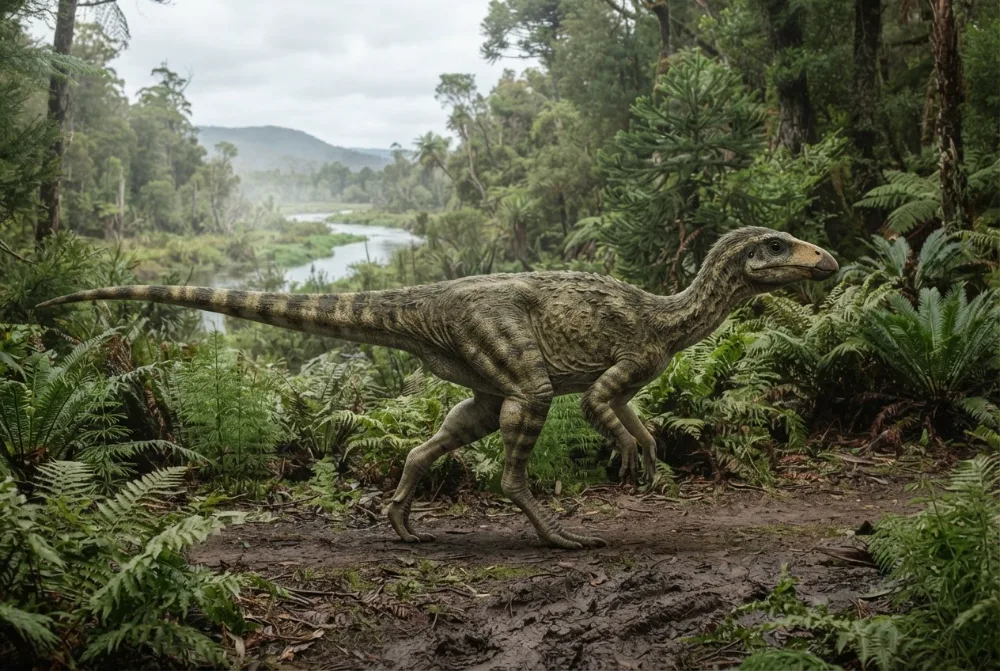
Iyuku was a small, plant-eating dinosaur that lived in what is now South Africa. What makes it really special is that almost all the fossils found are from babies and very young dinosaurs! Scientists think a whole group of Iyuku hatchlings died together during a dry season.21
E phetse neng?
E ne e le lebelo hakae?


Dintlha tse monate
All the juvenile Iyuku bones were found in a single, small bonebed, suggesting a group of hatchlings died together.21
The name Iyuku comes from the Xhosa language and means 'hatchling', because almost all the fossils are from very young animals.1
Iyuku lived during the Early Cretaceous period, about 137 to 132 million years ago.4
The bonebed where Iyuku was found also contained rare theropod teeth, crocodile teeth, turtle shell fragments, and fish bones.1
Dipotso tse botswang haholo ka Iyuku
?How big was Iyuku?
Iyuku was a small dinosaur. A subadult's shin bone was about 35 to 42 centimetres long, so the whole animal was probably the size of a large dog.3
?What did Iyuku eat?
Iyuku was a plant-eating dinosaur. It ate plants like ferns and leaves.3
?Why is Iyuku called a hatchling?
Its name comes from the Xhosa word for 'hatchling' because almost all the fossils found are from babies and very young dinosaurs.3
?When did Iyuku live?
Iyuku lived during the Early Cretaceous period, about 137 to 132 million years ago.3
Bakeng sa ditsebi tsa didinosaure
- Lebitso la saense
- Iyuku
- E rehilwe ke
- Forster et al. 20224
- Sehlopha
- Dija-dimela tse nang le melomo
- Lelapa / leloko
- Euiguanodontia4
- Tlhophiso
- Ornithischia > Ornithopoda > Iguanodontia4
- Dilemo tsa mafika
- dilemo tse dimilione tse 137 ho isa ho 133 (Valanginian)4
- Dibopeho tsa mafika
- Kirkwood4
- Dinaha
- Afrika Borwa4
- Direkoto tsa difosili
- 1 ho The Paleobiology Database4
- Ho sibollwa
- Iyuku was named in 2022 by Catherine Forster and her team based on fossils collected from 1995 to 1999 in the Kirkwood Formation, South Africa. The species name honors Dr. Michael Raath for his work on southern African fossils.1
- E sa ntse e phehwa kgang
- Scientists are not sure exactly how big Iyuku grew, because almost all the fossils are from babies and juveniles, not adults.1
Moo dintlha di tswang teng
- Iyuku raathi , a new iguanodontian dinosaur from the Early Cretaceous Kirkwood Formation, South Africa (anatomypubs.onlinelibrary.wiley.com)
- Iyuku raathi, a new iguanodontian dinosaur from the Early Cretaceous Kirkwood Formation, South Africa (pubmed.ncbi.nlm.nih.gov)
- Iyuku (en.wikipedia.org)
- Iyuku in The Paleobiology Database (CC BY 4.0): dilemo, dibaka, dibopeho tsa mafika, tlhophiso.
Ntlha e nngwe le e nngwe leqepheng lena e na le nomoro e supang mohlodi wa yona. Haeba re fositse ho hong, re kopa tshwarelo, re balatedi ba didinosaure, ha re koranta ya saense. Re bolelle ho [email protected] mme re tla e lokisa.
 Rex o lapile! Dino Wiki ke projeke ya ntate bakeng sa mora wa hae ya ratang didinosaure, ke mahala, ha ho dipapatso, ha ho disebedi. Batho ba baholo ba ka fepa Rex seneke ho thusa hore e dule e le inthaneteng.Fepa Rex
 Iguanodon
 Tenontosaurus
 Thescelosaurus
 Zalmoxes
 Camptosaurus
 Rhabdodon
 Stegosaurus
 Archaeopteryx
 Giganotosaurus
 Microraptor
 Deinonychus
 Baryonyx