 Kwisi: O dinosaure efe?
 Ntwa ya didinosaure
 Peiso ya didinosaure
 Dipapadi tse nyane tsa didinosaure
 Albamo ya ditikara
 Manane a TOP a didinosaure
 Nkgethele!
Luskhan
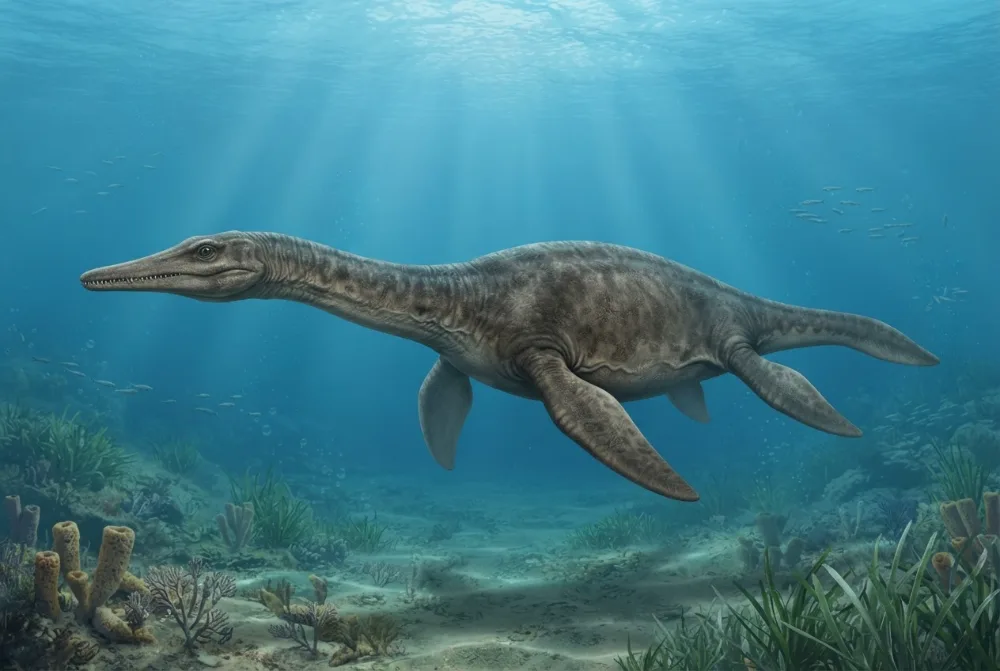
Luskhan was a plesiosaur, a marine reptile that lived in the ancient seas of what is now Russia. It had a long, slender snout and small teeth, perfect for catching soft, squishy prey like squid. Unlike many other pliosaurs, Luskhan was not a giant apex predator but a specialized hunter of small animals.12
E phetse neng?
E ne e le kgolo hakae?
E ne e le telele hakae?
 telele jwaloka dintja tse 6 ho tloha nkong ho isa mohatleng🍌telele jwaloka dibanana tse 36 di behilwe ka mola🏊e ne e ka sesa bolelele ba letamo le leholo la ho sesa (50 m) ka metsotswana e 6.9
Luskhan e ne e le kgolo hakae ha e bapiswa le WENA?
Ke dipalo feela ho browser ya hao. Ha ho letho le bolokwang kapa le romelwang kae kapa kae.
E ne e le lebelo hakae?


Dintlha tse monate
Luskhan is known from a nearly complete, three-dimensionally preserved skeleton, which is rare for pliosaurids.12
Its name comes from Mongolian and Turkic mythology: 'luus' means water spirit and 'khan' means chief.1
Luskhan lived about 128 million years ago, during the Hauterivian stage of the Early Cretaceous.1
Unlike most other pliosaurs, Luskhan had a long, slender snout and small teeth, similar to the distantly related polycotylid plesiosaurs.12
Luskhan evolved its fish-eating features independently from polycotylids, more than 10 million years later.1
The only known specimen was discovered in 2002 by Russian paleontologist Gleb N. Uspensky on the banks of the Volga River.1
Dipotso tse botswang haholo ka Luskhan
?How big was Luskhan?
Luskhan was about 6.5 metres (21 feet) long, which is roughly the length of a large boat.1
?What did Luskhan eat?
Luskhan ate small, soft prey like squid. Its slender snout and small teeth were perfect for catching soft animals, not large prey.13
?Was Luskhan a dinosaur?
No, Luskhan was a plesiosaur, a marine reptile that lived in the sea. It was not a dinosaur.1
Bakeng sa ditsebi tsa didinosaure
- Lebitso la saense
- Luskhan
- E rehilwe ke
- Fischer et al. 20174
- Sehlopha
- Diplesiosaure
- Lelapa / leloko
- Pliosauridae4
- Tlhophiso
- Plesiosauria > Pliosauridae > Sauropterygia4
- Dilemo tsa mafika
- dilemo tse dimilione tse 133 ho isa ho 126 (Hauterivian)4
- Dinaha
- Russia4
- Direkoto tsa difosili
- 1 ho The Paleobiology Database4
- Ho sibollwa
- Luskhan was named in 2017 by a team led by Valentin Fischer, based on a skeleton found in 2002 by Gleb N. Uspensky in western Russia.14
- E sa ntse e phehwa kgang
- Scientists are not sure exactly how large Luskhan grew, because no complete length estimate has been published.1
Moo dintlha di tswang teng
- Luskhan (en.wikipedia.org)
- Anatomy and relationships of the bizarre Early Cretaceous pliosaurid Luskhan itilensis | Zoological Journal of the Linnean Society | Oxford Academic (academic.oup.com)
- Plasticity and Convergence in the Evolution of Short-Necked Plesiosaurs: Current Biology (cell.com)
- Luskhan in The Paleobiology Database (CC BY 4.0): dilemo, dibaka, dibopeho tsa mafika, tlhophiso.
Ntlha e nngwe le e nngwe leqepheng lena e na le nomoro e supang mohlodi wa yona. Haeba re fositse ho hong, re kopa tshwarelo, re balatedi ba didinosaure, ha re koranta ya saense. Re bolelle ho [email protected] mme re tla e lokisa.
 Rex o lapile! Dino Wiki ke projeke ya ntate bakeng sa mora wa hae ya ratang didinosaure, ke mahala, ha ho dipapatso, ha ho disebedi. Batho ba baholo ba ka fepa Rex seneke ho thusa hore e dule e le inthaneteng.Fepa Rex
 Elasmosaurus
 Pliosaurus
 Plesiosaurus
 Cimoliasaurus
 Colymbosaurus
 Trinacromerum
 Stegosaurus
 Iguanodon
 Archaeopteryx
 Giganotosaurus
 Microraptor
 Deinonychus