 Kwisi: O dinosaure efe?
 Ntwa ya didinosaure
 Peiso ya didinosaure
 Dipapadi tse nyane tsa didinosaure
 Albamo ya ditikara
 Manane a TOP a didinosaure
 Nkgethele!
E phetse neng?

E ne e le kgolo hakae?
E ne e le telele hakae?
E ne e phahame hakae?
kakanyo
E ne e le boima hakae?

 telele jwaloka dikoloi tse 5 tse pakilweng ka mola🍌telele jwaloka dibanana tse 120 di behilwe ka mola🍉boima jwaloka mahapu a 6000🎒boima jwaloka ditlelase tse feletseng tse 38 tsa bana ba sekolo🐻❄️boima jwaloka dibere tse tshweu tse 67🏢e phahame hoo e ka nyarelang ka fensetere mokatong wa 2🏃e ne e ka matha dimitara tse 100 ka metsotswana e 33 (motho ya lebelo ka ho fetisisa o hloka 9,6)
Lusotitan e ne e le kgolo hakae ha e bapiswa le WENA?
Ke dipalo feela ho browser ya hao. Ha ho letho le bolokwang kapa le romelwang kae kapa kae.
E ne e le lebelo hakae?


Dintlha tse monate
Lusotitan was once thought to be a species of Brachiosaurus, but in 2003 scientists gave it its own name.1
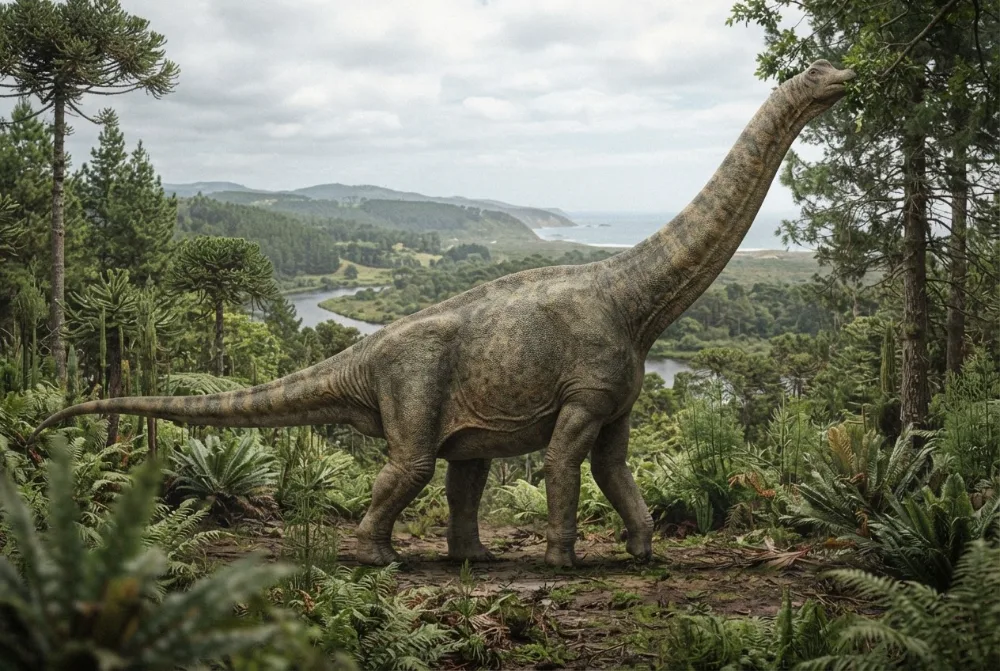
It belongs to a group called brachiosaurids, which had very long front legs and a body that slanted upward, like a giraffe.1
Lusotitan lived during the Late Jurassic period, about 150 to 143 million years ago.1
Only a few bones of Lusotitan have been found, including vertebrae and parts of the legs and hips.2
Scientists can tell Lusotitan apart from other dinosaurs by special features in its tail bones, like long projections that stick out far behind the bone.2
Like all sauropods, Lusotitan had air sacs inside its body that helped it breathe and kept it from being too heavy.1
Dipotso tse botswang haholo ka Lusotitan
?How big was Lusotitan?
Lusotitan was about 21 metres (69 feet) long and weighed around 25 to 30 tonnes (28 to 33 short tons). That is only an estimate because the full skeleton has never been found.31
?What did Lusotitan eat?
Lusotitan was a herbivore, meaning it ate plants. It used its long front legs and tall body to reach leaves high up in trees.1
?When did Lusotitan live?
Lusotitan lived during the Late Jurassic period, about 150 to 143 million years ago.1
?Where was Lusotitan found?
Lusotitan was found in Portugal, in the Lourinhã Formation. It is the largest dinosaur discovered in that area.3
?Was Lusotitan bigger than Brachiosaurus?
Nobody knows for sure. Lusotitan might not have been quite as large as Brachiosaurus, which was about 25 metres long, but its remains are too scarce to compare exactly.1
?Did Lusotitan have air sacs?
Yes, like all sauropods, Lusotitan had internal air sacs that helped it breathe and kept it from being too heavy. It is unknown if it had external air sacs on its head, as its skull has never been found.1
Mosenyi wa ditshomo
Tshomo: Lusotitan was exactly the same size as Brachiosaurus.
Nnete: Lusotitan might have been slightly smaller than Brachiosaurus, but because its skeleton is incomplete, scientists cannot be sure.1
Bakeng sa ditsebi tsa didinosaure
- Lebitso la saense
- Lusotitan
- E rehilwe ke
- Antunes and Mateus 20034
- Sehlopha
- Melala e melelele
- Lelapa / leloko
- Brachiosauridae4
- Tlhophiso
- Sauropodomorpha > Sauropoda > Macronaria4
- Dilemo tsa mafika
- dilemo tse dimilione tse 152 ho isa ho 145 (Kimmeridgian / Tithonian)4
- Dibopeho tsa mafika
- Lourinhã4
- Dinaha
- Portugal4
- Direkoto tsa difosili
- 1 ho The Paleobiology Database4
- Ho sibollwa
- Lusotitan was named in 2003 by paleontologists Miguel Telles Antunes and Octávio Mateus. The fossils were found in the Lourinhã Formation in Portugal.41
- E sa ntse e phehwa kgang
- Scientists are not sure exactly how tall Lusotitan was, because much of its neck is missing from the fossil record.1
Moo dintlha di tswang teng
- Lusotitan | Natural History Museum (nhm.ac.uk)
- Osteology of the Late Jurassic Portuguese sauropod dinosaur Lusotitan atalaiensis (Macronaria) and the evolutionary history of basal titanosauriforms | Zoological Journal of the Linnean Society | Oxford Academic (academic.oup.com)
- Lusotitan (Wikipedia) (Wikipedia)
- Lusotitan in The Paleobiology Database (CC BY 4.0): dilemo, dibaka, dibopeho tsa mafika, tlhophiso.
Ntlha e nngwe le e nngwe leqepheng lena e na le nomoro e supang mohlodi wa yona. Haeba re fositse ho hong, re kopa tshwarelo, re balatedi ba didinosaure, ha re koranta ya saense. Re bolelle ho [email protected] mme re tla e lokisa.
 Rex o lapile! Dino Wiki ke projeke ya ntate bakeng sa mora wa hae ya ratang didinosaure, ke mahala, ha ho dipapatso, ha ho disebedi. Batho ba baholo ba ka fepa Rex seneke ho thusa hore e dule e le inthaneteng.Fepa Rex
 Brachiosaurus
 Diplodocus
 Brontosaurus
 Argentinosaurus
 Camarasaurus
 Morosaurus
 Allosaurus
 Compsognathus
 Camptosaurus
 Nanosaurus
 Rhamphorhynchus
 Ceratosaurus