 Kwisi: O dinosaure efe?
 Ntwa ya didinosaure
 Peiso ya didinosaure
 Dipapadi tse nyane tsa didinosaure
 Albamo ya ditikara
 Manane a TOP a didinosaure
 Nkgethele!
Mantellisaurus
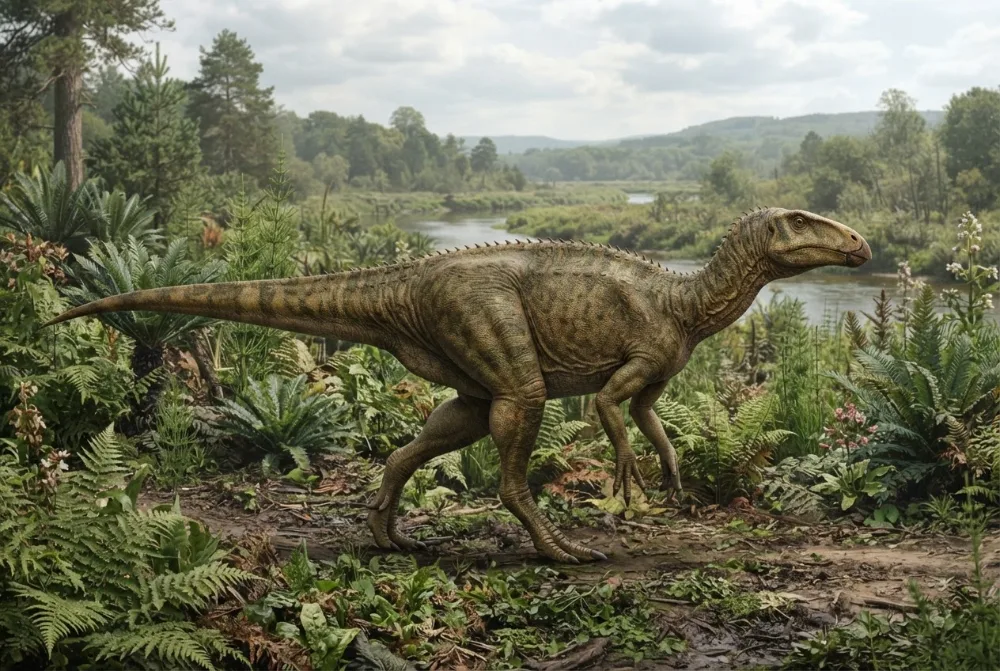
Mantellisaurus was a medium-sized, plant-eating dinosaur that lived in Europe during the Early Cretaceous. It had a light build and could walk on two legs or all fours. Its name honors Gideon Mantell, who discovered the first Iguanodon fossils.1
E phetse neng?
E ne e le kgolo hakae?
E ne e le telele hakae?
E ne e phahame hakae?
kakanyo
E ne e le boima hakae?
 telele jwaloka dintja tse 7 ho tloha nkong ho isa mohatleng🍌telele jwaloka dibanana tse 39 di behilwe ka mola🍉boima jwaloka mahapu a 150🧸boima jwaloka bana ba kereshe ba 39🎒boima jwaloka bana ba sekolo ba 23🏃e ne e ka matha dimitara tse 100 ka metsotswana e 10 (motho ya lebelo ka ho fetisisa o hloka 9,6)
Mantellisaurus e ne e le kgolo hakae ha e bapiswa le WENA?
Ke dipalo feela ho browser ya hao. Ha ho letho le bolokwang kapa le romelwang kae kapa kae.
E ne e le lebelo hakae?


Dintlha tse monate
Mantellisaurus was once thought to be a species of Iguanodon, but scientists gave it its own genus in 2007.1
Its forelimbs were only about half the length of its hindlimbs, so it probably walked on two legs most of the time.1
A nearly complete skeleton was found in a quarry in Nehden, Germany, in 1971, along with bones of Iguanodon and crocodiles.1
The first fossil of Mantellisaurus was discovered on the Isle of Wight, England, in 1914 and named Iguanodon atherfieldensis.1
Some scientists think the Belgian specimen IRSNB 1551 belongs to a separate genus called Dollodon, but others disagree.1
Mantellisaurus weighed about 750 kilograms (1,650 pounds), as heavy as a small car.1
Dipotso tse botswang haholo ka Mantellisaurus
?How big was Mantellisaurus?
Mantellisaurus was about 7 metres (23 feet) long and weighed around 750 kilograms (1,650 pounds), as heavy as a small car.1
?What did Mantellisaurus eat?
Mantellisaurus was a plant-eating dinosaur. It ate plants like ferns and cycads.1
?Did Mantellisaurus walk on two legs or four?
It mostly walked on two legs because its forelimbs were only half the length of its hindlimbs. It could go on all fours when standing still or moving slowly.1
?Where did Mantellisaurus live?
It lived in Europe during the Early Cretaceous. Fossils have been found in Belgium, England, Spain and Germany.1
?Is Mantellisaurus a dinosaur?
Yes, it is a dinosaur. It is an iguanodontian dinosaur, a type of plant-eating ornithischian.1
?When did Mantellisaurus live?
It lived during the Barremian and early Aptian ages of the Early Cretaceous Period, about 125 to 120 million years ago.1
Mosenyi wa ditshomo
Tshomo: Mantellisaurus was a slow, clumsy quadruped like a giant iguana.
Nnete: Mantellisaurus was lightly built and probably walked mostly on two legs, only going on all fours when standing still or moving slowly.1
Bakeng sa ditsebi tsa didinosaure
- Lebitso la saense
- Mantellisaurus
- E rehilwe ke
- Paul 20073
- Sehlopha
- Dija-dimela tse nang le melomo
- Lelapa / leloko
- Iguanodontia3
- Tlhophiso
- Ornithischia > Ornithopoda > Iguanodontia3
- Dilemo tsa mafika
- dilemo tse dimilione tse 143 ho isa ho 120 (Berriasian / Aptian)3
- Dibopeho tsa mafika
- Wessex, Arcillas de Morella, Vectis3
- Dinaha
- United Kingdom, Sepania, Jeremane, Fora, Belgium, Portugal3
- Direkoto tsa difosili
- 17 ho The Paleobiology Database3
- E boetse e tsejwa e le
- Dollodon, Mantellodon (mabitso a kgale jwale a balwa e le phoofolo e le nngwe)3
- Ho sibollwa
- The first fossil was found by Reginald Walter Hooley in 1914 on the Isle of Wight, England. He named it Iguanodon atherfieldensis in 1925. In 2007, Gregory Paul gave it its own genus, Mantellisaurus, honoring Gideon Mantell.1
- E sa ntse e phehwa kgang
- Scientists still debate whether the Belgian specimen IRSNB 1551 belongs to Mantellisaurus or to a separate genus called Dollodon.1
Moo dintlha di tswang teng
- Mantellisaurus (en.wikipedia.org)
- Mantellisaurus, an Isle of Wight Iguanodontid - DinoWight (dinowight.org.uk)
- Mantellisaurus in The Paleobiology Database (CC BY 4.0): dilemo, dibaka, dibopeho tsa mafika, tlhophiso.
Ntlha e nngwe le e nngwe leqepheng lena e na le nomoro e supang mohlodi wa yona. Haeba re fositse ho hong, re kopa tshwarelo, re balatedi ba didinosaure, ha re koranta ya saense. Re bolelle ho [email protected] mme re tla e lokisa.
 Rex o lapile! Dino Wiki ke projeke ya ntate bakeng sa mora wa hae ya ratang didinosaure, ke mahala, ha ho dipapatso, ha ho disebedi. Batho ba baholo ba ka fepa Rex seneke ho thusa hore e dule e le inthaneteng.Fepa Rex
 Iguanodon
 Tenontosaurus
 Thescelosaurus
 Zalmoxes
 Camptosaurus
 Rhabdodon
 Stegosaurus
 Archaeopteryx
 Giganotosaurus
 Microraptor
 Deinonychus
 Baryonyx