 Kwisi: O dinosaure efe?
 Ntwa ya didinosaure
 Peiso ya didinosaure
 Dipapadi tse nyane tsa didinosaure
 Albamo ya ditikara
 Manane a TOP a didinosaure
 Nkgethele!
Muraenosaurus
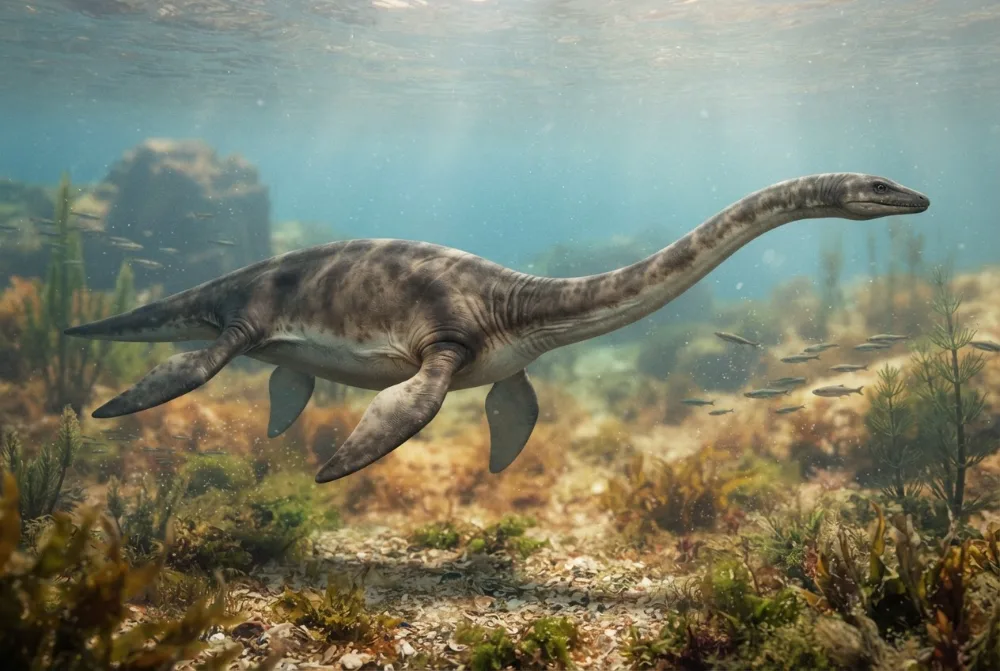
Muraenosaurus was a plesiosaur with a very long neck and a tiny head. It swam in warm, shallow seas during the Jurassic Period. Its name means 'eel lizard' because its neck looked like an eel's body.1
E phetse neng?
E ne e le kgolo hakae?
E ne e le telele hakae?
 telele jwaloka dintja tse 5 ho tloha nkong ho isa mohatleng🍌telele jwaloka dibanana tse 29 di behilwe ka mola🏊e ne e ka sesa bolelele ba letamo le leholo la ho sesa (50 m) ka metsotswana e 6.4
Muraenosaurus e ne e le kgolo hakae ha e bapiswa le WENA?
Ke dipalo feela ho browser ya hao. Ha ho letho le bolokwang kapa le romelwang kae kapa kae.
E ne e le lebelo hakae?


Dintlha tse monate
Muraenosaurus had 44 bones in its neck, which made up most of its 66 backbone bones before the hips.1
Its head was only about 37 centimeters (15 inches) long, very small compared to its 5.2-meter (17-foot) body.1
The first Muraenosaurus fossil was collected by Charles E. Leeds and described by Harry Seeley in 1874.1
Muraenosaurus lived in a warm, shallow sea that was less than 50 meters deep and about 20 °C (68 °F).1
Scientists think Muraenosaurus may have swallowed stones called gastroliths to help grind up food or to stop it from rolling in the water.1
Muraenosaurus was first thought to be an elasmosaur, but now scientists place it in the family Cryptoclididae.1
Dipotso tse botswang haholo ka Muraenosaurus
?How long was Muraenosaurus?
About 5.2 metres (17 feet) long.1
?What did Muraenosaurus eat?
It probably ate fish and cephalopods (like squid). Scientists think it may have swallowed stones to help grind up its food.1
?Could Muraenosaurus swim?
Yes, it was a marine reptile that swam in warm, shallow seas. Its long neck and flippers helped it move through the water.1
Mosenyi wa ditshomo
Tshomo: Some people think Muraenosaurus was a dinosaur.
Nnete: Muraenosaurus was a plesiosaur, a marine reptile that lived in the sea, not a dinosaur.1
Bakeng sa ditsebi tsa didinosaure
- Lebitso la saense
- Muraenosaurus
- E rehilwe ke
- Seeley 18742
- Sehlopha
- Diplesiosaure
- Lelapa / leloko
- Cryptoclididae2
- Tlhophiso
- Plesiosauria > Sauropterygia2
- Dilemo tsa mafika
- dilemo tse dimilione tse 165 ho isa ho 155 (Callovian / Oxfordian)2
- Dibopeho tsa mafika
- Oxford Clay, Lajas, Argiles de Montaubert2
- Dinaha
- United Kingdom, Argentina, Fora2
- Direkoto tsa difosili
- 11 ho The Paleobiology Database2
- E boetse e tsejwa e le
- Tremamesacleis (mabitso a kgale jwale a balwa e le phoofolo e le nngwe)2
- Ho sibollwa
- The first Muraenosaurus fossil was found by Charles E. Leeds in the Oxford Clay of England. Harry Seeley named it Muraenosaurus leedsii in 1874.1
- E sa ntse e phehwa kgang
- Scientists are not sure exactly how Muraenosaurus used its long neck to catch food. It may have attacked fish from below or grazed on the seafloor.1
Moo dintlha di tswang teng
- Muraenosaurus (en.wikipedia.org)
- Muraenosaurus in The Paleobiology Database (CC BY 4.0): dilemo, dibaka, dibopeho tsa mafika, tlhophiso.
Ntlha e nngwe le e nngwe leqepheng lena e na le nomoro e supang mohlodi wa yona. Haeba re fositse ho hong, re kopa tshwarelo, re balatedi ba didinosaure, ha re koranta ya saense. Re bolelle ho [email protected] mme re tla e lokisa.
 Rex o lapile! Dino Wiki ke projeke ya ntate bakeng sa mora wa hae ya ratang didinosaure, ke mahala, ha ho dipapatso, ha ho disebedi. Batho ba baholo ba ka fepa Rex seneke ho thusa hore e dule e le inthaneteng.Fepa Rex
 Elasmosaurus
 Pliosaurus
 Plesiosaurus
 Cimoliasaurus
 Colymbosaurus
 Trinacromerum
 Brachiosaurus
 Diplodocus
 Allosaurus
 Brontosaurus
 Compsognathus
 Camarasaurus