 Kwisi: O dinosaure efe?
 Ntwa ya didinosaure
 Peiso ya didinosaure
 Dipapadi tse nyane tsa didinosaure
 Albamo ya ditikara
 Manane a TOP a didinosaure
 Nkgethele!
Sauroplites
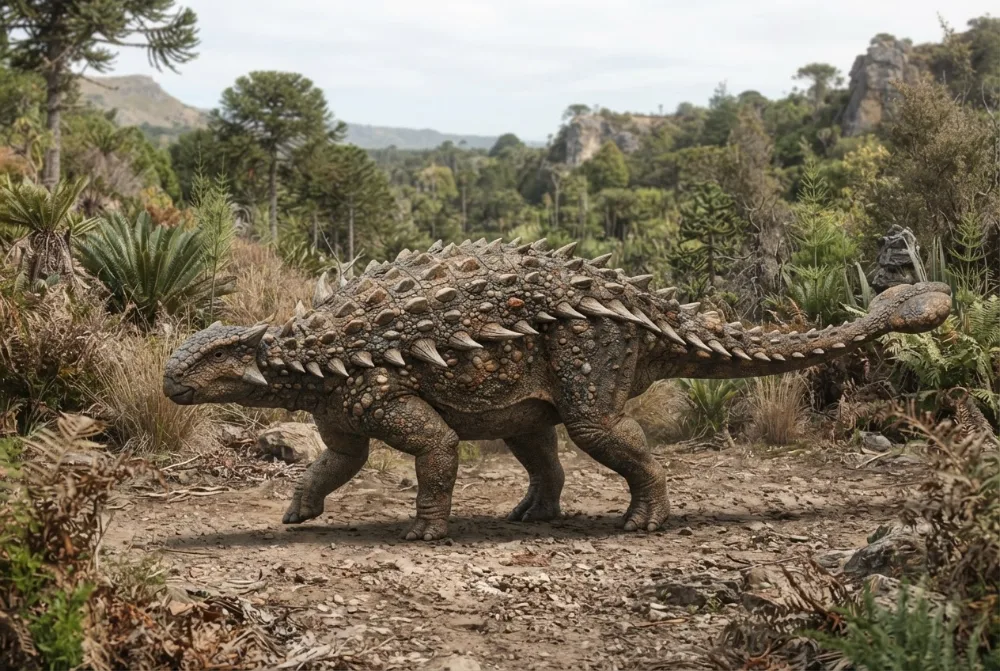
Sauroplites was an armoured dinosaur that walked on four legs and ate plants. Its back and hips were covered with a shield made of bony plates, like a suit of armour. It lived in what is now Inner Mongolia, China, during the Early Cretaceous period.14
E phetse neng?
E ne e le kgolo hakae?
E ne e le telele hakae?
E ne e phahame hakae?
 telele jwaloka dintja tse 6 ho tloha nkong ho isa mohatleng🍌telele jwaloka dibanana tse 31 di behilwe ka mola🏃e ne e ka matha dimitara tse 100 ka metsotswana e 22 (motho ya lebelo ka ho fetisisa o hloka 9,6)
Sauroplites e ne e le kgolo hakae ha e bapiswa le WENA?
Ke dipalo feela ho browser ya hao. Ha ho letho le bolokwang kapa le romelwang kae kapa kae.
E ne e le lebelo hakae?


Dintlha tse monate
Sauroplites had a special shield on its hips made of fused rosettes. Each rosette had one large central bony plate surrounded by a single ring of smaller plates. No other armoured dinosaur had this exact pattern.12
The largest bony plates on its back could be up to 40 centimetres (about 16 inches) long. The plates on its sides were about 30 centimetres (12 inches) across.1
The fossils of Sauroplites were discovered in 1930 by Swedish paleontologist Anders Birger Bohlin during an expedition in Inner Mongolia. The dinosaur was named and described by Bohlin in 1953.1
The original fossil bones of Sauroplites are lost today, but some casts (copies) are kept at the American Museum of Natural History in New York.1
For a long time, scientists thought Sauroplites might be a doubtful name because the fossils were so fragmentary. But in 2014, researcher Victoria Megan Arbour found a unique feature on the hip shield that proved it was a real, valid dinosaur.1
Dipotso tse botswang haholo ka Sauroplites
?How big was Sauroplites?
Nobody knows for sure because the fossils are very fragmentary. The largest bony plates on its back could be up to 40 centimetres (about 16 inches) long, but no complete skeleton has been found to estimate its full size.1
?What did Sauroplites eat?
Sauroplites was an herbivore, meaning it ate plants. It had a plant-eating dinosaur's body and teeth suited for chewing vegetation.1
?Is Sauroplites a dinosaur?
Yes, Sauroplites is a dinosaur. It is an ankylosaurian dinosaur from the Early Cretaceous of China.1
Bakeng sa ditsebi tsa didinosaure
- Lebitso la saense
- Sauroplites
- E rehilwe ke
- Bohlin 19534
- Sehlopha
- Didinosaure tse nang le sesireletsi
- Lelapa / leloko
- Nodosauridae4
- Tlhophiso
- Ornithischia > Ankylosauria > Nodosauridae > Thyreophora4
- Dilemo tsa mafika
- dilemo tse dimilione tse 121 ho isa ho 113 (Aptian)4
- Dinaha
- Tjhaena4
- Direkoto tsa difosili
- 1 ho The Paleobiology Database4
- Ho sibollwa
- Swedish paleontologist Anders Birger Bohlin discovered the fossils of Sauroplites in 1930 near Tebch in Inner Mongolia, during the Swedish-Chinese expeditions of Sven Hedin. He named and described the dinosaur in 1953.1
- E sa ntse e phehwa kgang
- Scientists are not sure whether Sauroplites belonged to the Nodosauridae family or the Ankylosauridae family. Some studies place it with nodosaurids because of its hip shield, but nodosaurids are rare in Asia.1
Moo dintlha di tswang teng
- Sauroplites (en.wikipedia.org)
- PBDB Taxon (paleobiodb.org)
- Sauroplites — Facts, Size, Diet & Pronunciation | Types of Dinosaurs (typesofdinosaurs.com)
- Sauroplites in The Paleobiology Database (CC BY 4.0): dilemo, dibaka, dibopeho tsa mafika, tlhophiso.
Ntlha e nngwe le e nngwe leqepheng lena e na le nomoro e supang mohlodi wa yona. Haeba re fositse ho hong, re kopa tshwarelo, re balatedi ba didinosaure, ha re koranta ya saense. Re bolelle ho [email protected] mme re tla e lokisa.
 Rex o lapile! Dino Wiki ke projeke ya ntate bakeng sa mora wa hae ya ratang didinosaure, ke mahala, ha ho dipapatso, ha ho disebedi. Batho ba baholo ba ka fepa Rex seneke ho thusa hore e dule e le inthaneteng.Fepa Rex
 Ankylosaurus
 Sauropelta
 Pinacosaurus
 Scutellosaurus
 Struthiosaurus
 Euoplocephalus
 Stegosaurus
 Iguanodon
 Archaeopteryx
 Giganotosaurus
 Microraptor
 Deinonychus