 Kwisi: O dinosaure efe?
 Ntwa ya didinosaure
 Peiso ya didinosaure
 Dipapadi tse nyane tsa didinosaure
 Albamo ya ditikara
 Manane a TOP a didinosaure
 Nkgethele!
Tyrannosaurus
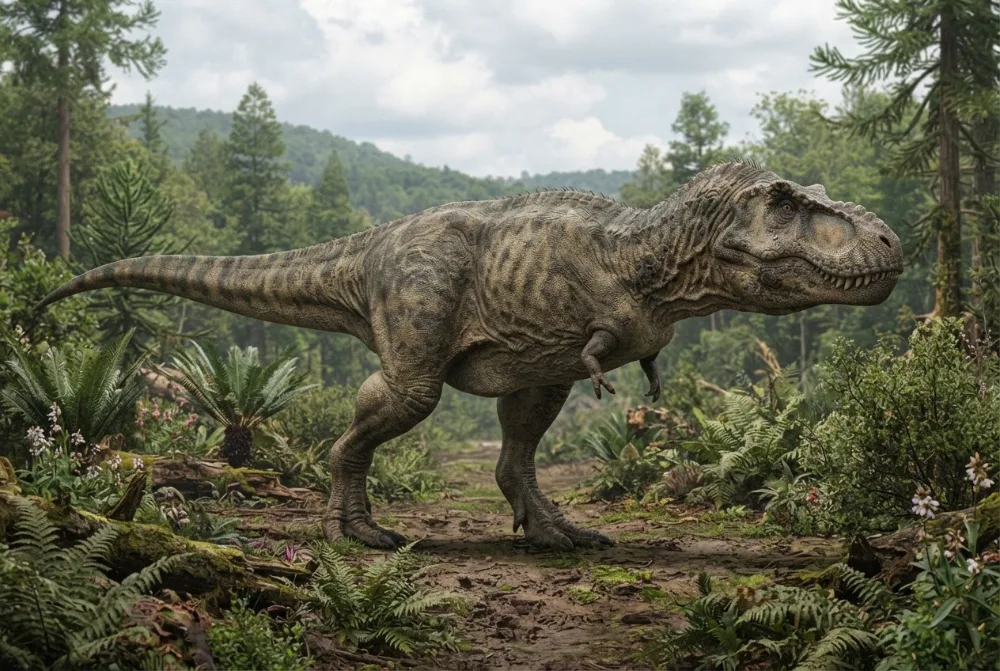
Tyrannosaurus rex was one of the biggest meat-eating dinosaurs that ever lived. It stomped across western North America about 69 to 66 million years ago, at the very end of the Age of Dinosaurs. With its huge skull, powerful legs, and tiny arms, it was the king of its prehistoric world.1
E phetse neng?
E ne e le kgolo hakae?
E ne e le telele hakae?
E ne e phahame hakae?
E ne e le boima hakae?
 telele jwaloka dikoloi tse 3 tse pakilweng ka mola🍌telele jwaloka dibanana tse 72 di behilwe ka mola
 boima jwaloka ditlou tse 1.5🍉boima jwaloka mahapu a 1800🎒boima jwaloka ditlelase tse feletseng tse 11 tsa bana ba sekolo🐻❄️boima jwaloka dibere tse tshweu tse 20🏃e ne e ka matha dimitara tse 100 ka metsotswana e 15 (motho ya lebelo ka ho fetisisa o hloka 9,6)
Tyrannosaurus e ne e le kgolo hakae ha e bapiswa le WENA?
Ke dipalo feela ho browser ya hao. Ha ho letho le bolokwang kapa le romelwang kae kapa kae.
E ne e le lebelo hakae?


Dintlha tse monate
Tyrannosaurus had the most powerful bite of any land animal ever, with a force of 35,000 to 57,000 newtons in its back teeth.1
Its arms were very short but surprisingly strong, with two clawed fingers on each hand.1
The first Tyrannosaurus rex fossil was a tooth found in Colorado in 1874, but the animal wasn't named until 1905.1
A set of footprints from Wyoming shows that a young Tyrannosaurus walked at a speed of about 2.8 to 5 miles per hour.1
Tyrannosaurus lived on an island continent called Laramidia, which was separated by a shallow sea from the eastern part of North America.1
Dipotso tse botswang haholo ka Tyrannosaurus
?How big was Tyrannosaurus?
About 12 to 13 metres (40 to 43 feet) long, 3.7 to 4 metres (12 to 13 feet) tall at the hip, and weighed up to 8.8 tonnes (9.7 tons).13
?What did Tyrannosaurus eat?
It was a meat-eater that hunted large dinosaurs like Edmontosaurus and Triceratops, and probably also scavenged. Its powerful jaws and serrated teeth could crush bone.43
?How fast could Tyrannosaurus run?
Up to about 24 km/h (15 mph), about as fast as a grown-up riding a bike. T. rex was too heavy to really run like a horse, so most scientists think it moved with a big, fast power walk. That was still fast enough to catch other large dinosaurs.43
?Why were Tyrannosaurus arms so small?
Nobody knows for sure. One idea is that as its head grew bigger, the arms got shorter to keep the dinosaur balanced. They were still very strong and had two claws.43
?When did Tyrannosaurus live?
It lived about 69 to 66 million years ago, at the very end of the Cretaceous Period, just before the dinosaurs went extinct.14
?Where did Tyrannosaurus live?
It lived in western North America, on an island continent called Laramidia. Fossils have been found in the United States (like Montana and Wyoming) and Canada.14
?Was Tyrannosaurus the biggest meat-eating dinosaur?
It was one of the largest land predators ever, but some other dinosaurs like Giganotosaurus and Spinosaurus were similar in size. T. rex was the biggest predator in its own time and place.41
?Did Tyrannosaurus have feathers?
Some scientists think young T. rex may have had a light covering of feathers, but adults probably had mostly scaly skin. No direct fossil feathers have been found on T. rex.1
?How strong was Tyrannosaurus bite?
It had the most powerful bite of any land animal ever, with a force of 35,000 to 57,000 newtons in its back teeth. That is a very strong bite.1
Mosenyi wa ditshomo
Tshomo: Tyrannosaurus rex was just a slow scavenger that only ate dead animals.
Nnete: Most paleontologists now agree that T. rex was an active predator that hunted live prey, though it also scavenged when it had the chance.1
Bakeng sa ditsebi tsa didinosaure
- Lebitso la saense
- Tyrannosaurus
- E rehilwe ke
- Osborn 19055
- Sehlopha
- Ditiranosaure
- Lelapa / leloko
- Tyrannosauridae5
- Tlhophiso
- Theropoda > Tyrannosauroidea > Tyrannosauridae5
- Dilemo tsa mafika
- dilemo tse dimilione tse 84 ho isa ho 66 (Campanian / Maastrichtian)5
- Dibopeho tsa mafika
- Hell Creek, Lance, Denver5
- Dinaha
- Amerika, Kanada, Russia, Meksiko, Tjhaena5
- Direkoto tsa difosili
- 87 ho The Paleobiology Database5
- E boetse e tsejwa e le
- Dinotyrannus, Dynamosaurus, Manospondylus, Stygivenator (mabitso a kgale jwale a balwa e le phoofolo e le nngwe)5
- Ho sibollwa
- Barnum Brown of the American Museum of Natural History found the first partial skeleton in Wyoming in 1900, and a more complete one in Montana in 1902. Henry Fairfield Osborn named it Tyrannosaurus rex in 1905.12
- E sa ntse e phehwa kgang
- Scientists still debate whether some smaller tyrannosaur fossils belong to a separate genus called Nanotyrannus or are just young Tyrannosaurus rex.1
Moo dintlha di tswang teng
- Tyrannosaurus (en.wikipedia.org)
- Bulletin of the American Museum of Natural History/Volume 21/Tyrannosaurus and Other Cretaceous Carnivorous Dinosaurs - Wikisource, the free online library (en.wikisource.org)
- Dinosaur - Tyrannosaurus rex - The Australian Museum (australian.museum)
- si.edu (si.edu)
- Tyrannosaurus in The Paleobiology Database (CC BY 4.0): dilemo, dibaka, dibopeho tsa mafika, tlhophiso.
Ntlha e nngwe le e nngwe leqepheng lena e na le nomoro e supang mohlodi wa yona. Haeba re fositse ho hong, re kopa tshwarelo, re balatedi ba didinosaure, ha re koranta ya saense. Re bolelle ho [email protected] mme re tla e lokisa.
 Rex o lapile! Dino Wiki ke projeke ya ntate bakeng sa mora wa hae ya ratang didinosaure, ke mahala, ha ho dipapatso, ha ho disebedi. Batho ba baholo ba ka fepa Rex seneke ho thusa hore e dule e le inthaneteng.Fepa Rex
 Tarbosaurus
 Albertosaurus
 Daspletosaurus
 Gorgosaurus
 Alectrosaurus
 Dryptosaurus
 Triceratops
 Velociraptor
 Spinosaurus
 Ankylosaurus
 Parasaurolophus
 Pteranodon