 Kwisi: O dinosaure efe?
 Ntwa ya didinosaure
 Peiso ya didinosaure
 Dipapadi tse nyane tsa didinosaure
 Albamo ya ditikara
 Manane a TOP a didinosaure
 Nkgethele!
Xinjiangtitan
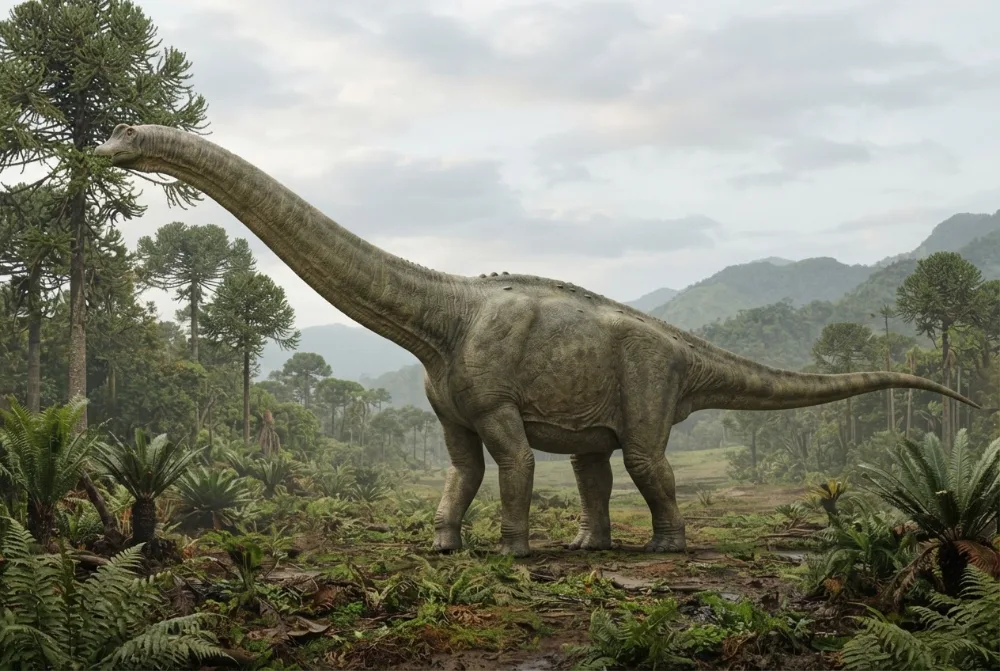
Xinjiangtitan was a gigantic, long-necked plant-eater that lived in what is now China. Its neck was the longest complete neck ever found on any animal, stretching almost 15 metres (49 feet). It was one of the longest dinosaurs ever discovered, as long as a blue whale!1
E phetse neng?
E ne e le kgolo hakae?
E ne e le telele hakae?
E ne e phahame hakae?
kakanyo
E ne e le boima hakae?

 telele jwaloka dikoloi tse 7 tse pakilweng ka mola🍌telele jwaloka dibanana tse 180 di behilwe ka mola🍉boima jwaloka mahapu a 8000🎒boima jwaloka ditlelase tse feletseng tse 50 tsa bana ba sekolo🐻❄️boima jwaloka dibere tse tshweu tse 89🏢e phahame hoo e ka nyarelang ka fensetere mokatong wa 3🏃e ne e ka matha dimitara tse 100 ka metsotswana e 36 (motho ya lebelo ka ho fetisisa o hloka 9,6)
Xinjiangtitan e ne e le kgolo hakae ha e bapiswa le WENA?
Ke dipalo feela ho browser ya hao. Ha ho letho le bolokwang kapa le romelwang kae kapa kae.
E ne e le lebelo hakae?


Dintlha tse monate
Xinjiangtitan's neck had 18 vertebrae and was nearly 15 metres (49 feet) long, the longest complete neck of any known animal.1
Its thigh bone (femur) was 1.65 metres (5.4 feet) long, taller than most adult humans.1
The backbone of Xinjiangtitan is one of the most complete vertebral columns ever found for a sauropod in Asia.1
Xinjiangtitan lived during the Middle Jurassic period, about 164 million years ago.1
Scientists think Xinjiangtitan weighed up to 40 metric tons (44 short tons), as much as a herd of elephants.1
Xinjiangtitan had some features similar to diplodocid dinosaurs, like a short hind limb and a special bump on its pubis bone.1
Dipotso tse botswang haholo ka Xinjiangtitan
?How big was Xinjiangtitan?
Xinjiangtitan was one of the longest known sauropods, measuring 30 to 32 metres (98 to 105 ft) long and weighing up to 40 metric tons (44 short tons).1
?What did Xinjiangtitan eat?
Xinjiangtitan was a plant-eater. Its long neck helped it reach lots of food without moving much.13
?When did Xinjiangtitan live?
Xinjiangtitan lived during the Middle Jurassic period, about 164 million years ago.1
?Where was Xinjiangtitan found?
Xinjiangtitan was discovered in Xinjiang, northwestern China, in the Qiketai Formation.1
?Is Xinjiangtitan a dinosaur?
Yes, Xinjiangtitan is a dinosaur. It is a mamenchisaurid sauropod.1
?How many neck bones did Xinjiangtitan have?
Xinjiangtitan had 18 neck vertebrae, and its neck was nearly 15 metres (49 ft) long, the longest complete neck of any animal.1
Mosenyi wa ditshomo
Tshomo: Xinjiangtitan is sometimes called the 'Chinese dragon' because of its long neck.
Nnete: Xinjiangtitan was a real dinosaur, not a mythical dragon. Its long neck was used for feeding, not for flying or breathing fire.1
Bakeng sa ditsebi tsa didinosaure
- Lebitso la saense
- Xinjiangtitan
- E rehilwe ke
- Wu et al. 20134
- Sehlopha
- Melala e melelele
- Lelapa / leloko
- Mamenchisauridae4
- Tlhophiso
- Sauropodomorpha > Sauropoda4
- Dilemo tsa mafika
- dilemo tse dimilione tse 168 ho isa ho 143 (Bathonian / Tithonian)4
- Dibopeho tsa mafika
- Qiketai4
- Dinaha
- Tjhaena4
- Direkoto tsa difosili
- 1 ho The Paleobiology Database4
- Ho sibollwa
- Xinjiangtitan was discovered in 2012 by a joint expedition from Jilin University, Shenyang Normal University, and the Xinjiang Geological Survey Institute. It was named in 2013 by Wu Wen-hao, Zhou Chang-fu, Oliver Wings, Toru Sekiya, and Dong Zhiming.1
- E sa ntse e phehwa kgang
- Scientists still debate whether the species name should be spelled 'shanshanesis' or 'shanshanensis', and whether the fossils come from the Middle Jurassic Qiketai Formation or the Late Jurassic Qigu Formation.12
Moo dintlha di tswang teng
- Xinjiangtitan (en.wikipedia.org)
- Xinjiangtitan, new mamenchisaurid sauropod from Middle Jurassic of China (free pdf) (dml.reptilis.net)
- Longest ever necked dinosaur discovered in China | Natural History Museum (nhm.ac.uk)
- Xinjiangtitan in The Paleobiology Database (CC BY 4.0): dilemo, dibaka, dibopeho tsa mafika, tlhophiso.
Ntlha e nngwe le e nngwe leqepheng lena e na le nomoro e supang mohlodi wa yona. Haeba re fositse ho hong, re kopa tshwarelo, re balatedi ba didinosaure, ha re koranta ya saense. Re bolelle ho [email protected] mme re tla e lokisa.
 Rex o lapile! Dino Wiki ke projeke ya ntate bakeng sa mora wa hae ya ratang didinosaure, ke mahala, ha ho dipapatso, ha ho disebedi. Batho ba baholo ba ka fepa Rex seneke ho thusa hore e dule e le inthaneteng.Fepa Rex
 Brachiosaurus
 Diplodocus
 Brontosaurus
 Argentinosaurus
 Camarasaurus
 Morosaurus
 Allosaurus
 Compsognathus
 Camptosaurus
 Nanosaurus
 Rhamphorhynchus
 Ceratosaurus