 Kwisi: O dinosaure efe?
 Ntwa ya didinosaure
 Peiso ya didinosaure
 Dipapadi tse nyane tsa didinosaure
 Albamo ya ditikara
 Manane a TOP a didinosaure
 Nkgethele!
E phetse neng?

E ne e le kgolo hakae?
E ne e le telele hakae?
E ne e phahame hakae?
kakanyo
E ne e le boima hakae?
 telele jwaloka dikatse tsa lapeng tse 2 ho tloha nkong ho isa mohatleng🍌telele jwaloka dibanana tse 6 di behilwe ka molae batla e le boima jwaloka katse ya lapeng🍌boima jwaloka dibanana tse 50🪑e nyane hoo e ka tsamayang ka tlasa setulo🏃e ne e ka matha dimitara tse 100 ka metsotswana e 15 (motho ya lebelo ka ho fetisisa o hloka 9,6)
Xuanhuaceratops e ne e le kgolo hakae ha e bapiswa le WENA?
Ke dipalo feela ho browser ya hao. Ha ho letho le bolokwang kapa le romelwang kae kapa kae.
E ne e le lebelo hakae?


Dintlha tse monate
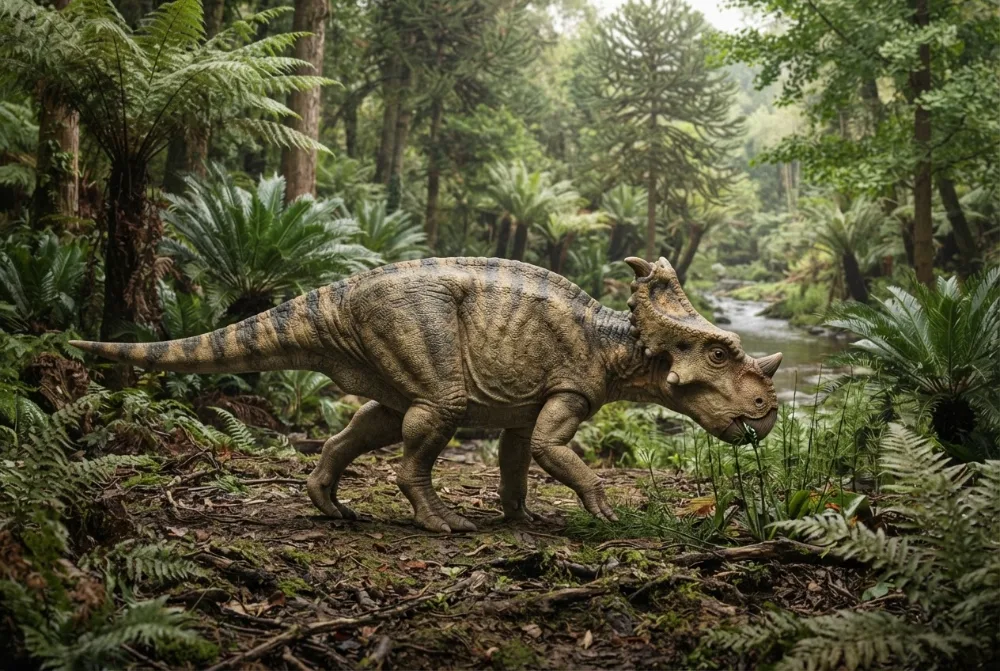
Xuanhuaceratops is one of the earliest known horned dinosaurs, living about 150 million years ago in the Late Jurassic.1
It was very small, only about 1 metre (3.3 feet) long and weighed as much as a large cat, around 6 kilograms (13 pounds).1
The first fossil was discovered in the 1970s by a man named Nie Rongzhen near Yanjiagou, China.1
Xuanhuaceratops had a unique feature: a single tooth in the premaxilla (the front part of the upper jaw).1
Its upper arm bones were very slender, only 4 centimetres (1.6 inches) long, suggesting it could walk on two legs when needed.1
Dipotso tse botswang haholo ka Xuanhuaceratops
?What did Xuanhuaceratops eat?
It was an herbivore, meaning it ate plants. It used its beak to nibble on plants.13
?How big was Xuanhuaceratops?
About 1 metre (3.3 feet) long and weighed around 6 kilograms (13 pounds), about the size of a large dog.1
?When did Xuanhuaceratops live?
It lived during the Late Jurassic Period, about 150 to 145 million years ago.1
Bakeng sa ditsebi tsa didinosaure
- Lebitso la saense
- Xuanhuaceratops
- E rehilwe ke
- Zhao et al. 20063
- Sehlopha
- Didinosaure tse dinaka
- Lelapa / leloko
- Chaoyangsauridae3
- Tlhophiso
- Ornithischia > Ceratopsia3
- Dilemo tsa mafika
- dilemo tse dimilione tse 152 ho isa ho 133 (Kimmeridgian / Valanginian)3
- Dibopeho tsa mafika
- Tuchengzi3
- Dinaha
- Tjhaena3
- Direkoto tsa difosili
- 1 ho The Paleobiology Database3
- Ho sibollwa
- The first fragmentary skeleton was found in the 1970s by Nie Rongzhen near Yanjiagou, China. It was named Xuanhuaceratops niei in 2006 by Zhao Xijin, Cheng Zhengwu, Xu Xing, and Peter J. Makovicky.1
- E sa ntse e phehwa kgang
- Scientists are not sure exactly how Xuanhuaceratops is related to other early ceratopsians because its fossils are incomplete.2
Moo dintlha di tswang teng
- Xuanhuaceratops (en.wikipedia.org)
- A New Taxon of Basal Ceratopsian from China and the Early Evolution of Ceratopsia | PLOS One (journals.plos.org)
- Xuanhuaceratops in The Paleobiology Database (CC BY 4.0): dilemo, dibaka, dibopeho tsa mafika, tlhophiso.
Ntlha e nngwe le e nngwe leqepheng lena e na le nomoro e supang mohlodi wa yona. Haeba re fositse ho hong, re kopa tshwarelo, re balatedi ba didinosaure, ha re koranta ya saense. Re bolelle ho [email protected] mme re tla e lokisa.
 Rex o lapile! Dino Wiki ke projeke ya ntate bakeng sa mora wa hae ya ratang didinosaure, ke mahala, ha ho dipapatso, ha ho disebedi. Batho ba baholo ba ka fepa Rex seneke ho thusa hore e dule e le inthaneteng.Fepa Rex
 Triceratops
 Protoceratops
 Ojoceratops
 Tatankaceratops
 Psittacosaurus
 Centrosaurus
 Stegosaurus
 Iguanodon
 Archaeopteryx
 Giganotosaurus
 Microraptor
 Deinonychus