 Kwisi: O dinosaure efe?
 Ntwa ya didinosaure
 Peiso ya didinosaure
 Dipapadi tse nyane tsa didinosaure
 Albamo ya ditikara
 Manane a TOP a didinosaure
 Nkgethele!
Yongjinglong
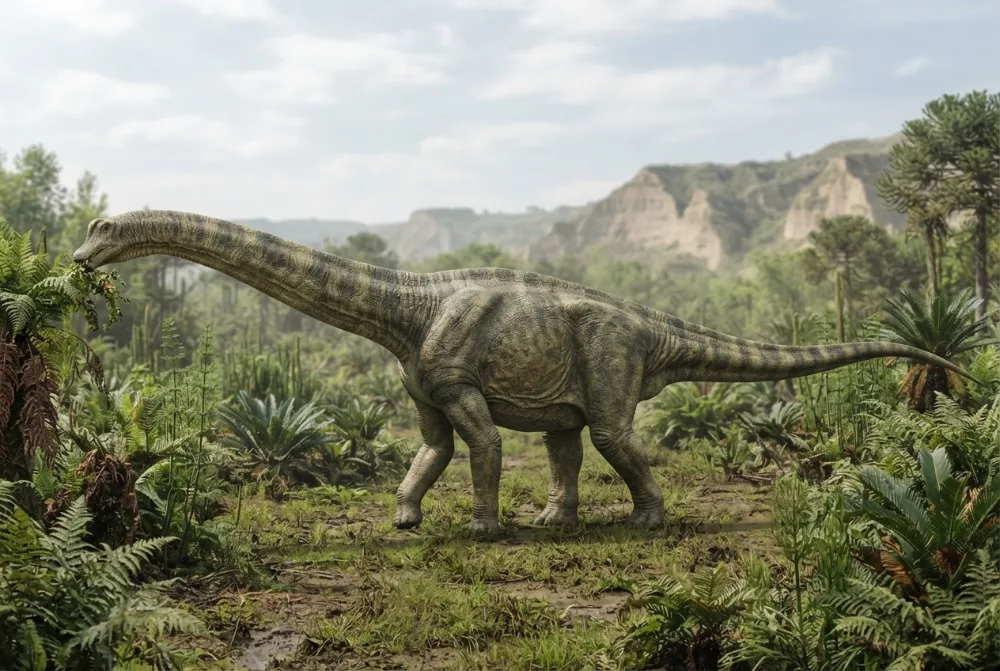
Yongjinglong was a big, long-necked plant-eater that lived in what is now China. It had a very long shoulder blade that stretched more than half the length of its body. Scientists think it was still growing when it died.1
E phetse neng?
E ne e le kgolo hakae?
E ne e le telele hakae?
E ne e phahame hakae?
kakanyo
E ne e le boima hakae?
 telele jwaloka dikoloi tse 2.5 tse pakilweng ka mola🍌telele jwaloka dibanana tse 67 di behilwe ka mola
 e batla e le boima jwaloka tlou🍉boima jwaloka mahapu a 1500🎒boima jwaloka ditlelase tse feletseng tse 9 tsa bana ba sekolo🐻❄️boima jwaloka dibere tse tshweu tse 17🏃e ne e ka matha dimitara tse 100 ka metsotswana e 22 (motho ya lebelo ka ho fetisisa o hloka 9,6)
Yongjinglong e ne e le kgolo hakae ha e bapiswa le WENA?
Ke dipalo feela ho browser ya hao. Ha ho letho le bolokwang kapa le romelwang kae kapa kae.
E ne e le lebelo hakae?


Dintlha tse monate
Yongjinglong's shoulder blade was extremely long and straight, stretching over half the length of its trunk.1
Its neck and back bones had deep, air-filled holes called pleurocoels that covered the whole side of each bone, making the skeleton lighter.1
The ridges on the sides of its middle back bones formed a pattern that looks like the Roman numeral XI.1
Yongjinglong lived about 125 to 113 million years ago, during the Early Cretaceous period.2
The only known fossil is a subadult, meaning Yongjinglong was not fully grown when it died.1
Its teeth were long and spoon-shaped, perfect for scooping up plants.1
Bakeng sa ditsebi tsa didinosaure
- Lebitso la saense
- Yongjinglong
- E rehilwe ke
- Li et al. 20144
- Sehlopha
- Melala e melelele
- Lelapa / leloko
- Euhelopodidae4
- Tlhophiso
- Sauropodomorpha > Sauropoda > Macronaria4
- Dilemo tsa mafika
- dilemo tse dimilione tse 126 ho isa ho 113 (Barremian / Aptian)4
- Dibopeho tsa mafika
- 54
- Dinaha
- Tjhaena4
- Direkoto tsa difosili
- 1 ho The Paleobiology Database4
- Ho sibollwa
- Yongjinglong was discovered in 2008 by Li Daqing and You Hailu beside the G75 Highway in Gansu, China. It was named and described by Li and colleagues in 2014.12
- E sa ntse e phehwa kgang
- Scientists are not sure exactly how big Yongjinglong grew, because the only known fossil is from a young animal.1
Moo dintlha di tswang teng
- A New Titanosaurian Sauropod from the Hekou Group (Lower Cretaceous) of the Lanzhou-Minhe Basin, Gansu Province, China | PLOS One (journals.plos.org)
- PBDB Taxon (paleobiodb.org)
- Yongjinglong datangi | Dinosaur Database by DinoAnimals.com (dinoanimals.com)
- Yongjinglong in The Paleobiology Database (CC BY 4.0): dilemo, dibaka, dibopeho tsa mafika, tlhophiso.
Ntlha e nngwe le e nngwe leqepheng lena e na le nomoro e supang mohlodi wa yona. Haeba re fositse ho hong, re kopa tshwarelo, re balatedi ba didinosaure, ha re koranta ya saense. Re bolelle ho [email protected] mme re tla e lokisa.
 Rex o lapile! Dino Wiki ke projeke ya ntate bakeng sa mora wa hae ya ratang didinosaure, ke mahala, ha ho dipapatso, ha ho disebedi. Batho ba baholo ba ka fepa Rex seneke ho thusa hore e dule e le inthaneteng.Fepa Rex
 Brachiosaurus
 Diplodocus
 Brontosaurus
 Argentinosaurus
 Camarasaurus
 Morosaurus
 Stegosaurus
 Iguanodon
 Archaeopteryx
 Giganotosaurus
 Microraptor
 Deinonychus