 O dino efe? Kwisi
 Ntwa ya didino
 Peiso ya didino
 Metshamekwana ya didino
 Alebamo ya disetikara
 Manane a TOP a didino
 Ngakgamatsa!
Parasaurolophus
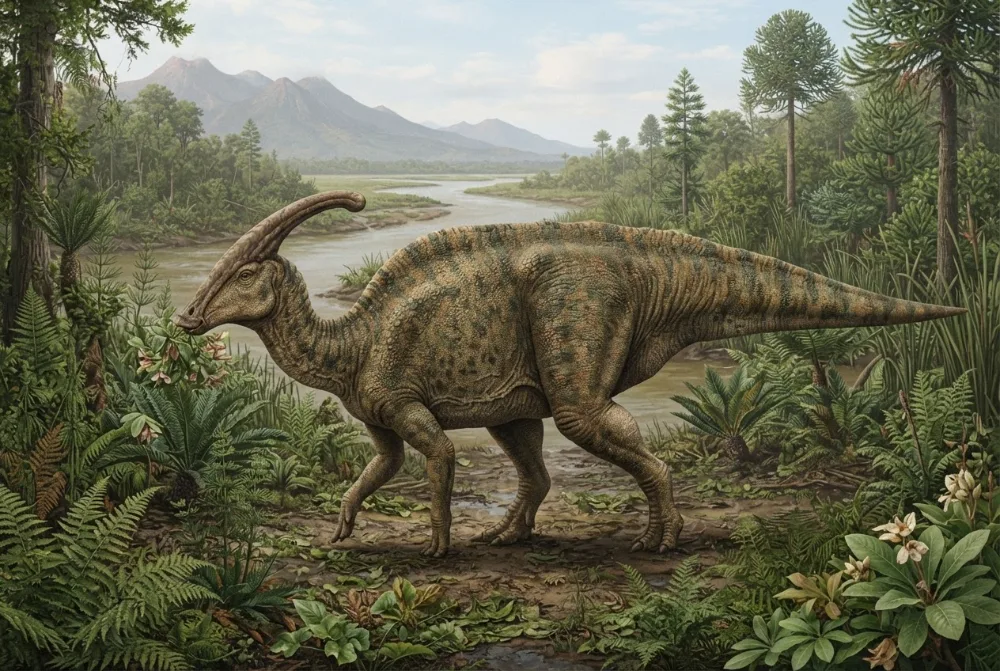
Parasaurolophus was a duck-billed dinosaur with a long, curved crest on its head. It lived in North America during the Late Cretaceous Period, about 77 to 73 million years ago. This plant-eater could walk on two legs or all fours.21
E tshetse leng?
E ne e le kgolo go le kae?
E ne e le telele go le kae?
E ne e le kwa godimo go le kae?
E ne e le bokete go le kae?
 telele jaaka dikoloi di le 2 di emisitswe mo moleng🍌telele jaaka dibanana di le 50 di latelana
 e ka nna bokete jaaka tlou🍉bokete jaaka magapu a le 1000🎒bokete jaaka diphaposiborutelo tse di tletseng bana di le 6🐻❄️bokete jaaka dibere tse ditshweu di le 11🏃e ne e ka taboga dimetara di le 100 mo metsotswaneng e le 17 (motho yo o bonako go gaisa o tlhoka 9,6)
Parasaurolophus e ne e le kgolo go le kae fa e bapisiwa le WENA?
Ke dipalo fela mo sebatling sa gago. Ga go sepe se se bolokwang kgotsa se se romelwang gope.
E ne e le bonako go le kae?


Dintlha tse di monate
Parasaurolophus had a huge, hollow crest on its head that was shaped like a long tube. Scientists think it may have used the crest to make sounds like a trumpet.1
It had a beak like a duck and cheeks to hold food while chewing. Its teeth were constantly replaced, with hundreds packed together in a 'dental battery'.21
Parasaurolophus could walk on two legs or on all fours. It probably spent most of its time on all fours but could stand on its back legs when needed.2
Three species are known: P. walkeri, P. tubicen, and P. cyrtocristatus. P. tubicen was the largest and had the longest, straightest crest.1
The first Parasaurolophus fossil was found in 1920 near Sand Creek in Alberta, Canada. It was named in 1922 by William Parks.1
Parasaurolophus lived in a warm, swampy environment near the shore of a huge inland sea that split North America in two.1
Dipotso tse di botswang thata ka ga Parasaurolophus
?How big was Parasaurolophus?
Parasaurolophus could reach over 9 metres (30 ft) long and weigh over 5 metric tons (5.5 short tons).1
?What did Parasaurolophus eat?
Parasaurolophus was a herbivore, eating plants like leaves, twigs, and pine needles. It used its beak to crop plants and its many teeth to grind them.12
?Why did Parasaurolophus have a crest?
Nobody knows for sure. Scientists think it may have been used for making loud sounds, for visual recognition, or for controlling body temperature, and it probably had more than one use.21
?Could Parasaurolophus swim?
The sources do not say whether Parasaurolophus could swim. It lived in a warm, swampy environment near a huge inland sea, but its swimming ability is not mentioned.1
?How fast could Parasaurolophus run?
Probably up to about 21 km/h (13 mph), about as fast as a grown-up riding a bike. This is an estimate from its size. It could walk on two legs or four, and probably ran on two legs.12
?Was Parasaurolophus bigger than T. rex?
No, Parasaurolophus was smaller than T. rex. Parasaurolophus was about 9 metres (30 ft) long, while T. rex could be over 12 metres (40 ft) long.1
?Did Parasaurolophus have feathers?
The sources do not mention feathers on Parasaurolophus. Skin impressions show scales, not feathers.1
?When did Parasaurolophus live?
Parasaurolophus lived during the Late Cretaceous Period, about 76.5 to 73 million years ago.1
?Where was Parasaurolophus found?
Parasaurolophus fossils have been found in Alberta, New Mexico, and Utah in North America, and possibly in Asia.1
Ya baitseanape ba didino
- Leina la saense
- Parasaurolophus
- Leina le neilwe ke
- Parks 19225
- Setlhopha
- Melomo-pidipidi
- Lelapa / clade
- Hadrosauridae5
- Thulaganyo
- Ornithischia > Ornithopoda > Iguanodontia > Hadrosauridae5
- Bogolo jwa matlapa
- 84 go ya go 72 dimilione tsa dingwaga (Campanian)5
- Dibopego tsa matlapa
- Kirtland, Dinosaur Park, Fruitland5
- Dinaga
- Amerika, Khanata5
- Direkoto tsa difosili
- 20 mo The Paleobiology Database5
- Go fitlhelwa
- The first Parasaurolophus fossil, a skull and partial skeleton, was found in 1920 by a University of Toronto field party near Sand Creek in Alberta, Canada. William Parks named it Parasaurolophus walkeri in 1922.1
- Go sa ntse go ganetsanwa
- Scientists debate whether the different crest shapes belong to separate species or are just males and females of the same species.1
Kwa dintlha di tswang teng
- Parasaurolophus (en.wikipedia.org)
- Parasaurolophus | Natural History Museum (nhm.ac.uk)
- PARASAUROLOPHUS : DinoChecker dinosaur archive (dinochecker.com)
- Parasaurolophus Size: How Big Was It and What Did It Look Like? (extinctatlas.org)
- Parasaurolophus in The Paleobiology Database (CC BY 4.0): dingwaga, mafelo, dibopego tsa matlapa, thulaganyo.
Ntlha nngwe le nngwe mo tsebeng eno e na le nomoro e e supang motswedi wa yona. Fa re dirile phoso, maitshwarelo, re barati ba didino, ga re lokwalodikgang lwa saense. Re bolelele kwa [email protected] mme re tla e baakanya.
 Rex o tshwerwe ke tlala! Dino Wiki ke porojeke ya rre e a e diretseng morwawe yo o ratang didino, ke mahala, ga e na dipapatso e bile ga e na dilatedi. Batho ba bagolo ba ka fepa Rex senyamo go thusa gore e nne mo inthaneteng.Fepa Rex
 Edmontosaurus
 Saurolophus
 Hypacrosaurus
 Corythosaurus
 Kritosaurus
 Gryposaurus
 Tyrannosaurus
 Triceratops
 Velociraptor
 Spinosaurus
 Ankylosaurus
 Pteranodon