 O dino efe? Kwisi
 Ntwa ya didino
 Peiso ya didino
 Metshamekwana ya didino
 Alebamo ya disetikara
 Manane a TOP a didino
 Ngakgamatsa!
Peloneustes
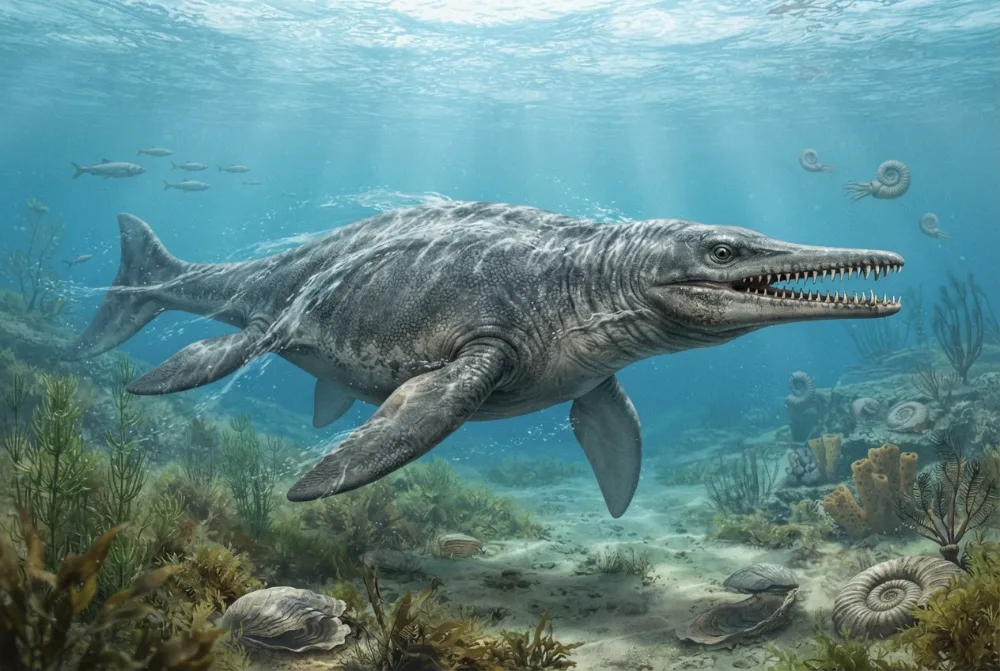
Peloneustes was a pliosaur, a kind of short-necked plesiosaur that lived in a shallow sea. It had a long, narrow snout like a dolphin and many sharp teeth for catching fish. This marine reptile was a fast and fierce hunter in the water.1
E tshetse leng?
E ne e le kgolo go le kae?
E ne e le telele go le kae?
E ne e le bokete go le kae?
 telele jaaka dintšwa di le 4 go tswa kwa nkong go ya kwa mogatleng🍌telele jaaka dibanana di le 24 di latelana🍉bokete jaaka magapu a le 200🧸bokete jaaka bana ba kreše ba le 53🎒bokete jaaka bana ba sekolo ba le 31🐻❄️bokete jaaka dibere tse ditshweu di le 2🏊e ne e ka thuma boleele jwa letamo le legolo la go thuma (50 m) mo metsotswaneng e le 6.7
Peloneustes e ne e le kgolo go le kae fa e bapisiwa le WENA?
Ke dipalo fela mo sebatling sa gago. Ga go sepe se se bolokwang kgotsa se se romelwang gope.
E ne e le bonako go le kae?


Dintlha tse di monate
Peloneustes lived about 165 to 161 million years ago during the Middle Jurassic period.3
Its name means 'mud swimmer' because its fossils were found in mud from an ancient sea.1
Peloneustes had a long, narrow snout that was shaped like a dolphin's beak. This helped it move quickly through the water.1
It had 30 to 31 teeth in its upper jaw and 36 to 44 teeth in its lower jaw. The teeth were sharp and slightly curved for piercing fish.2
Peloneustes shared its sea home with other marine reptiles like ichthyosaurs and other plesiosaurs. At least five different pliosaurids lived in the same area.1
The sea where Peloneustes swam was only about 30 to 50 metres (100 to 160 feet) deep. It was a shallow inland sea.1
Dipotso tse di botswang thata ka ga Peloneustes
?How big was Peloneustes?
Peloneustes was about 3.5 to 4 metres (11 to 13 feet) long. This is small for a pliosaurid.1
?What did Peloneustes eat?
Peloneustes ate fish. It had a long, narrow snout and many sharp teeth for piercing fish, and it would swing its head quickly to catch them.1
?When did Peloneustes live?
Peloneustes lived during the Middle Jurassic period, about 165 to 161 million years ago. Its fossils are from the Oxford Clay Formation in England.1
?Was Peloneustes a dinosaur?
No, Peloneustes was a plesiosaur, a marine reptile, not a dinosaur. It lived in the sea and used its flippers to swim.1
Ya baitseanape ba didino
- Leina la saense
- Peloneustes
- Leina le neilwe ke
- Lydekker 18893
- Setlhopha
- Dipleisiosoro
- Lelapa / clade
- Pliosauridae3
- Thulaganyo
- Plesiosauria > Pliosauridae > Sauropterygia3
- Bogolo jwa matlapa
- 165 go ya go 162 dimilione tsa dingwaga (Callovian)3
- Dibopego tsa matlapa
- Oxford Clay, Ornatenton, Argiles de Montaubert3
- Dinaga
- Bogosi jo bo Kopaneng, Fora, Jeremane3
- Direkoto tsa difosili
- 12 mo The Paleobiology Database3
- Go fitlhelwa
- Peloneustes was first described as a species of Plesiosaurus by Harry Govier Seeley in 1869. Richard Lydekker gave it its own genus name in 1889.1
- Go sa ntse go ganetsanwa
- Scientists are not sure if Peloneustes was a close relative of Pliosaurus or a more early-diverging pliosaurid. They are still studying its family tree.1
Kwa dintlha di tswang teng
- Peloneustes (en.wikipedia.org)
- The cranial anatomy and taxonomy of Peloneustes philarchus (Sauropterygia, Pliosauridae) from the Peterborough Member (Callovian, Middle Jurassic) of the United Kingdom (onlinelibrary.wiley.com)
- Peloneustes in The Paleobiology Database (CC BY 4.0): dingwaga, mafelo, dibopego tsa matlapa, thulaganyo.
Ntlha nngwe le nngwe mo tsebeng eno e na le nomoro e e supang motswedi wa yona. Fa re dirile phoso, maitshwarelo, re barati ba didino, ga re lokwalodikgang lwa saense. Re bolelele kwa [email protected] mme re tla e baakanya.
 Rex o tshwerwe ke tlala! Dino Wiki ke porojeke ya rre e a e diretseng morwawe yo o ratang didino, ke mahala, ga e na dipapatso e bile ga e na dilatedi. Batho ba bagolo ba ka fepa Rex senyamo go thusa gore e nne mo inthaneteng.Fepa Rex
 Elasmosaurus
 Pliosaurus
 Plesiosaurus
 Cimoliasaurus
 Colymbosaurus
 Trinacromerum
 Ichthyosaurus
 Khudiakovia
 Ophthalmosaurus
 Pterodactylus
 Rhamphocephalus
 Gongbusaurus