 Ban dino nga? Kiis
 Xeexu dino
 Rawante dino
 Fo yu ndaw yu dino
 Albomu sitikeer
 Limu TOP yu dino
 Bett ma!
Kañ la dundoon?

Naka la gaawoon?


Xibaar yu neex
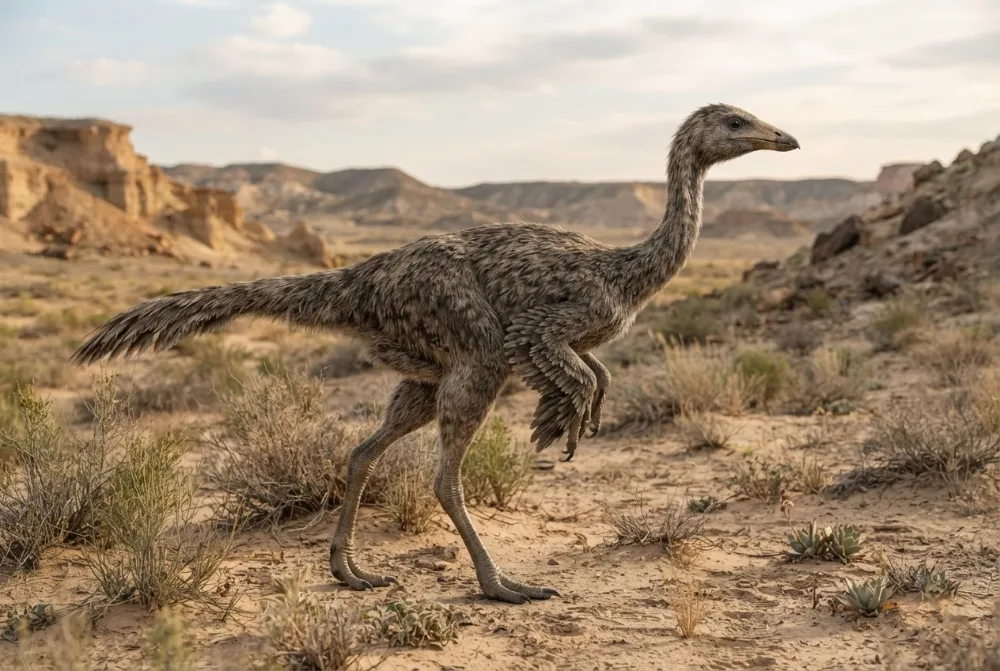
Aepyornithomimus is known from only a single left foot and ankle bones, but it is the best preserved ornithomimid specimen from the Djadokhta Formation.12
Its name means 'ostrich mimic from Tögrögiin Shiree' because its foot looks like that of a giant ostrich.12
This dinosaur lived about 83 to 72 million years ago during the Late Cretaceous period.3
Laaj yi ñu gën a laaj ci Aepyornithomimus
?How big was Aepyornithomimus?
Scientists have not found enough bones to know its full size, but it was a medium-sized ornithomimid dinosaur, probably about 3 to 4 metres long, based on related dinosaurs like Gallimimus.41
?What did Aepyornithomimus eat?
It had a toothless beak like an ostrich, so it probably ate plants, small animals, and maybe eggs. Scientists think it was an omnivore.4
Ngir ñi xam dino lool
- Turu xam-xam
- Aepyornithomimus
- Ku ko tudde
- Chinzorig et al. 20175
- Kurél
- Dino yu niru otris
- Njaboot / klad
- Ornithomimidae5
- Klasifikasiyoŋ
- Theropoda > Ornithomimosauria5
- Màggaayu doj yi
- 84 ba 72 milyoŋ at (Campanian)5
- Formasiyoŋi doj
- Djadokhta5
- Réew yi
- Mongoli5
- Fosil yu ñu gis
- 1 ci The Paleobiology Database5
- Gisees
- Aepyornithomimus was named in 2017 by Chinzorig and colleagues based on a single left foot and ankle found in the Djadokhta Formation of Mongolia.13
- Ñu ngi koy werante ba tey
- Scientists are not sure exactly what Aepyornithomimus ate, as it may have been a plant-eater or an omnivore.3
Fa xibaar yi jóge
- First Ornithomimid (Theropoda, Ornithomimosauria) from the Upper Cretaceous Djadokhta Formation of Tögrögiin Shiree, Mongolia | Scientific Reports (nature.com)
- First Ornithomimid (Theropoda, Ornithomimosauria) from the Upper Cretaceous Djadokhta Formation of Tögrögiin Shiree, Mongolia (pmc.ncbi.nlm.nih.gov)
- PBDB Taxon (paleobiodb.org)
- Aepyornithomimus (en.wikipedia.org)
- Aepyornithomimus in The Paleobiology Database (CC BY 4.0): at, béréb yi, formasiyoŋi doj, klasifikasiyoŋ.
Bépp xibaar ci xët wii am na lim bu wone fa mu jóge. Su nu juumee, baal nu, nun ñu bëgg dino lanu, du ab sërnaalu xam-xam. Wax nu ko ci [email protected] nu defar ko.
 Rex xiif na! Dino Wiki, mbiru ab baay la ngir doomam ju góor ju bëgg dinosoor, ci neen te amul kaamuñaate, amul tracker. Mag ñi mën nañu jox Rex tuuti ñam ngir dimbali ko mu des ci internet.Dundal Rex
 Gallimimus
 Ornithomimus
 Struthiomimus
 Deinocheirus
 Dromiceiomimus
 Archaeornithomimus
 Tyrannosaurus
 Triceratops
 Velociraptor
 Spinosaurus
 Ankylosaurus
 Parasaurolophus