 Ban dino nga? Kiis
 Xeexu dino
 Rawante dino
 Fo yu ndaw yu dino
 Albomu sitikeer
 Limu TOP yu dino
 Bett ma!
Alaskacephale
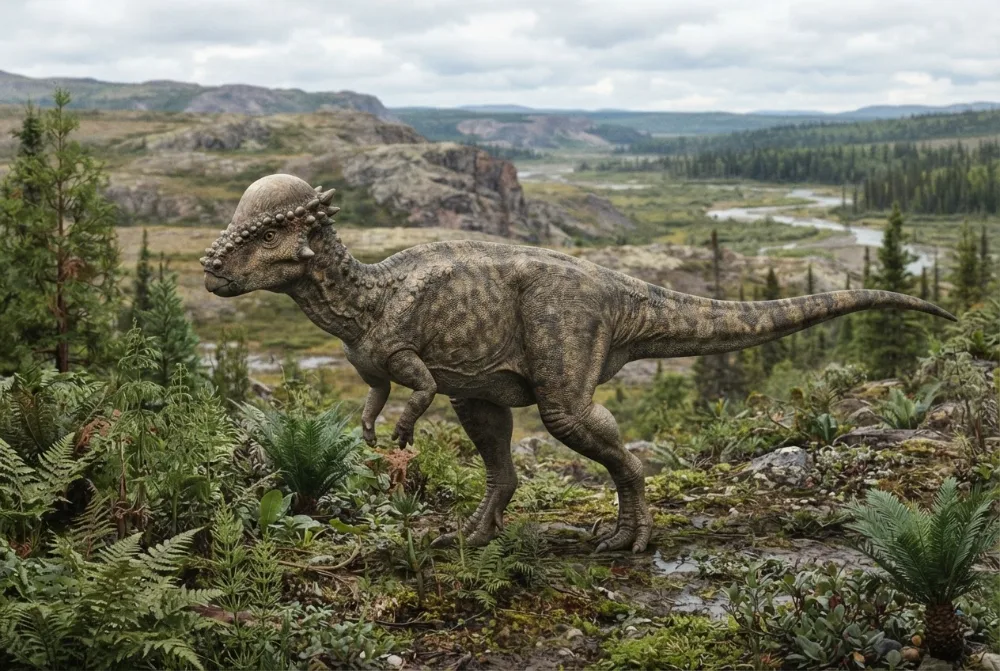
Alaskacephale was a small, dome-headed dinosaur that lived in the cold Arctic of ancient Alaska. It had a thick, bony skull with two rows of bumps along the back of its head. This plant-eater was one of the few dinosaurs that lived near the North Pole.1
Kañ la dundoon?
Naka la réyoon?
Naka la guddoon?
Naka la diisoon?
 gudd ni 3 muusu kër, bakkan ba geen🍌gudd ni 8 banaana yu ñu topp-toppale🍌diis ni 83 banaana🏃mënoon na daw 100 meetar ci 11 segond (nit ki gën a gaaw dafay soxla 9,6)
Naka la Alaskacephale réyoon, bu ñu ko méngalee ak YAW?
Ay kalkil rekk ci sa navigatëer. Dara du ñu denc, dara du ñu yónne fenn.
Naka la gaawoon?


Xibaar yu neex
Alaskacephale lived about 70 to 69 million years ago, during the Maastrichtian stage of the Late Cretaceous.1
Only one fossil of Alaskacephale has been found: a piece of skull bone called a squamosal.1
The skull had two rows of bony bumps that helped scientists tell it apart from other dome-headed dinosaurs.1
Alaskacephale lived in a cold Arctic environment with winter darkness for 120 days and temperatures as low as -2°C (28°F).1
It shared its home with other dinosaurs like the horned Pachyrhinosaurus, the duck-billed Edmontosaurus, and the tyrannosaur Nanuqsaurus.1
Alaskacephale was about half the size of its relative Pachycephalosaurus, making it one of the smaller pachycephalosaurs.1
Laaj yi ñu gën a laaj ci Alaskacephale
?How big was Alaskacephale?
About 1.5 metres long and 10 kilograms, based on a similarly sized relative. It was one of the smaller pachycephalosaurs.1
?What did Alaskacephale eat?
It was a plant-eater, like all dome-headed dinosaurs.1
?When did Alaskacephale live?
It lived about 72 to 71 million years ago, during the Late Cretaceous (Maastrichtian stage).1
?Is Alaskacephale a dinosaur?
Yes, it is a dome-headed dinosaur (a pachycephalosaur).1
?Why did Alaskacephale have a thick skull?
The thick, bony dome on its skull might have been used for head-butting or for display, but scientists are not sure.1
?Did Alaskacephale have feathers?
Nobody knows for sure. No fossil feathers have been found with Alaskacephale, and it is not known if pachycephalosaurs had feathers.1
Ngir ñi xam dino lool
- Turu xam-xam
- Alaskacephale
- Ku ko tudde
- Sullivan 20062
- Kurél
- Bopp yu wërngel
- Njaboot / klad
- Pachycephalosauridae2
- Klasifikasiyoŋ
- Ornithischia > Pachycephalosauria2
- Màggaayu doj yi
- 72 ba 66 milyoŋ at (Maastrichtian)2
- Formasiyoŋi doj
- Prince Creek2
- Réew yi
- Amerig2
- Fosil yu ñu gis
- 1 ci The Paleobiology Database2
- Gisees
- The only fossil was found in 1999 by a University of Alaska expedition on the Colville River. It was named Alaskacephale gangloffi in 2006 by paleontologist Robert Sullivan, honoring the earlier researcher Roland Gangloff.1
- Ñu ngi koy werante ba tey
- Scientists are not sure exactly how big Alaskacephale was, because only a skull fragment has been found.1
Fa xibaar yi jóge
- Alaskacephale (en.wikipedia.org)
- Alaskacephale in The Paleobiology Database (CC BY 4.0): at, béréb yi, formasiyoŋi doj, klasifikasiyoŋ.
Bépp xibaar ci xët wii am na lim bu wone fa mu jóge. Su nu juumee, baal nu, nun ñu bëgg dino lanu, du ab sërnaalu xam-xam. Wax nu ko ci [email protected] nu defar ko.
 Rex xiif na! Dino Wiki, mbiru ab baay la ngir doomam ju góor ju bëgg dinosoor, ci neen te amul kaamuñaate, amul tracker. Mag ñi mën nañu jox Rex tuuti ñam ngir dimbali ko mu des ci internet.Dundal Rex
 Pachycephalosaurus
 Stegoceras
 Prenocephale
 Sphaerotholus
 Foraminacephale
 Brontotholus
 Tyrannosaurus
 Triceratops
 Velociraptor
 Spinosaurus
 Ankylosaurus
 Parasaurolophus