 Ban dino nga? Kiis
 Xeexu dino
 Rawante dino
 Fo yu ndaw yu dino
 Albomu sitikeer
 Limu TOP yu dino
 Bett ma!
Kañ la dundoon?

Naka la réyoon?
Naka la guddoon?
Naka la kawewoon?
jortu
Naka la diisoon?
 gudd ni 6 xaj, bakkan ba geen🍌gudd ni 33 banaana yu ñu topp-toppale🍉diis ni 140 xaal🧸diis ni 37 xale yu maternel🎒diis ni 22 xale yu lekkool🏃mënoon na daw 100 meetar ci 8,6 segond (nit ki gën a gaaw dafay soxla 9,6)
Naka la Alioramus réyoon, bu ñu ko méngalee ak YAW?
Ay kalkil rekk ci sa navigatëer. Dara du ñu denc, dara du ñu yónne fenn.
Naka la gaawoon?


Xibaar yu neex
Alioramus had a long, low snout, unlike the deep, powerful skulls of most other tyrannosaurs.2
Its skull was decorated with eight separate horns, more than any other known tyrannosaur.2
One nearly complete skeleton belonged to a nine-year-old animal, but it was still smaller than other tyrannosaurs of the same age.2
Alioramus is closely related to the giant Tarbosaurus and Tyrannosaurus, even though it was much smaller and lighter.2
The name Alioramus means 'other branch', because scientists thought it was a different line of evolution.1
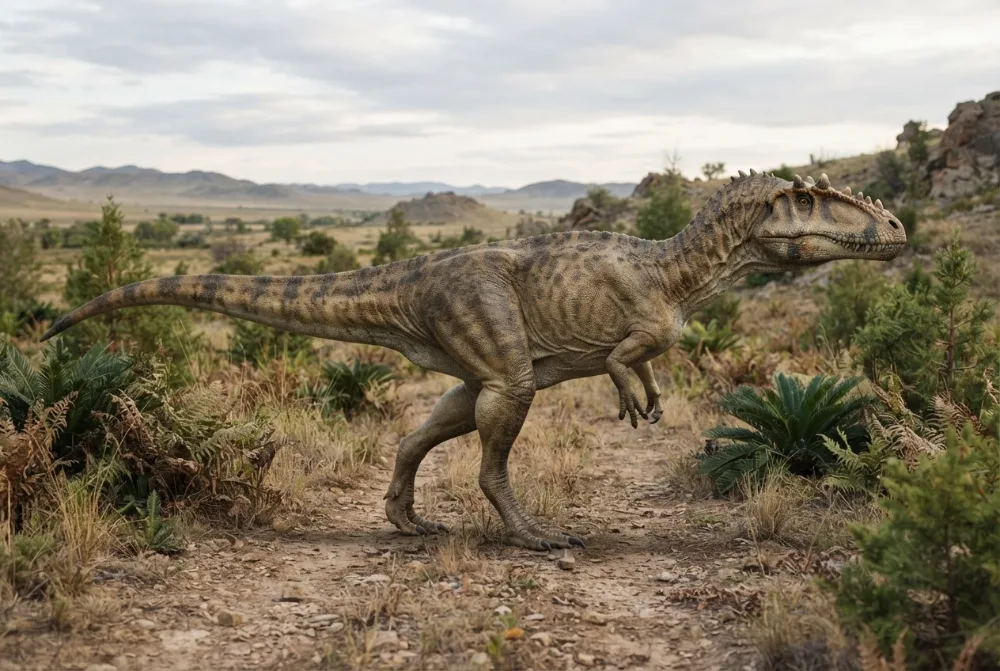
Laaj yi ñu gën a laaj ci Alioramus
?How big was Alioramus?
Alioramus was about 5 to 6 metres (16 to 20 feet) long and weighed around 385 to 700 kilograms (849 to 1,500 pounds), depending on the species and estimate. It was significantly smaller than a T. rex.341
?What did Alioramus eat?
Alioramus was a carnivore that ate meat. It had sharp teeth and probably hunted small prey, since its skull was not built for bone-crushing like larger tyrannosaurs.34
?How fast could Alioramus run?
The sources do not give a specific speed for Alioramus. It probably relied on speed and agility to hunt, but no exact running speed is known.4
?Why did Alioramus have horns on its head?
Alioramus had a row of five bony crests along the top of its snout, which may have been used for display or to attract mates. These crests were more than 1 cm (0.39 in) tall.3
?Is Alioramus a dinosaur?
Yes, Alioramus is a dinosaur. It is a genus of tyrannosaurid theropod dinosaurs from the Late Cretaceous period.31
Ngir ñi xam dino lool
- Turu xam-xam
- Alioramus
- Ku ko tudde
- Kurzanov 19765
- Kurél
- Tiranosoor yi
- Njaboot / klad
- Tyrannosauridae5
- Klasifikasiyoŋ
- Theropoda > Tyrannosauroidea > Tyrannosauridae5
- Màggaayu doj yi
- 72 ba 66 milyoŋ at (Maastrichtian)5
- Formasiyoŋi doj
- Beds of Nogon Tsav, Nemegt5
- Réew yi
- Mongoli, Siin5
- Fosil yu ñu gis
- 3 ci The Paleobiology Database5
- Gisees
- Alioramus was named by Soviet paleontologist Sergei Kurzanov in 1976, based on fossils from the Nogon Tsav locality in Mongolia.5
- Ñu ngi koy werante ba tey
- Scientists still debate whether Alioramus is a juvenile of another tyrannosaur or a distinct, smaller adult species.2
Fa xibaar yi jóge
- Alioramus | Natural History Museum (nhm.ac.uk)
- pnas.org (pnas.org)
- Alioramus (en.wikipedia.org)
- Dinosaur - Alioramus altai - The Australian Museum (australian.museum)
- Alioramus in The Paleobiology Database (CC BY 4.0): at, béréb yi, formasiyoŋi doj, klasifikasiyoŋ.
Bépp xibaar ci xët wii am na lim bu wone fa mu jóge. Su nu juumee, baal nu, nun ñu bëgg dino lanu, du ab sërnaalu xam-xam. Wax nu ko ci [email protected] nu defar ko.
 Rex xiif na! Dino Wiki, mbiru ab baay la ngir doomam ju góor ju bëgg dinosoor, ci neen te amul kaamuñaate, amul tracker. Mag ñi mën nañu jox Rex tuuti ñam ngir dimbali ko mu des ci internet.Dundal Rex
 Tyrannosaurus
 Tarbosaurus
 Albertosaurus
 Daspletosaurus
 Gorgosaurus
 Alectrosaurus
 Triceratops
 Velociraptor
 Spinosaurus
 Ankylosaurus
 Parasaurolophus
 Pteranodon