 Ban dino nga? Kiis
 Xeexu dino
 Rawante dino
 Fo yu ndaw yu dino
 Albomu sitikeer
 Limu TOP yu dino
 Bett ma!
Kañ la dundoon?

Naka la réyoon?
Naka la guddoon?
Naka la kawewoon?
Naka la diisoon?
 gudd ni 6 xaj, bakkan ba geen🍌gudd ni 33 banaana yu ñu topp-toppale🍉diis ni 260 xaal🧸diis ni 68 xale yu maternel🎒diis ni 41 xale yu lekkool🐻❄️diis ni 3 uurs yu weex🏃mënoon na daw 100 meetar ci 9,7 segond (nit ki gën a gaaw dafay soxla 9,6)
Naka la Arrhinoceratops réyoon, bu ñu ko méngalee ak YAW?
Ay kalkil rekk ci sa navigatëer. Dara du ñu denc, dara du ñu yónne fenn.
Naka la gaawoon?


Xibaar yu neex
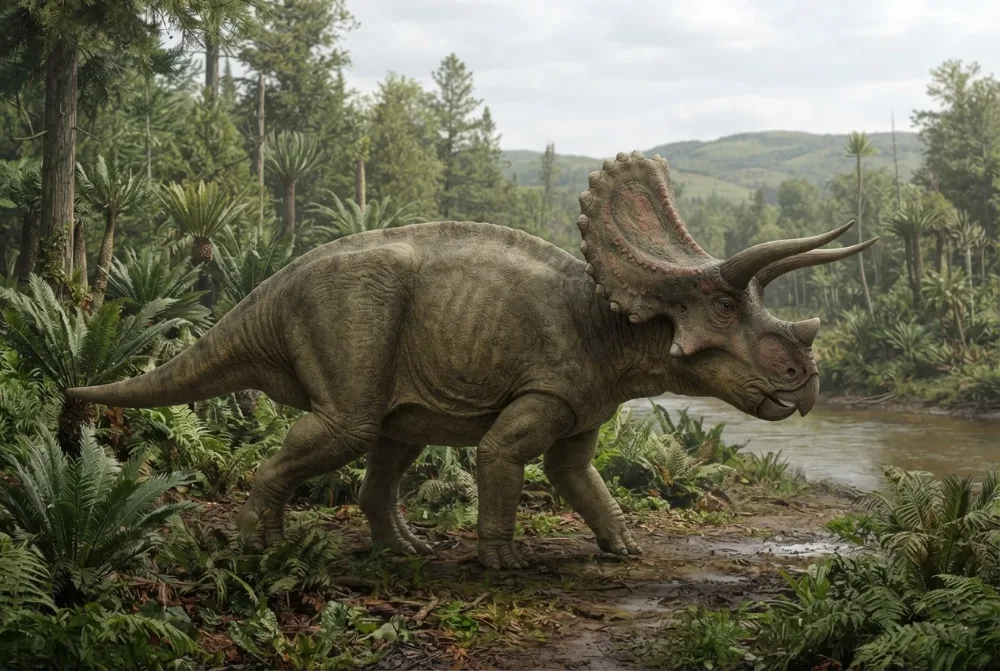
Arrhinoceratops lived a few million years before its famous relative Triceratops.1
The name 'Arrhinoceratops' means 'no nose-horn face', but scientists later realized it actually did have a nose horn, just a short one.1
Only one complete skull of Arrhinoceratops has been found, so scientists do not know much about the rest of its body.12
Its skull had a broad, square frill with two oval openings and a scalloped rear edge.1
The frill of Arrhinoceratops was decorated with about nine bony bumps called osteoderms along the sides.1
Arrhinoceratops lived in a wet coastal environment with warm summers and cool winters, and may have been hunted by the tyrannosaur Albertosaurus.1
The first Arrhinoceratops skull was found by a University of Toronto expedition in 1923 along the Red Deer River in Alberta.1
Laaj yi ñu gën a laaj ci Arrhinoceratops
?How big was Arrhinoceratops?
Estimates vary. Some popular science books estimate it was about 6 metres (20 ft) long, while Gregory S. Paul estimated 4.5 metres (15 ft) and 1.3 tonnes (2,900 lb).12
?What did Arrhinoceratops eat?
Arrhinoceratops was a herbivore. It likely ate ferns, cycads and conifers, using its sharp beak to bite off leaves or needles.1
?When did Arrhinoceratops live?
It lived during the Late Cretaceous, about 72 to 67 million years ago, a few million years before Triceratops.21
?Where was Arrhinoceratops found?
Its remains have been found in Canada, specifically along the Red Deer River in Alberta.12
?Did Arrhinoceratops have a nose horn?
Yes, it did have a nose horn, but it was short and blunt. The name 'no nose-horn face' was based on a misunderstanding.1
Ku tas léeb yu dul dëgg
Léeb: Arrhinoceratops had no nose horn at all.
Dëgg: It actually had a short, blunt nose horn, like many other horned dinosaurs.1
Ngir ñi xam dino lool
- Turu xam-xam
- Arrhinoceratops
- Ku ko tudde
- Parks 19254
- Kurél
- Dino yu am béjjén
- Njaboot / klad
- Ceratopsidae4
- Klasifikasiyoŋ
- Ornithischia > Ceratopsia > Ceratopsidae4
- Màggaayu doj yi
- 84 ba 66 milyoŋ at (Campanian / Maastrichtian)4
- Formasiyoŋi doj
- Horseshoe Canyon4
- Réew yi
- Kanadaa4
- Fosil yu ñu gis
- 3 ci The Paleobiology Database4
- Gisees
- William Arthur Parks named Arrhinoceratops in 1925 based on a skull found in Alberta, Canada, by a University of Toronto expedition in 1923.14
- Ñu ngi koy werante ba tey
- Scientists are not sure exactly how Arrhinoceratops is related to other horned dinosaurs like Torosaurus and Anchiceratops.1
Fa xibaar yi jóge
- Arrhinoceratops (en.wikipedia.org)
- Arrhinoceratops | Natural History Museum (nhm.ac.uk)
- Arrhinoceratops | Part of the Ceratopsian Family of Dinosaurs (dinosaurmadness.com)
- Arrhinoceratops in The Paleobiology Database (CC BY 4.0): at, béréb yi, formasiyoŋi doj, klasifikasiyoŋ.
Bépp xibaar ci xët wii am na lim bu wone fa mu jóge. Su nu juumee, baal nu, nun ñu bëgg dino lanu, du ab sërnaalu xam-xam. Wax nu ko ci [email protected] nu defar ko.
 Rex xiif na! Dino Wiki, mbiru ab baay la ngir doomam ju góor ju bëgg dinosoor, ci neen te amul kaamuñaate, amul tracker. Mag ñi mën nañu jox Rex tuuti ñam ngir dimbali ko mu des ci internet.Dundal Rex
 Triceratops
 Protoceratops
 Ojoceratops
 Tatankaceratops
 Psittacosaurus
 Centrosaurus
 Tyrannosaurus
 Velociraptor
 Spinosaurus
 Ankylosaurus
 Parasaurolophus
 Pteranodon