 Ban dino nga? Kiis
 Xeexu dino
 Rawante dino
 Fo yu ndaw yu dino
 Albomu sitikeer
 Limu TOP yu dino
 Bett ma!
Arthropleura
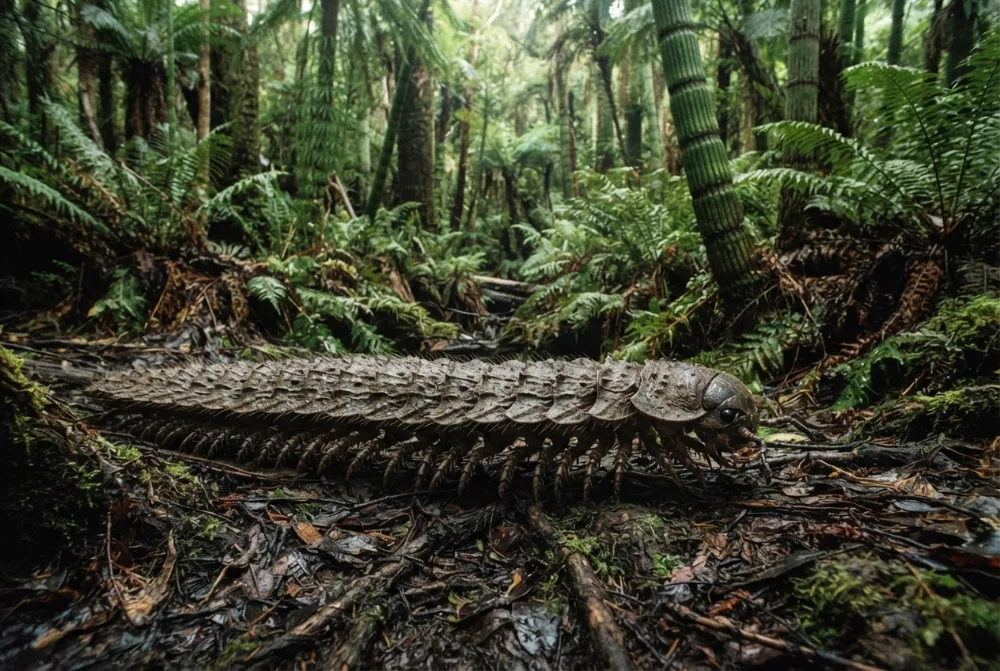
Arthropleura was a giant millipede that lived long before the dinosaurs. It could grow as long as a car, making it the biggest land bug ever! It crawled through ancient forests near water.1
Kañ la dundoon?
Naka la réyoon?
Naka la guddoon?
Naka la diisoon?
 gudd ni 2,5 xaj, bakkan ba geen🍌gudd ni 14 banaana yu ñu topp-toppale
 diis ni 12 muusu kër🍉diis ni 10 xaal🧸diis ni 2,5 xale yu maternel🎒diis ni 1,5 xale yu lekkool🏃mënoon na daw 100 meetar ci 90 segond (nit ki gën a gaaw dafay soxla 9,6)
Naka la Arthropleura réyoon, bu ñu ko méngalee ak YAW?
Ay kalkil rekk ci sa navigatëer. Dara du ñu denc, dara du ñu yónne fenn.
Naka la gaawoon?


Xibaar yu neex
Arthropleura is the largest known land arthropod of all time, reaching at least 2 metres (6.5 feet) long.1
It left giant trackways up to 50 centimetres (20 inches) wide, which are fossilized footprints of its many legs.1
Its head had features of both millipedes and centipedes, showing it was a mix of both groups.2
Arthropleura lived in open, sparsely wooded areas near water and may have been able to go on land and in water.1
It was a slow mover, not a fast runner like centipedes, based on its short legs and trackways.2
Some Arthropleura fossils are so well preserved that scientists can see the details of its head and mouthparts using special scanners.2
Laaj yi ñu gën a laaj ci Arthropleura
?How big was Arthropleura?
About 2 metres (6.5 feet) long, possibly up to 2.63 metres (8.6 feet). That makes it the largest known land arthropod of all time.12
?What did Arthropleura eat?
It probably ate dead plants and other detritus, like modern millipedes. It did not have venom fangs or legs for catching prey.5
?Was Arthropleura a dinosaur?
No, it was a giant millipede, not a dinosaur. It lived long before the dinosaurs, from about 344 to 292 million years ago.1
?Could Arthropleura swim?
It may have been amphibious, meaning it could live both on land and in water. It lived in open, sparsely wooded areas near water.1
?How fast could Arthropleura move?
Probably only about 4 km/h (2 mph), a slow walking pace. This is a guess: it was a giant millipede with short legs, and its trackways show it did not hurry.5
?Did Arthropleura have a head?
Yes, and scientists recently used special scanners to see its head in detail. It had antennae, mandibles, and two pairs of maxillae.2
?When did Arthropleura go extinct?
It died out around 292 million years ago, during the early Permian period.1
?Where did Arthropleura live?
It lived in what is now Europe and North America, in open, sparsely wooded forests near water.1
?Is Arthropleura related to centipedes?
It is a millipede, but its head has features of both millipedes and centipedes, showing it was a mix of both groups.5
?How much did Arthropleura weigh?
One large fossil suggests it weighed about 50 kilograms (110 pounds), as heavy as a small human.1
Ku tas léeb yu dul dëgg
Léeb: Arthropleura was a giant centipede that hunted other animals.
Dëgg: Arthropleura was actually a millipede, and it was likely a slow plant-eater, not a predator.2
Ngir ñi xam dino lool
- Turu xam-xam
- Arthropleura
- Ku ko tudde
- (Jordan 1854)6
- Kurél
- Rab yu siiw lool yu jamono ju yàgg
- Njaboot / klad
- Arthropleuridae6
- Klasifikasiyoŋ
- Myriapoda > Arthropleurida > Arthropleuridae6
- Màggaayu doj yi
- 347 ba 290 milyoŋ at (Visean / Sakmarian)6
- Formasiyoŋi doj
- Saarbrucker layers, Farrington6
- Réew yi
- Almaañ, Faraas, Belsik, Angalteer, Españ, Amerig6
- Fosil yu ñu gis
- 61 ci The Paleobiology Database6
- Gisees
- Arthropleura was first named by Jordan in 1854, based on fossils found in Europe.3
- Ñu ngi koy werante ba tey
- Scientists still debate whether Arthropleura was a true millipede or a more primitive relative, and they are not sure exactly what it ate.2
Fa xibaar yi jóge
- Arthropleura (en.wikipedia.org)
- Head anatomy and phylogenomics show the Carboniferous giant Arthropleura belonged to a millipede-centipede group (science.org)
- PBDB Taxon (paleobiodb.org)
- Millipedes ‘as big as cars’ once roamed England | University of Cambridge (cam.ac.uk)
- Largest ever millipede’s head revealed by 300-million-year-old fossils | Natural History Museum (nhm.ac.uk)
- Arthropleura in The Paleobiology Database (CC BY 4.0): at, béréb yi, formasiyoŋi doj, klasifikasiyoŋ.
Bépp xibaar ci xët wii am na lim bu wone fa mu jóge. Su nu juumee, baal nu, nun ñu bëgg dino lanu, du ab sërnaalu xam-xam. Wax nu ko ci [email protected] nu defar ko.
 Rex xiif na! Dino Wiki, mbiru ab baay la ngir doomam ju góor ju bëgg dinosoor, ci neen te amul kaamuñaate, amul tracker. Mag ñi mën nañu jox Rex tuuti ñam ngir dimbali ko mu des ci internet.Dundal Rex
 Megalodon
 Sabre-toothed cat
 Dimetrodon
 Woolly mammoth
 Helicoprion
 Deinosuchus