 Ban dino nga? Kiis
 Xeexu dino
 Rawante dino
 Fo yu ndaw yu dino
 Albomu sitikeer
 Limu TOP yu dino
 Bett ma!
Kañ la dundoon?

Naka la réyoon?
Naka la guddoon?
Naka la kawewoon?
 gudd ni 4 xaj, bakkan ba geen🍌gudd ni 19 banaana yu ñu topp-toppale🏃mënoon na daw 100 meetar ci 7,2 segond (nit ki gën a gaaw dafay soxla 9,6)
Naka la Bagaraatan réyoon, bu ñu ko méngalee ak YAW?
Ay kalkil rekk ci sa navigatëer. Dara du ñu denc, dara du ñu yónne fenn.
Naka la gaawoon?


Xibaar yu neex
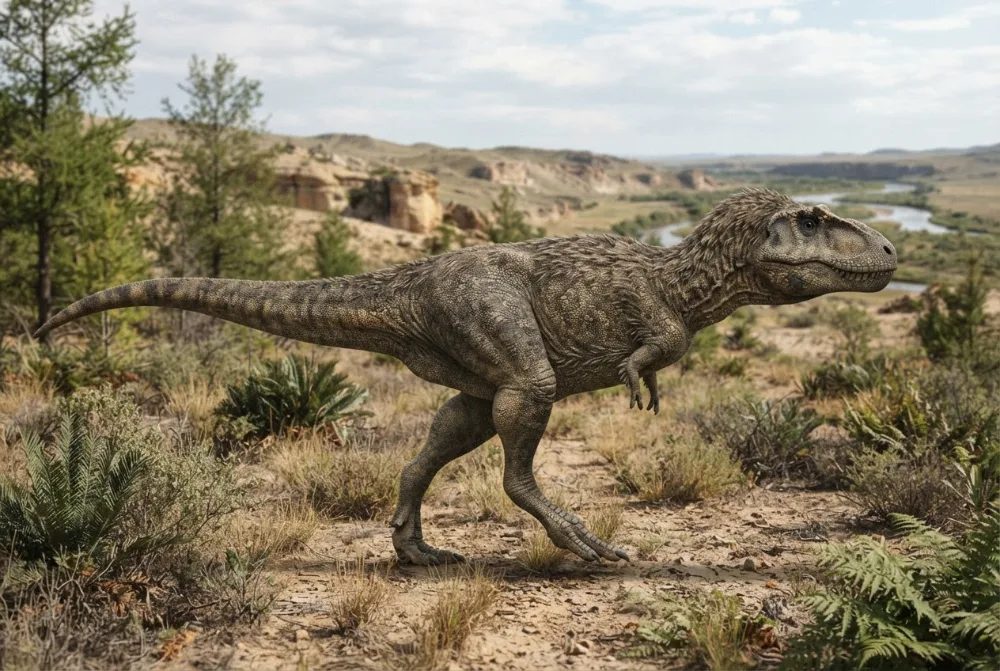
Bagaraatan had a tail that was not very flexible near the body, because many bones in the tail were locked together.2
The first fossil of Bagaraatan was found in 1970 by Zofia Kielan-Jaworowska during a Polish-Mongolian expedition.2
At first, scientists thought Bagaraatan was a mix of different dinosaur parts, but later studies showed it is likely a small relative of Tyrannosaurus.1
Bagaraatan was about 3 to 3.5 meters long, which is similar to a large Deinonychus.2
The shin and ankle bones of Bagaraatan were fused together, giving it a strong lower leg.2
Bagaraatan had two holes in the back part of its lower jaw, which is unusual among theropod dinosaurs.2
Laaj yi ñu gën a laaj ci Bagaraatan
?How big was Bagaraatan?
About 3 to 3.5 metres (10 to 11.5 feet) long, which is about as long as a small car. It stood less than 1 metre (3.3 feet) tall at the hips.12
?What did Bagaraatan eat?
It was a meat-eater. It had strong jaws with sharp teeth and long legs for chasing prey, so it was probably an active predator or scavenger.2
?Was Bagaraatan a dinosaur?
Yes, it was a theropod dinosaur from the Late Cretaceous period. It lived in what is now Mongolia.1
Ku tas léeb yu dul dëgg
Léeb: Bagaraatan was a bird-like dinosaur with feathers.
Dëgg: Scientists have not found any evidence of feathers for Bagaraatan, and it is now thought to be a small tyrannosaurid, which probably had scaly skin like other tyrannosaurs.1
Ngir ñi xam dino lool
- Turu xam-xam
- Bagaraatan
- Ku ko tudde
- Osmólska 19964
- Kurél
- Tiranosoor yi
- Njaboot / klad
- Tyrannosauridae4
- Klasifikasiyoŋ
- Theropoda > Tyrannosauroidea > Tyrannosauridae4
- Màggaayu doj yi
- 72 ba 66 milyoŋ at (Maastrichtian)4
- Formasiyoŋi doj
- Nemegt4
- Réew yi
- Mongoli4
- Fosil yu ñu gis
- 1 ci The Paleobiology Database4
- Gisees
- Bagaraatan was named in 1996 by Halszka Osmólska based on a partial skeleton found in Mongolia. The skeleton was discovered by Zofia Kielan-Jaworowska in 1970.42
- Ñu ngi koy werante ba tey
- Scientists are still debating whether Bagaraatan is a true tyrannosaurid or a close relative, and whether the fossils include bones from more than one animal.1
Fa xibaar yi jóge
- Bagaraatan (en.wikipedia.org)
- An unusual theropod dinosaur from the Late Cretaceous Nemegt Formation of Mongolia (app.pan.pl)
- Reassessment of the enigmatic Late Cretaceous theropod dinosaur, Bagaraatan ostromi | Zoological Journal of the Linnean Society | Oxford Academic (academic.oup.com)
- Bagaraatan in The Paleobiology Database (CC BY 4.0): at, béréb yi, formasiyoŋi doj, klasifikasiyoŋ.
Bépp xibaar ci xët wii am na lim bu wone fa mu jóge. Su nu juumee, baal nu, nun ñu bëgg dino lanu, du ab sërnaalu xam-xam. Wax nu ko ci [email protected] nu defar ko.
 Rex xiif na! Dino Wiki, mbiru ab baay la ngir doomam ju góor ju bëgg dinosoor, ci neen te amul kaamuñaate, amul tracker. Mag ñi mën nañu jox Rex tuuti ñam ngir dimbali ko mu des ci internet.Dundal Rex
 Tyrannosaurus
 Tarbosaurus
 Albertosaurus
 Daspletosaurus
 Gorgosaurus
 Alectrosaurus
 Triceratops
 Velociraptor
 Spinosaurus
 Ankylosaurus
 Parasaurolophus
 Pteranodon