 Ban dino nga? Kiis
 Xeexu dino
 Rawante dino
 Fo yu ndaw yu dino
 Albomu sitikeer
 Limu TOP yu dino
 Bett ma!
Bistahieversor
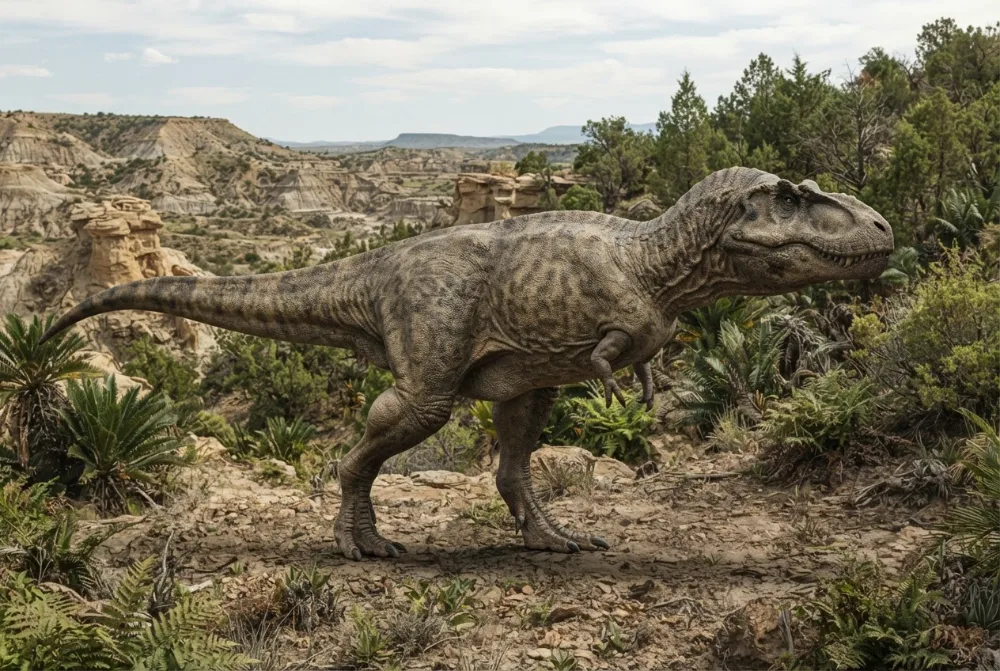
Bistahieversor was a fierce meat-eating dinosaur that lived in what is now New Mexico, USA. It was a close cousin of the famous Tyrannosaurus rex and had a deep, strong snout for biting. Scientists call it the 'Bisti Beast' after the wild area where its bones were found.1
Kañ la dundoon?
Naka la réyoon?
Naka la guddoon?
Naka la kawewoon?
jortu
Naka la diisoon?
 gudd ni 2 oto yu ñu taxawal ci benn rëdd🍌gudd ni 50 banaana yu ñu topp-toppale
 diis ni 160 xaj🍉diis ni 660 xaal🎒diis ni 4 klaas yu mat yu xale yu lekkool🐻❄️diis ni 7 uurs yu weex🏃mënoon na daw 100 meetar ci 13 segond (nit ki gën a gaaw dafay soxla 9,6)
Naka la Bistahieversor réyoon, bu ñu ko méngalee ak YAW?
Ay kalkil rekk ci sa navigatëer. Dara du ñu denc, dara du ñu yónne fenn.
Naka la gaawoon?


Xibaar yu neex
Bistahieversor had 64 teeth, more than many other tyrannosaurs.1
It had an extra opening above its eye, which scientists think held an air sac that made the skull lighter.1
A keel along its lower jaw helped strengthen its bite.1
Bistahieversor lived about 75.5 to 74.5 million years ago, during the Late Cretaceous.1
The first fossils of Bistahieversor were once mistaken for another dinosaur called Aublysodon.2
Both adult and juvenile skeletons have been found, giving scientists a good look at how it grew.2
Laaj yi ñu gën a laaj ci Bistahieversor
?How big was Bistahieversor?
About 8 to 9 metres (26 to 30 feet) long and weighed between 2.5 and 3.3 metric tons (2.75 to 3.6 short tons).13
?Was Bistahieversor bigger than T. rex?
No, Bistahieversor was much smaller than Tyrannosaurus rex. T. rex could be over 12 metres (40 feet) long and weigh more than 8 metric tons.1
?What did Bistahieversor eat?
It was a meat-eater that hunted other dinosaurs. Its deep snout and strong bite helped it catch and eat prey.13
?Where was Bistahieversor found?
Its fossils were found in the Bisti/De-Na-Zin Wilderness Area in New Mexico, USA. That's why it's called the 'Bisti Beast'.13
?When did Bistahieversor live?
It lived about 75.5 to 74.5 million years ago, during the Late Cretaceous Period.1
?Did Bistahieversor have feathers?
Scientists are not sure. No feathers have been found with Bistahieversor fossils, but some of its close relatives may have had simple feathers.1
Ku tas léeb yu dul dëgg
Léeb: Bistahieversor is often called a tyrannosaurid like T. rex.
Dëgg: Scientists now think Bistahieversor was a close relative of tyrannosaurids, but not a true member of that family. It belongs to a group called Eutyrannosauria.1
Ngir ñi xam dino lool
- Turu xam-xam
- Bistahieversor
- Ku ko tudde
- Carr and Williamson 20104
- Kurél
- Tiranosoor yi
- Njaboot / klad
- Tyrannosauridae4
- Klasifikasiyoŋ
- Theropoda > Tyrannosauroidea > Tyrannosauridae4
- Màggaayu doj yi
- 84 ba 72 milyoŋ at (Campanian)4
- Formasiyoŋi doj
- Fruitland, Kirtland4
- Réew yi
- Amerig4
- Fosil yu ñu gis
- 4 ci The Paleobiology Database4
- Gisees
- Bistahieversor was named in 2010 by Thomas Carr and Thomas Williamson. The first skeleton was found by Paul Sealey in the Bisti Wilderness Area of New Mexico.2
- Ñu ngi koy werante ba tey
- Scientists are still debating exactly how Bistahieversor is related to other tyrannosaurs, and whether its deep snout evolved separately from that of T. rex.2
Fa xibaar yi jóge
- en.wikipedia.org (en.wikipedia.org)
- Full article: Bistahieversor sealeyi, gen. et sp. nov., a new tyrannosauroid from New Mexico and the origin of deep snouts in Tyrannosauroidea (tandfonline.com)
- The Bisti Beast | New Mexico Museum of Natural History & Science (nmnaturalhistory.org)
- Bistahieversor in The Paleobiology Database (CC BY 4.0): at, béréb yi, formasiyoŋi doj, klasifikasiyoŋ.
Bépp xibaar ci xët wii am na lim bu wone fa mu jóge. Su nu juumee, baal nu, nun ñu bëgg dino lanu, du ab sërnaalu xam-xam. Wax nu ko ci [email protected] nu defar ko.
 Rex xiif na! Dino Wiki, mbiru ab baay la ngir doomam ju góor ju bëgg dinosoor, ci neen te amul kaamuñaate, amul tracker. Mag ñi mën nañu jox Rex tuuti ñam ngir dimbali ko mu des ci internet.Dundal Rex
 Tyrannosaurus
 Tarbosaurus
 Albertosaurus
 Daspletosaurus
 Gorgosaurus
 Alectrosaurus
 Triceratops
 Velociraptor
 Spinosaurus
 Ankylosaurus
 Parasaurolophus
 Pteranodon