 Ban dino nga? Kiis
 Xeexu dino
 Rawante dino
 Fo yu ndaw yu dino
 Albomu sitikeer
 Limu TOP yu dino
 Bett ma!
Kañ la dundoon?

Naka la réyoon?
Naka la guddoon?
Naka la kawewoon?
Naka la diisoon?

 gudd ni 4 muusu kër, bakkan ba geen🍌gudd ni 11 banaana yu ñu topp-toppale🍉diis ni 40 xaal🧸diis ni 11 xale yu maternel🎒diis ni 6 xale yu lekkool🏃mënoon na daw 100 meetar ci 9,7 segond (nit ki gën a gaaw dafay soxla 9,6)
Naka la Breviceratops réyoon, bu ñu ko méngalee ak YAW?
Ay kalkil rekk ci sa navigatëer. Dara du ñu denc, dara du ñu yónne fenn.
Naka la gaawoon?


Xibaar yu neex
Breviceratops had teeth in the front of its upper jaw, which is a primitive feature shared with Protoceratops andrewsi.1
It had an opening in its skull in front of the eye socket, called an antorbital fenestra, which was narrow and straight-shaped.1
The skull ended in a moderately pronounced neck frill, a common feature among protoceratopsids.1
The first fossils were found in the 1960s by a Polish expedition to the Gobi Desert.1
Breviceratops was originally named as a species of Protoceratops, but was given its own genus in 1990.1
Some scientists think Breviceratops might be a juvenile stage of Bagaceratops, but the holotype has primitive teeth that don't match.1
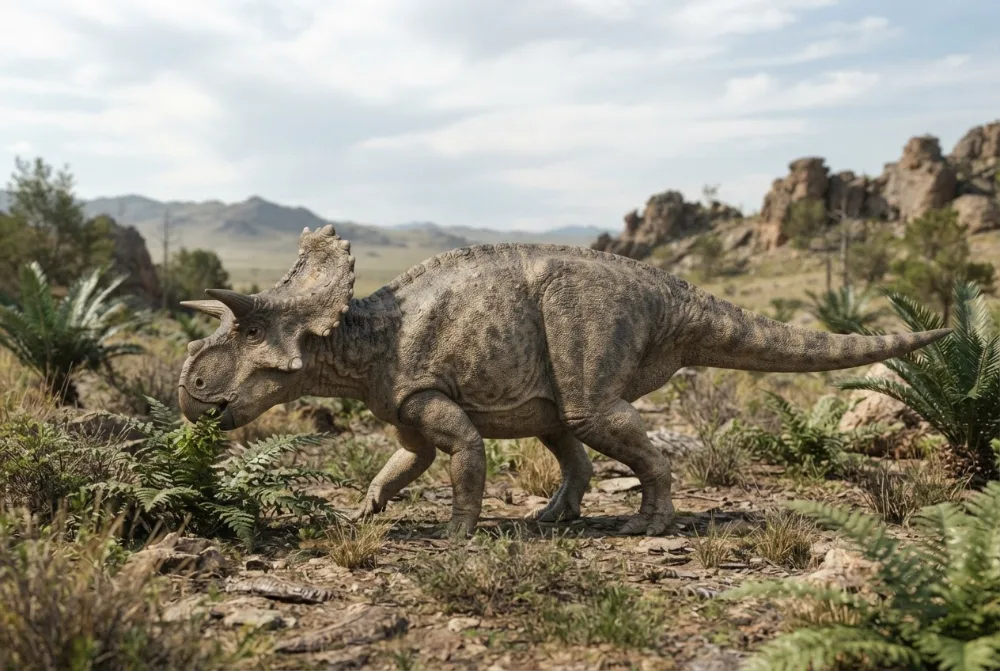
Laaj yi ñu gën a laaj ci Breviceratops
?How big was Breviceratops?
Nobody knows for sure because only juvenile fossils have been found. The known skull is small, suggesting it was a small dinosaur.1
?What did Breviceratops eat?
It was a plant-eater (herbivore). It used its parrot-like beak to bite off plants.14
?Is Breviceratops a dinosaur?
Yes, it is a dinosaur. It belongs to the group Ceratopsia, which includes horned, parrot-beaked dinosaurs.1
Ku tas léeb yu dul dëgg
Léeb: Breviceratops is the same as Bagaceratops.
Dëgg: Some scientists have suggested that, but the holotype from Khulsan has primitive premaxillary teeth that are different from Bagaceratops, so most researchers now treat it as a separate genus.1
Ngir ñi xam dino lool
- Turu xam-xam
- Breviceratops
- Ku ko tudde
- Kurzanov 19904
- Kurél
- Dino yu am béjjén
- Njaboot / klad
- Protoceratopsidae4
- Klasifikasiyoŋ
- Ornithischia > Ceratopsia4
- Màggaayu doj yi
- 84 ba 72 milyoŋ at (Campanian)4
- Formasiyoŋi doj
- Baruungoyot4
- Réew yi
- Mongoli4
- Fosil yu ñu gis
- 2 ci The Paleobiology Database4
- Gisees
- The first fossils were found in the 1960s by a Polish expedition to the Gobi Desert. They were named Protoceratops kozlowskii in 1975, and then renamed Breviceratops by Sergei Kurzanov in 1990.1
- Ñu ngi koy werante ba tey
- Scientists still debate whether Breviceratops is a separate genus or a juvenile form of Bagaceratops.1
Fa xibaar yi jóge
- Breviceratops (en.wikipedia.org)
- PBDB Taxon (paleobiodb.org)
- Breviceratops: Insights into the Late Cretaceous Herbivore (thedinosaurs.org)
- Breviceratops in The Paleobiology Database (CC BY 4.0): at, béréb yi, formasiyoŋi doj, klasifikasiyoŋ.
Bépp xibaar ci xët wii am na lim bu wone fa mu jóge. Su nu juumee, baal nu, nun ñu bëgg dino lanu, du ab sërnaalu xam-xam. Wax nu ko ci [email protected] nu defar ko.
 Rex xiif na! Dino Wiki, mbiru ab baay la ngir doomam ju góor ju bëgg dinosoor, ci neen te amul kaamuñaate, amul tracker. Mag ñi mën nañu jox Rex tuuti ñam ngir dimbali ko mu des ci internet.Dundal Rex
 Triceratops
 Protoceratops
 Ojoceratops
 Tatankaceratops
 Psittacosaurus
 Centrosaurus
 Tyrannosaurus
 Velociraptor
 Spinosaurus
 Ankylosaurus
 Parasaurolophus
 Pteranodon