 Ban dino nga? Kiis
 Xeexu dino
 Rawante dino
 Fo yu ndaw yu dino
 Albomu sitikeer
 Limu TOP yu dino
 Bett ma!
Clidastes
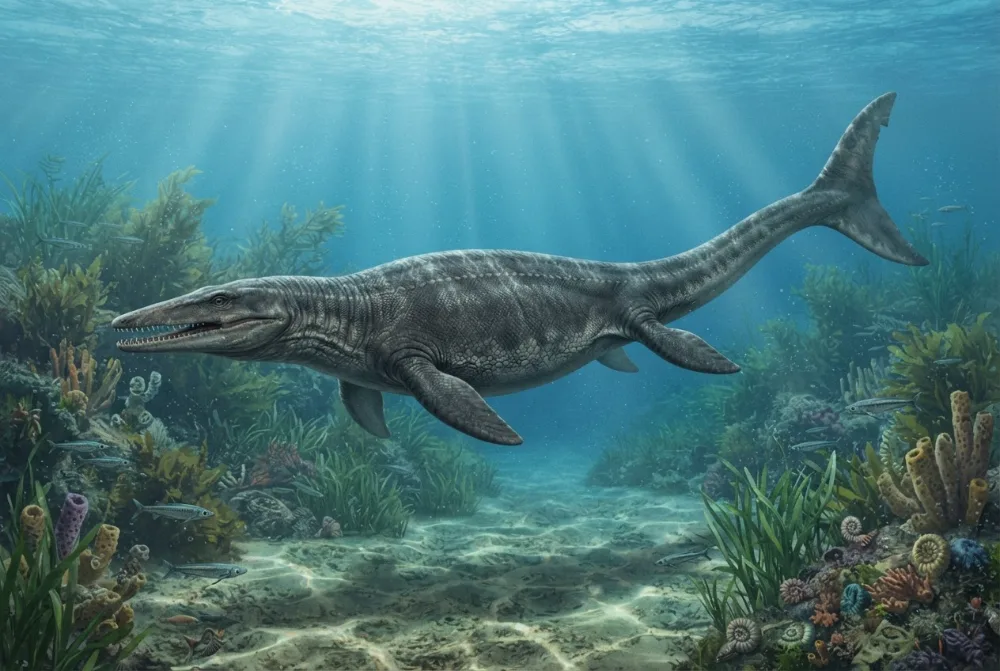
Clidastes was a small, speedy marine lizard that lived in the Late Cretaceous seas. It was one of the smallest mosasaurs, but it was a fast swimmer that chased down fish and squid in shallow waters.1
Kañ la dundoon?
Naka la réyoon?
Naka la guddoon?
Naka la diisoon?
 gudd ni 6 xaj, bakkan ba geen🍌gudd ni 34 banaana yu ñu topp-toppale
 diis ni 14 muusu kër🍉diis ni 11 xaal🧸diis ni 3 xale yu maternel🎒diis ni 1,5 xale yu lekkool🏊mënoon na féey guddaayu pisin bu mag (50 m) ci 5,5 segond
Naka la Clidastes réyoon, bu ñu ko méngalee ak YAW?
Ay kalkil rekk ci sa navigatëer. Dara du ñu denc, dara du ñu yónne fenn.
Naka la gaawoon?


Xibaar yu neex
Clidastes had special vertebrae that locked together, making its spine strong and stable for fast swimming.1
It was one of the smallest mosasaurs, only 2 to 4 meters long on average, but some grew up to 6.2 meters.1
Isotope studies on its teeth suggest Clidastes sometimes entered freshwater, like modern sea snakes.1
The first Clidastes fossils were found in Alabama in 1869 by E. D. Cope, and they were beautifully preserved.1
Its tail had extra-strong bones and muscles, which helped it chase down the fastest prey.1
Some scientists think that only one species, Clidastes propython, is valid, but others recognize more.1
Laaj yi ñu gën a laaj ci Clidastes
?Was Clidastes a dinosaur?
No, Clidastes was a marine lizard, not a dinosaur. It belonged to a group called mosasaurs, which are reptiles that lived in the sea.13
?How big was Clidastes?
Clidastes was one of the smallest mosasaurs, averaging 2 to 4 metres (6.6 to 13.1 feet) long. The largest specimens reached about 6.2 metres (20 feet).13
?What did Clidastes eat?
Clidastes likely ate cephalopods (like squid), fish, and other small vertebrates. It hunted in shallow water.13
?Could Clidastes swim in freshwater?
Yes, isotope studies on its teeth suggest Clidastes sometimes entered freshwater, similar to modern sea snakes.1
Ngir ñi xam dino lool
- Turu xam-xam
- Clidastes
- Ku ko tudde
- Cope 18684
- Kurél
- Mosasoor yi
- Njaboot / klad
- Mosasauridae4
- Klasifikasiyoŋ
- Mosasauroidea4
- Màggaayu doj yi
- 94 ba 66 milyoŋ at (Turonian / Maastrichtian)4
- Formasiyoŋi doj
- Mooreville Chalk, Niobrara, Pierre Shale4
- Réew yi
- Amerig, Suwed, Almaañ, Meksik, Riisi, Jordani4
- Fosil yu ñu gis
- 34 ci The Paleobiology Database4
- Gisees
- E. D. Cope named Clidastes in 1868, and in 1869 he found the first good fossils in the Mooreville Chalk of Alabama.14
- Ñu ngi koy werante ba tey
- Scientists debate whether fossils from Europe and Jordan really belong to Clidastes or to other mosasaurs.1
Fa xibaar yi jóge
- Clidastes (en.wikipedia.org)
- Clidastes - Justapedia (justapedia.org)
- Clidastes Facts for Kids (kids.kiddle.co)
- Clidastes in The Paleobiology Database (CC BY 4.0): at, béréb yi, formasiyoŋi doj, klasifikasiyoŋ.
Bépp xibaar ci xët wii am na lim bu wone fa mu jóge. Su nu juumee, baal nu, nun ñu bëgg dino lanu, du ab sërnaalu xam-xam. Wax nu ko ci [email protected] nu defar ko.
 Rex xiif na! Dino Wiki, mbiru ab baay la ngir doomam ju góor ju bëgg dinosoor, ci neen te amul kaamuñaate, amul tracker. Mag ñi mën nañu jox Rex tuuti ñam ngir dimbali ko mu des ci internet.Dundal Rex
 Mosasaurus
 Prognathodon
 Tylosaurus
 Platecarpus
 Globidens
 Halisaurus
 Tyrannosaurus
 Triceratops
 Velociraptor
 Spinosaurus
 Ankylosaurus
 Parasaurolophus