 Ban dino nga? Kiis
 Xeexu dino
 Rawante dino
 Fo yu ndaw yu dino
 Albomu sitikeer
 Limu TOP yu dino
 Bett ma!
Kañ la dundoon?

Naka la réyoon?
Naka la guddoon?
Naka la kawewoon?
Naka la diisoon?
 gudd ni 3 muusu kër, bakkan ba geen🍌gudd ni 8 banaana yu ñu topp-toppalelu tollu ci diisaayu muusu kër🍌diis ni 25 banaana🪑tuuti ba mën a dox ci suufu siis🏃mënoon na daw 100 meetar ci 5,6 segond (nit ki gën a gaaw dafay soxla 9,6)
Naka la Compsognathus réyoon, bu ñu ko méngalee ak YAW?
Ay kalkil rekk ci sa navigatëer. Dara du ñu denc, dara du ñu yónne fenn.
Naka la gaawoon?


Xibaar yu neex
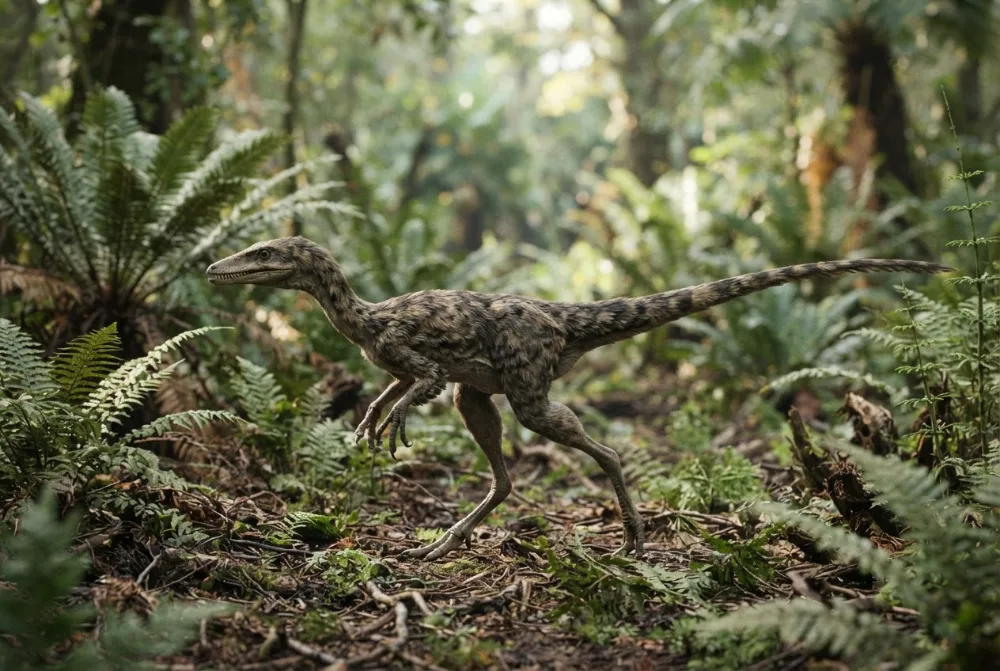
Compsognathus was one of the smallest dinosaurs ever discovered. Until the 1990s, it was the smallest known non-bird dinosaur.1
Scientists know exactly what Compsognathus ate because both fossils have the remains of lizards in their bellies.1
The first Compsognathus fossil was found in Germany in the 1850s. It was originally thought to be a lizard, not a dinosaur.1
Compsognathus lived on islands in a warm, tropical sea. Its fossils were preserved in fine limestone that was once lagoon mud.1
The German specimen of Compsognathus is only about 0.7 metres (2.3 feet) long. Scientists think it was a juvenile.21
Compsognathus had small, sharp teeth. The front teeth had no serrations, but the back teeth had fine serrations on the rear edge.1
Laaj yi ñu gën a laaj ci Compsognathus
?How big was Compsognathus?
The smaller German specimen was about 0.7 to 0.9 m (2.3 to 3 ft) long and weighed around 0.3 to 0.6 kg (0.7 to 1.3 lb). The larger French specimen reached about 1.25 to 1.4 m (4.1 to 4.6 ft) and weighed up to 3.5 kg (7.7 lb).12
?Was Compsognathus a dinosaur?
Yes, Compsognathus was a small, bipedal, carnivorous theropod dinosaur. It is one of the first theropod dinosaurs known from a nearly complete skeleton.1
?What did Compsognathus eat?
Compsognathus was a carnivore that ate small vertebrates, especially lizards. Both known fossils have lizard remains preserved in their stomachs.12
?How fast could Compsognathus run?
Maybe up to about 64 km/h (40 mph), almost as fast as a galloping horse! A computer model of its legs and muscles worked this out, though some scientists think that is too fast. It was small, light and very quick.3
?Did Compsognathus have feathers?
No direct feather fossils have been found with Compsognathus. It lived in the same environment as the feathered dinosaur Archaeopteryx, so some scientists think it may have had simple feathers, but there is no proof yet.1
?Was Compsognathus smaller than a chicken?
The German specimen was roughly chicken-sized, about 0.7 m (2.3 ft) long. The French specimen was larger, about 1.25 to 1.4 m (4.1 to 4.6 ft).12
?When did Compsognathus live?
Compsognathus lived about 150 million years ago, during the late Jurassic period. Its fossils are from the Tithonian age.12
?Where was Compsognathus found?
Two nearly complete fossils have been found: one in Bavaria, Germany, discovered in the 1850s, and one in Canjuers near Nice, France, discovered in the 1970s. Possible teeth have also been found in Portugal.12
?Could Compsognathus swim?
There is no evidence that Compsognathus could swim, but it lived on tropical islands near lagoons and may have occasionally entered shallow water.1
?Was Compsognathus the smallest dinosaur?
Until the 1990s, it was the smallest known non-bird dinosaur, but later discoveries like Microraptor and Mahakala are even smaller.1
Ku tas léeb yu dul dëgg
Léeb: Compsognathus is often shown as a tiny dinosaur that hunted in packs.
Dëgg: There is no evidence that Compsognathus lived or hunted in groups. The fossils found are of single animals.1
Ngir ñi xam dino lool
- Turu xam-xam
- Compsognathus
- Ku ko tudde
- Wagner 18614
- Kurél
- Dino yuy lekk yàpp
- Njaboot / klad
- Compsognathidae4
- Klasifikasiyoŋ
- Theropoda > Compsognathidae4
- Màggaayu doj yi
- 155 ba 145 milyoŋ at (Kimmeridgian / Tithonian)4
- Formasiyoŋi doj
- Alcobaça, Painten4
- Réew yi
- Faraas, Portigaal, Almaañ4
- Fosil yu ñu gis
- 4 ci The Paleobiology Database4
- Gisees
- The first Compsognathus fossil was found in Germany in the 1850s by a doctor named Joseph Oberndorfer. He lent it to paleontologist Johann A. Wagner, who named it Compsognathus longipes in 1859.1
- Ñu ngi koy werante ba tey
- Scientists are not sure if the smaller German specimen is a juvenile or a different species. Some think both fossils belong to the same species, Compsognathus longipes.1
Fa xibaar yi jóge
- Compsognathus (en.wikipedia.org)
- Compsognathus | Natural History Museum (nhm.ac.uk)
- Compsognathus- Enchanted Learning Software (enchantedlearning.com)
- Compsognathus in The Paleobiology Database (CC BY 4.0): at, béréb yi, formasiyoŋi doj, klasifikasiyoŋ.
Bépp xibaar ci xët wii am na lim bu wone fa mu jóge. Su nu juumee, baal nu, nun ñu bëgg dino lanu, du ab sërnaalu xam-xam. Wax nu ko ci [email protected] nu defar ko.
 Rex xiif na! Dino Wiki, mbiru ab baay la ngir doomam ju góor ju bëgg dinosoor, ci neen te amul kaamuñaate, amul tracker. Mag ñi mën nañu jox Rex tuuti ñam ngir dimbali ko mu des ci internet.Dundal Rex
 Allosaurus
 Carnotaurus
 Dilophosaurus
 Giganotosaurus
 Paronychodon
 Megalosaurus
 Brachiosaurus
 Diplodocus
 Brontosaurus
 Camarasaurus
 Morosaurus
 Apatosaurus