 Ban dino nga? Kiis
 Xeexu dino
 Rawante dino
 Fo yu ndaw yu dino
 Albomu sitikeer
 Limu TOP yu dino
 Bett ma!
Kañ la dundoon?

Naka la réyoon?
Naka la guddoon?
Naka la kawewoon?
Naka la diisoon?

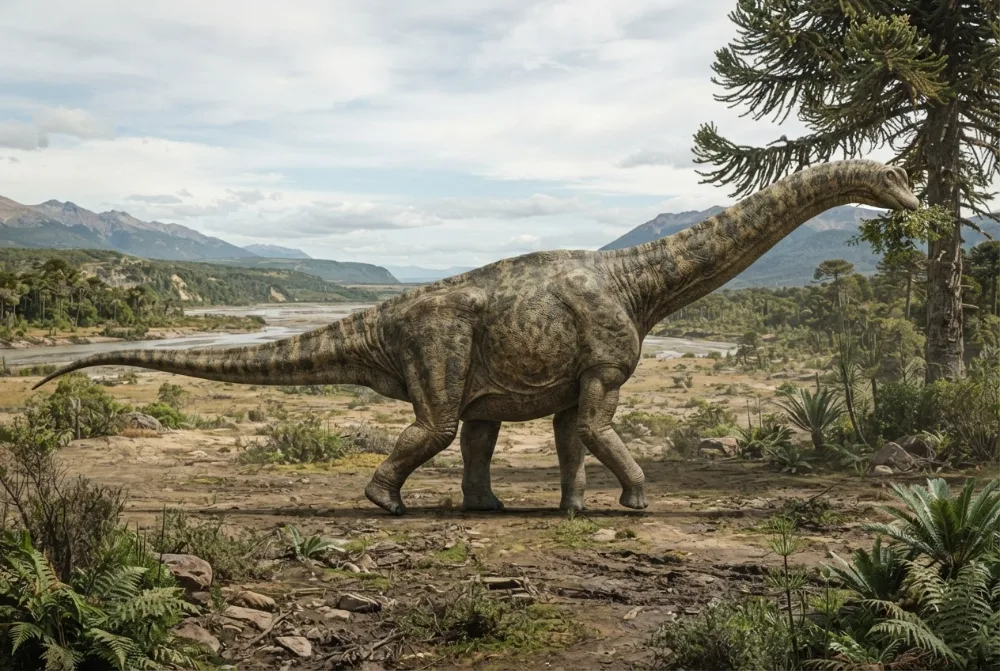
 gudd ni 6 oto yu ñu taxawal ci benn rëdd🍌gudd ni 140 banaana yu ñu topp-toppale🍉diis ni 9800 xaal🎒diis ni 61 klaas yu mat yu xale yu lekkool🐻❄️diis ni 110 uurs yu weex🏢kawe ba mën a xool ci palanteer bu nekk ci eta 3🏃mënoon na daw 100 meetar ci 40 segond (nit ki gën a gaaw dafay soxla 9,6)
Naka la Dreadnoughtus réyoon, bu ñu ko méngalee ak YAW?
Ay kalkil rekk ci sa navigatëer. Dara du ñu denc, dara du ñu yónne fenn.
Naka la gaawoon?


Xibaar yu neex
Dreadnoughtus is known from more complete skeletons than any other gigantic titanosaur, with about 70% of the bones behind the skull preserved.13
Its neck was super long, about 11.3 metres (37 feet), which is almost half of its total body length.1
The type specimen was still growing when it died, so adults might have been even bigger.1
Its bones were buried quickly in a flood, which is why they are so well preserved.1
Small theropod teeth found with the bones suggest scavengers, maybe megaraptorans, nibbled on the carcass.1
Dreadnoughtus lived about 76 to 70 million years ago, during the Late Cretaceous.1
Laaj yi ñu gën a laaj ci Dreadnoughtus
?How big was Dreadnoughtus?
About 26 metres long and weighed around 48 to 49 metric tons, though some estimates range higher or lower.14
?What did Dreadnoughtus eat?
It was a plant-eater (herbivore). Its long neck helped it reach lots of different plants without moving much.51
?Was Dreadnoughtus bigger than T. rex?
Yes, Dreadnoughtus was much bigger. It was about 26 metres long and weighed up to 49 metric tons, while T. rex was about 12 metres long and weighed around 8 metric tons.15
?Did Dreadnoughtus have any predators?
Healthy adults were probably too big to be attacked, but small theropod teeth found with the bones suggest scavengers like megaraptorans nibbled on the carcass.15
?How fast could Dreadnoughtus run?
Nobody knows for sure, but because it was so huge and walked on four legs, it probably moved slowly, like a modern elephant.5
?Where was Dreadnoughtus found?
In Patagonia, Argentina, in the Cerro Fortaleza Formation of Santa Cruz Province.14
Ku tas léeb yu dul dëgg
Léeb: Some people think Dreadnoughtus was the biggest dinosaur ever.
Dëgg: It was one of the largest known from fairly complete remains, but other titanosaurs like Argentinosaurus might have been heavier, though they are known from much less complete fossils.1
Ngir ñi xam dino lool
- Turu xam-xam
- Dreadnoughtus
- Ku ko tudde
- Lacovara et al. 20146
- Kurél
- Baat yu gudd
- Njaboot / klad
- Eutitanosauria6
- Klasifikasiyoŋ
- Sauropodomorpha > Sauropoda > Titanosauria > Macronaria6
- Màggaayu doj yi
- 84 ba 72 milyoŋ at (Campanian)6
- Formasiyoŋi doj
- Cerro Fortaleza6
- Réew yi
- Arsantin6
- Fosil yu ñu gis
- 2 ci The Paleobiology Database6
- Gisees
- Paleontologist Kenneth Lacovara discovered Dreadnoughtus in 2005 in the Cerro Fortaleza Formation in Argentina. It took four summers to dig out the huge bones, using mules and ropes to move them.1
- Ñu ngi koy werante ba tey
- Scientists still debate exactly where Dreadnoughtus fits in the titanosaur family tree, because it has a mix of advanced and primitive features.1
Fa xibaar yi jóge
- Dreadnoughtus (en.wikipedia.org)
- PBDB Taxon (paleobiodb.org)
- A Gigantic, Exceptionally Complete Titanosaurian Sauropod Dinosaur from Southern Patagonia, Argentina (exa.ai)
- A Gigantic, Exceptionally Complete Titanosaurian Sauropod Dinosaur from Southern Patagonia, Argentina | Scientific Reports (nature.com)
- Dreadnoughtus (nhm.ac.uk)
- Dreadnoughtus in The Paleobiology Database (CC BY 4.0): at, béréb yi, formasiyoŋi doj, klasifikasiyoŋ.
Bépp xibaar ci xët wii am na lim bu wone fa mu jóge. Su nu juumee, baal nu, nun ñu bëgg dino lanu, du ab sërnaalu xam-xam. Wax nu ko ci [email protected] nu defar ko.
 Rex xiif na! Dino Wiki, mbiru ab baay la ngir doomam ju góor ju bëgg dinosoor, ci neen te amul kaamuñaate, amul tracker. Mag ñi mën nañu jox Rex tuuti ñam ngir dimbali ko mu des ci internet.Dundal Rex
 Brachiosaurus
 Diplodocus
 Brontosaurus
 Argentinosaurus
 Camarasaurus
 Morosaurus
 Tyrannosaurus
 Triceratops
 Velociraptor
 Spinosaurus
 Ankylosaurus
 Parasaurolophus