 Ban dino nga? Kiis
 Xeexu dino
 Rawante dino
 Fo yu ndaw yu dino
 Albomu sitikeer
 Limu TOP yu dino
 Bett ma!
Kañ la dundoon?

Naka la réyoon?
Naka la guddoon?
Naka la kawewoon?
Naka la diisoon?
 gudd ni 6 xaj, bakkan ba geen🍌gudd ni 33 banaana yu ñu topp-toppale🍉diis ni 260 xaal🧸diis ni 68 xale yu maternel🎒diis ni 41 xale yu lekkool🐻❄️diis ni 3 uurs yu weex🏃mënoon na daw 100 meetar ci 9,7 segond (nit ki gën a gaaw dafay soxla 9,6)
Naka la Einiosaurus réyoon, bu ñu ko méngalee ak YAW?
Ay kalkil rekk ci sa navigatëer. Dara du ñu denc, dara du ñu yónne fenn.
Naka la gaawoon?


Xibaar yu neex
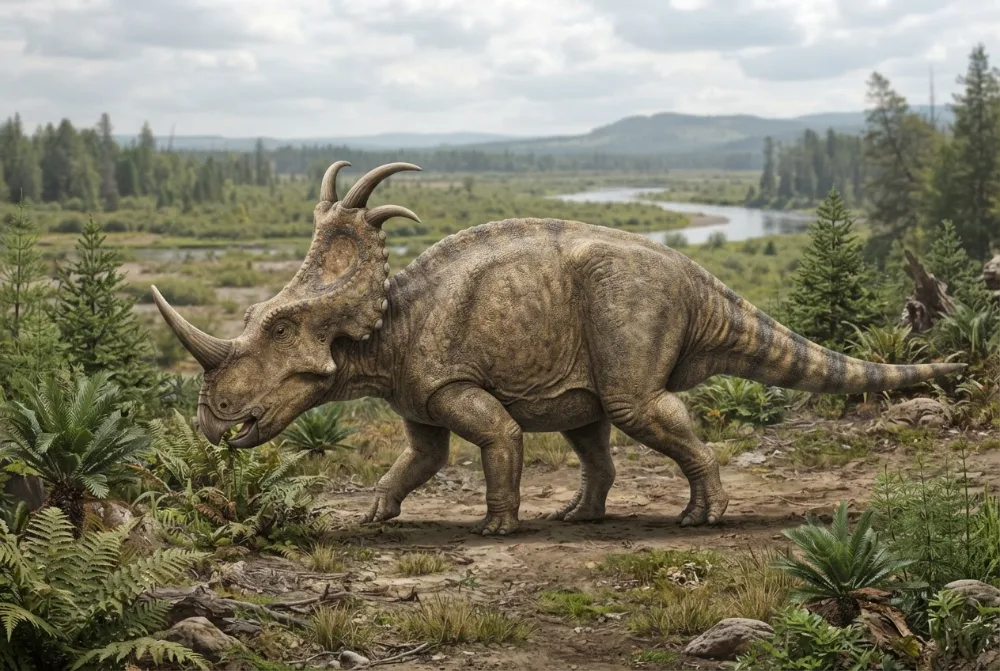
The name Einiosaurus comes from the Blackfeet word for bison, because these dinosaurs may have lived in herds like bison do today.1
At least fifteen Einiosaurus individuals of different ages have been found together in two bonebeds. Scientists think they died in a drought or flood.1
The nasal horn of Einiosaurus curves forward over the nose, which is why its species name means 'with a forward-curving horn'.1
Einiosaurus had a pair of large, curved spikes sticking out from the back of its skull frill.1
All known Einiosaurus fossils are kept at the Museum of the Rockies in Bozeman, Montana.1
Einiosaurus lived in a warm, semiarid climate with a long dry season and a short wet season.1
Laaj yi ñu gën a laaj ci Einiosaurus
?How big was Einiosaurus?
About 4.5 metres (15 feet) long and weighed around 1.3 tonnes (1.4 short tons). That is about as long as a car.1
?What did Einiosaurus eat?
It ate plants. It was a herbivore that fed on low-growing vegetation, probably no taller than 1 metre (3.5 feet).1
?Did Einiosaurus live in herds?
Yes. Scientists think Einiosaurus lived in herds, like bison do today, because many skeletons of different ages were found together in bonebeds.1
?When did Einiosaurus live?
It lived during the Late Cretaceous Period, about 74 million years ago.12
?Where was Einiosaurus found?
All Einiosaurus fossils have been found in Montana, USA, on the Blackfeet Indian Reservation.1
?Why did Einiosaurus have a curved horn?
The forward-curving horn on its nose may have been used for display or fighting. Its species name 'procurvicornis' means 'with a forward-curving horn'.1
Ngir ñi xam dino lool
- Turu xam-xam
- Einiosaurus
- Ku ko tudde
- Sampson 19944
- Kurél
- Dino yu am béjjén
- Njaboot / klad
- Ceratopsidae4
- Klasifikasiyoŋ
- Ornithischia > Ceratopsia > Ceratopsidae4
- Màggaayu doj yi
- 84 ba 72 milyoŋ at (Campanian)4
- Formasiyoŋi doj
- Two Medicine4
- Réew yi
- Amerig4
- Fosil yu ñu gis
- 3 ci The Paleobiology Database4
- Gisees
- Jack Horner discovered the first Einiosaurus fossils in 1985 in Montana. The dinosaur was named by Scott Sampson in 1994.1
- Ñu ngi koy werante ba tey
- Scientists debate whether Einiosaurus is a separate genus or should be placed in the genus Centrosaurus.1
Fa xibaar yi jóge
- Einiosaurus (en.wikipedia.org)
- Einiosaurus | Natural History Museum (nhm.ac.uk)
- Einiosaurus — size, diet & habitat | DinoLifePedia (dinolifepedia.com)
- Einiosaurus in The Paleobiology Database (CC BY 4.0): at, béréb yi, formasiyoŋi doj, klasifikasiyoŋ.
Bépp xibaar ci xët wii am na lim bu wone fa mu jóge. Su nu juumee, baal nu, nun ñu bëgg dino lanu, du ab sërnaalu xam-xam. Wax nu ko ci [email protected] nu defar ko.
 Rex xiif na! Dino Wiki, mbiru ab baay la ngir doomam ju góor ju bëgg dinosoor, ci neen te amul kaamuñaate, amul tracker. Mag ñi mën nañu jox Rex tuuti ñam ngir dimbali ko mu des ci internet.Dundal Rex
 Triceratops
 Protoceratops
 Ojoceratops
 Tatankaceratops
 Psittacosaurus
 Centrosaurus
 Tyrannosaurus
 Velociraptor
 Spinosaurus
 Ankylosaurus
 Parasaurolophus
 Pteranodon