 Ban dino nga? Kiis
 Xeexu dino
 Rawante dino
 Fo yu ndaw yu dino
 Albomu sitikeer
 Limu TOP yu dino
 Bett ma!
Elasmosaurus
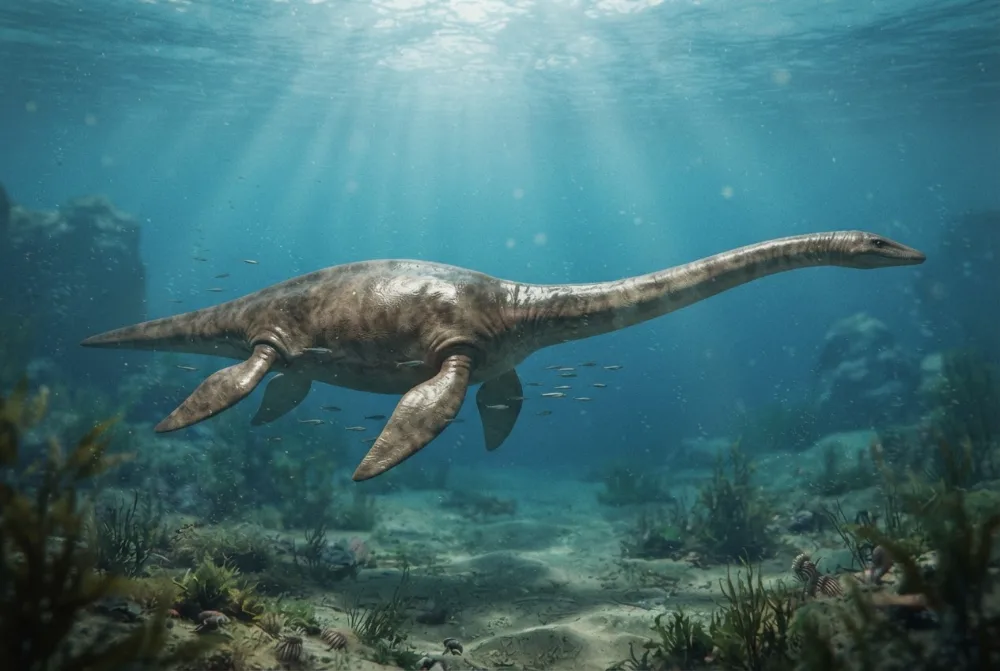
Elasmosaurus was a giant marine reptile with an incredibly long neck, longer than a school bus! It swam in the ancient sea that once covered the middle of North America, using its four flippers to paddle through the water.1
Kañ la dundoon?
Naka la réyoon?
Naka la guddoon?
 gudd ni 2,5 oto yu ñu taxawal ci benn rëdd🍌gudd ni 57 banaana yu ñu topp-toppale🏊mënoon na féey guddaayu pisin bu mag (50 m) ci 8,2 segond
Naka la Elasmosaurus réyoon, bu ñu ko méngalee ak YAW?
Ay kalkil rekk ci sa navigatëer. Dara du ñu denc, dara du ñu yónne fenn.
Naka la gaawoon?


Xibaar yu neex
Elasmosaurus had 72 bones in its neck, which was about 7.1 meters (23 feet) long, making it one of the longest-necked animals ever.1
The first Elasmosaurus fossil was found in 1867 near Fort Wallace, Kansas, by a military doctor named Theophilus Turner.1
The scientist who named Elasmosaurus, Edward Drinker Cope, made a famous mistake: he put the skull on the tail end of the skeleton!1
Elasmosaurus lived about 80.6 to 77 million years ago, during the Late Cretaceous Period, in a shallow sea called the Western Interior Seaway.1
Despite its long neck, Elasmosaurus could not lift its head high above the water like a swan; its neck was not very flexible.1
Elasmosaurus may have used stomach stones, called gastroliths, to help grind up food in its belly.1
The name Elasmosaurus means 'thin-plate reptile', referring to the flat bones in its chest and hips.1
Laaj yi ñu gën a laaj ci Elasmosaurus
?How big was Elasmosaurus?
Elasmosaurus was about 10.3 meters (34 feet) long, with its neck alone around 7.1 meters (23 feet). That is longer than a school bus.1
?What did Elasmosaurus eat?
Elasmosaurus probably ate small fish and marine invertebrates, seizing them with its long teeth. It may have used stomach stones to help digest its food.12
?Was Elasmosaurus a dinosaur?
No, Elasmosaurus was a plesiosaur, a marine reptile that lived in the sea. It was not a dinosaur, though it lived during the time of dinosaurs.13
?Could Elasmosaurus lift its neck out of water?
No, Elasmosaurus could not raise its head and neck high above the water like a swan. Its neck was too heavy and not flexible enough, so it could only lift its head above water in very shallow water.1
?How many neck bones did Elasmosaurus have?
Elasmosaurus had 72 neck vertebrae, which is the second largest number known in any animal. Its relative Albertonectes had even more, with at least 75.1
?Where did Elasmosaurus live?
Elasmosaurus lived in the Western Interior Seaway, a shallow sea that covered the middle of North America about 80.6 to 77 million years ago. Its fossils have been found in Kansas, USA.1
?Why did Elasmosaurus have such a long neck?
Scientists are not sure why Elasmosaurus had such a long neck. It may have helped in feeding, perhaps by sneaking up on prey, but the exact reason is unknown.12
?What was Cope's mistake with Elasmosaurus?
Edward Drinker Cope, who named Elasmosaurus, mistakenly put the skull on the tail end of the skeleton in his reconstruction. This famous error was pointed out by his rival Othniel Charles Marsh.1
Ku tas léeb yu dul dëgg
Léeb: Many people think Elasmosaurus could hold its neck high out of the water like a giraffe.
Dëgg: Scientists now know its neck was not flexible enough to lift high; it probably kept its neck low in the water while swimming.1
Ngir ñi xam dino lool
- Turu xam-xam
- Elasmosaurus
- Ku ko tudde
- Cope 18684
- Kurél
- Plesiyosoor yi
- Njaboot / klad
- Elasmosauridae4
- Klasifikasiyoŋ
- Plesiosauria > Elasmosauridae > Sauropterygia4
- Màggaayu doj yi
- 94 ba 72 milyoŋ at (Turonian / Campanian)4
- Formasiyoŋi doj
- Pierre Shale4
- Réew yi
- Sapoŋ, Amerig4
- Fosil yu ñu gis
- 9 ci The Paleobiology Database4
- Gisees
- Elasmosaurus was named in 1868 by American paleontologist Edward Drinker Cope, based on a partial skeleton found in Kansas. The fossil was dug out of shale and shipped to Philadelphia in crates.1
- Ñu ngi koy werante ba tey
- Scientists are still not sure exactly what Elasmosaurus used its extremely long neck for, though it may have helped it catch prey on the seafloor or surprise fish.1
Fa xibaar yi jóge
- Elasmosaurus (en.wikipedia.org)
- BBC - Science & Nature - Sea Monsters - Fact File: Elasmosaurus (bbc.co.uk)
- Fossil Focus: Elasmosaurs – PALAEONTOLOGY[online] (palaeontologyonline.com)
- Elasmosaurus in The Paleobiology Database (CC BY 4.0): at, béréb yi, formasiyoŋi doj, klasifikasiyoŋ.
Bépp xibaar ci xët wii am na lim bu wone fa mu jóge. Su nu juumee, baal nu, nun ñu bëgg dino lanu, du ab sërnaalu xam-xam. Wax nu ko ci [email protected] nu defar ko.
 Rex xiif na! Dino Wiki, mbiru ab baay la ngir doomam ju góor ju bëgg dinosoor, ci neen te amul kaamuñaate, amul tracker. Mag ñi mën nañu jox Rex tuuti ñam ngir dimbali ko mu des ci internet.Dundal Rex
 Pliosaurus
 Plesiosaurus
 Cimoliasaurus
 Colymbosaurus
 Trinacromerum
 Cryptoclidus
 Tyrannosaurus
 Triceratops
 Velociraptor
 Spinosaurus
 Ankylosaurus
 Parasaurolophus