 Ban dino nga? Kiis
 Xeexu dino
 Rawante dino
 Fo yu ndaw yu dino
 Albomu sitikeer
 Limu TOP yu dino
 Bett ma!
Kañ la dundoon?

Naka la réyoon?
Naka la guddoon?
Naka la kawewoon?
Naka la diisoon?
 gudd ni 2 oto yu ñu taxawal ci benn rëdd🍌gudd ni 51 banaana yu ñu topp-toppale
 diis ni 200 xaj🍉diis ni 800 xaal🎒diis ni 5 klaas yu mat yu xale yu lekkool🐻❄️diis ni 9 uurs yu weex🏃mënoon na daw 100 meetar ci 16 segond (nit ki gën a gaaw dafay soxla 9,6)
Naka la Hypacrosaurus réyoon, bu ñu ko méngalee ak YAW?
Ay kalkil rekk ci sa navigatëer. Dara du ñu denc, dara du ñu yónne fenn.
Naka la gaawoon?


Xibaar yu neex
Hypacrosaurus had very tall spines on its backbone, making its back look high and ridged.1
Its hollow crest was like Corythosaurus's but smaller and more pointed, and it may have been used to make sounds.1
Scientists found nests, eggs, and babies of Hypacrosaurus, giving us a rare look at how these dinosaurs raised their young.1
Hypacrosaurus could walk on two legs or four, and it could reach plants up to 4 metres (13 feet) high.1
Its teeth were constantly replaced, and it had hundreds of teeth packed together for grinding tough plants.1
The species H. stebingeri is known from the largest collection of baby skeletons of any single hadrosaur species.1
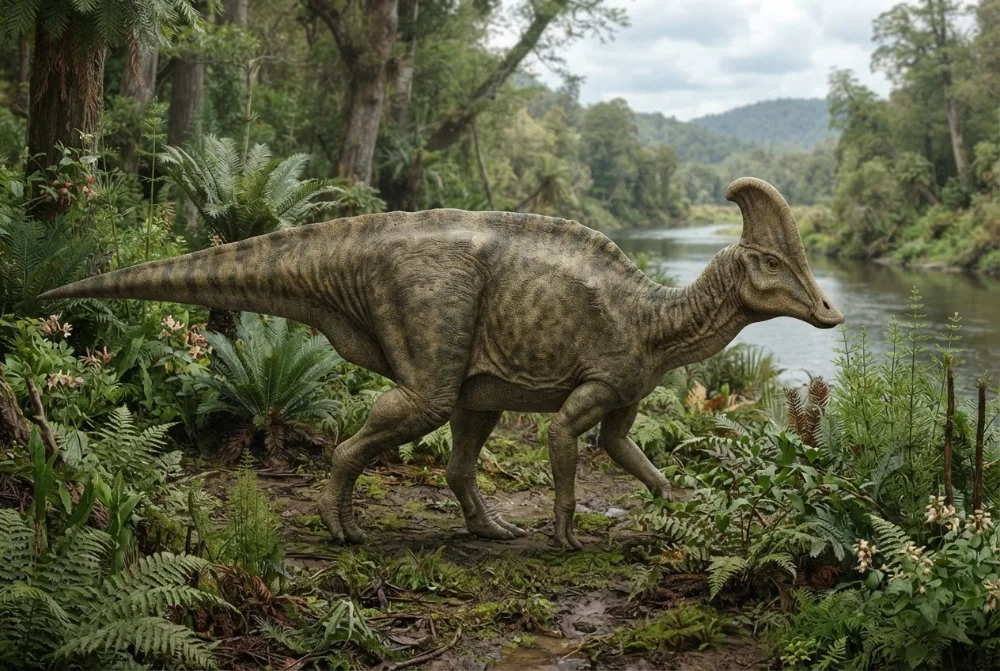
Laaj yi ñu gën a laaj ci Hypacrosaurus
?How big was Hypacrosaurus?
About 9.1 metres (30 feet) long and up to 4.0 tonnes (4.4 tons).1
?What did Hypacrosaurus eat?
It was an herbivore that ate plants like pine needles, seeds, fruit, twigs, and magnolia leaves.3
?When did Hypacrosaurus live?
It lived during the Late Cretaceous period, about 75 to 69.5 million years ago.1
?Where was Hypacrosaurus found?
Fossils have been found in Alberta, Canada, and Montana, United States.1
?Did Hypacrosaurus have a crest?
Yes, it had a tall, hollow, rounded crest on its head, which was probably used for making sounds and as a visual signal.1
?How fast could Hypacrosaurus run?
Probably up to about 22 km/h (14 mph), about as fast as a grown-up riding a bike. This is an estimate from its size. It walked and ran on two legs.3
Ku tas léeb yu dul dëgg
Léeb: Some people think Hypacrosaurus was a sea creature because of its crest.
Dëgg: It was a land dinosaur that lived near rivers and plains, not in the sea.1
Ngir ñi xam dino lool
- Turu xam-xam
- Hypacrosaurus
- Ku ko tudde
- Brown 19134
- Kurél
- Gémmiñu kanaar
- Njaboot / klad
- Hadrosauridae4
- Klasifikasiyoŋ
- Ornithischia > Ornithopoda > Iguanodontia > Hadrosauridae4
- Màggaayu doj yi
- 84 ba 66 milyoŋ at (Campanian / Maastrichtian)4
- Formasiyoŋi doj
- Two Medicine, Horseshoe Canyon, Oldman4
- Réew yi
- Kanadaa, Amerig4
- Fosil yu ñu gis
- 37 ci The Paleobiology Database4
- Ñu ngi koy wooye itam
- Cheneosaurus (tur yu njëkk yi, léegi ñu ngi leen jàppe ni benn rab rekk)4
- Gisees
- Barnum Brown collected the first fossils in 1910 along the Red Deer River in Alberta, Canada, and named Hypacrosaurus in 1913.1
- Ñu ngi koy werante ba tey
- Scientists debate whether H. stebingeri is a separate species or just a younger version of H. altispinus.1
Fa xibaar yi jóge
- Hypacrosaurus (en.wikipedia.org)
- Hypacrosaurus | Natural History Museum (nhm.ac.uk)
- enchantedlearning.com (enchantedlearning.com)
- Hypacrosaurus in The Paleobiology Database (CC BY 4.0): at, béréb yi, formasiyoŋi doj, klasifikasiyoŋ.
Bépp xibaar ci xët wii am na lim bu wone fa mu jóge. Su nu juumee, baal nu, nun ñu bëgg dino lanu, du ab sërnaalu xam-xam. Wax nu ko ci [email protected] nu defar ko.
 Rex xiif na! Dino Wiki, mbiru ab baay la ngir doomam ju góor ju bëgg dinosoor, ci neen te amul kaamuñaate, amul tracker. Mag ñi mën nañu jox Rex tuuti ñam ngir dimbali ko mu des ci internet.Dundal Rex
 Parasaurolophus
 Edmontosaurus
 Saurolophus
 Corythosaurus
 Kritosaurus
 Gryposaurus
 Tyrannosaurus
 Triceratops
 Velociraptor
 Spinosaurus
 Ankylosaurus
 Pteranodon