 Ban dino nga? Kiis
 Xeexu dino
 Rawante dino
 Fo yu ndaw yu dino
 Albomu sitikeer
 Limu TOP yu dino
 Bett ma!
Ibirania
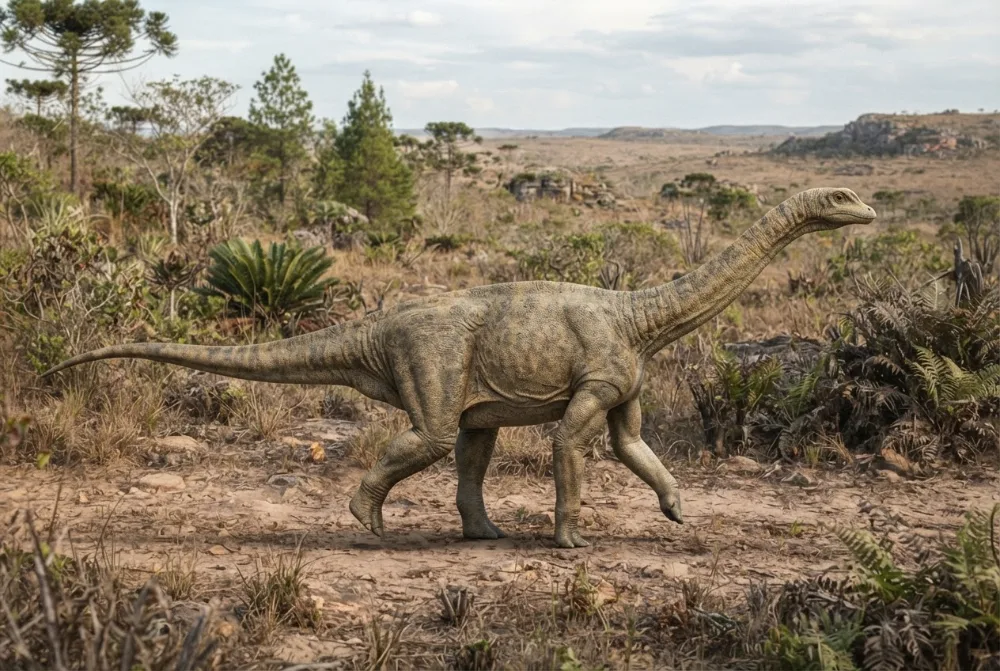
Ibirania was a tiny sauropod, one of the smallest long-necked dinosaurs ever found. It lived in a dry, inland part of Brazil about 80 million years ago. Despite its small size, it had air-filled bones just like its giant relatives.12
Kañ la dundoon?
Naka la réyoon?
Naka la guddoon?
Naka la kawewoon?
jortu
 gudd ni 6 xaj, bakkan ba geen🍌gudd ni 32 banaana yu ñu topp-toppale🏃mënoon na daw 100 meetar ci 11 segond (nit ki gën a gaaw dafay soxla 9,6)
Naka la Ibirania réyoon, bu ñu ko méngalee ak YAW?
Ay kalkil rekk ci sa navigatëer. Dara du ñu denc, dara du ñu yónne fenn.
Naka la gaawoon?


Xibaar yu neex
Its bones were extremely hollow and filled with air sacs, like a bird's, which helped make it lighter.1
Scientists found fossilised parasites inside the bone canals of one Ibirania leg bone, the first time such parasites have been seen in a dinosaur.1
One Ibirania specimen had a bone infection called acute osteomyelitis, which scientists studied using CT scans and thin slices of the bone.1
Ibirania lived in a dry, inland environment, and its small size may have been an adaptation to scarce resources, not island life like other dwarf sauropods.1
Laaj yi ñu gën a laaj ci Ibirania
?How big was Ibirania?
About 5.7 metres (18.7 feet) long, making it one of the smallest sauropods ever found.12
?What did Ibirania eat?
It was a plant-eater. Its name means 'tree wanderer,' which hints that it browsed on trees and shrubs.1
?Did Ibirania have feathers?
No, it did not. Ibirania was a sauropod, and sauropods had scaly skin, not feathers.1
?Why was Ibirania so small?
Scientists think its small size was an adaptation to living in a dry, inland environment with scarce resources, not because it lived on an island.1
Ngir ñi xam dino lool
- Turu xam-xam
- Ibirania
- Ku ko tudde
- Navarro et al. 20224
- Kurél
- Baat yu gudd
- Njaboot / klad
- Saltasauridae4
- Klasifikasiyoŋ
- Sauropodomorpha > Sauropoda > Titanosauria > Macronaria4
- Màggaayu doj yi
- 86 ba 72 milyoŋ at (Santonian / Campanian)4
- Formasiyoŋi doj
- São José do Rio Preto4
- Réew yi
- Beresil4
- Fosil yu ñu gis
- 3 ci The Paleobiology Database4
- Gisees
- Ibirania was named in 2022 by Navarro and colleagues based on fossils found on a farm in Ibirá, São Paulo, Brazil. The name means 'little tree wanderer' after the town and its small size.12
- Ñu ngi koy werante ba tey
- Scientists are still studying the tiny parasites found in Ibirania's bones to figure out exactly what they were.1
Fa xibaar yi jóge
- Ibirania (en.wikipedia.org)
- A NEW NANOID TITANOSAUR (DINOSAURIA: SAUROPODA) FROM THE UPPER CRETACEOUS OF BRAZIL | Ameghiniana (web.archive.org)
- PBDB Taxon (paleobiodb.org)
- Ibirania in The Paleobiology Database (CC BY 4.0): at, béréb yi, formasiyoŋi doj, klasifikasiyoŋ.
Bépp xibaar ci xët wii am na lim bu wone fa mu jóge. Su nu juumee, baal nu, nun ñu bëgg dino lanu, du ab sërnaalu xam-xam. Wax nu ko ci [email protected] nu defar ko.
 Rex xiif na! Dino Wiki, mbiru ab baay la ngir doomam ju góor ju bëgg dinosoor, ci neen te amul kaamuñaate, amul tracker. Mag ñi mën nañu jox Rex tuuti ñam ngir dimbali ko mu des ci internet.Dundal Rex
 Brachiosaurus
 Diplodocus
 Brontosaurus
 Argentinosaurus
 Camarasaurus
 Morosaurus
 Tyrannosaurus
 Triceratops
 Velociraptor
 Spinosaurus
 Ankylosaurus
 Parasaurolophus